
Designers: Helge Meissner, Eilif Svensson, Anna Wermlund, Kristian Amundsen Ostby

Publisher: Aporta Games
Players: 1-4
Time: 90-120 min
Revive is an interesting strategy game with multiple mechanisms set in a post apocalyptic world. You play different factions of survivors striving to renew technologies and explore the frozen planet.
Goal: Earn the most points by repopulating and rebuilding the world. The game end is triggered when the last
Components: Main game board which represents the planet and individual player boards which are dual layered. Faction boards which aren’t dual layered but completely functional and numbersis standard diles, disks and meeples.
The main game board consists of face up starter iles around the central chasm which is the starting point for exploration. The 4 corners of the map have Ancient Location tiles which if populated by your faction will score end game points. The main board also has a score track, a Hibernation track and it holds the major artifacts. As you progress up the tracks certain values have rewards.

The player boards hold your faction. There are 6 factions included and all are double sided with a basic and an advanced version. (Note I have not tried any of the advanced versions.) The factions hold your meeples and your small and large buildings. The player board consists of several slots 2 above, one on the side and 2 on the bottom to hold cards. The slots can be modified by adding modules. The central portion of the player board has 3 paths which intertwine and each path connects to a number of covered different technologies. As players progress on the tracks, the machines become available for use.
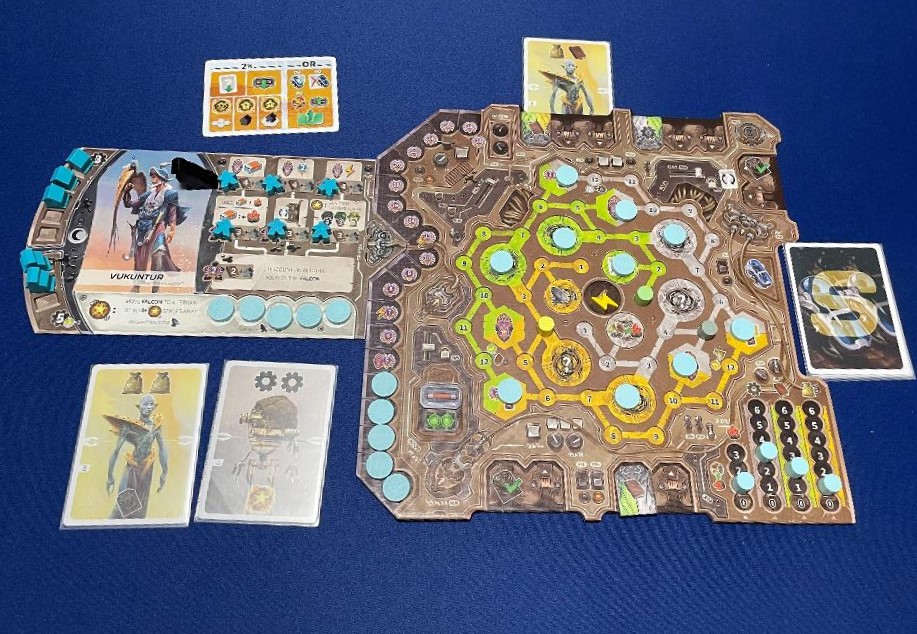
Each player starts with an identical deck and there are additional starter cards for drafting options. Each player will also start with an Artifact card for end game scoring. Players can earn major artifacts as multipliers for these cards.
Gameplay: On your turn you may do either 2 actions (the same or different) or hibernate.
The first possible action is playing a card from your active card display. Players start with identical decks. Cards have simple icons along the top or bottom. You play a card to a slot and follow the icons, most have to do with gathering resources.
The next action is to use your switch. Each player board has a switch which you can use once per round to gather a resource in the base game.
Explore is the next action. You must pay “range” the distance from the chasm or one of your tokens already on the board to the tile you wish to explore in food. Then you must pay food and possibly books to flip the tile which earns you points and a new card for your deck. The below picture is courtesy of one of the designers.

You may also populate. You pay books to place one of your meeples from your faction board into a location space on the main board. This also unlocks one of your faction abilities. Having your meeples in the ancient locations will give you end game points.
Finally you may build a small or large building. If you build next to certain terrains you also advance your markers on your machine unlocking new technologies. You may use these technologies as a free action if you have energy.
If you don’t choose or can’t do any actions you may hibernate. Hibernation lets you refill your active card display, clears your card slots, resets your switch and recycles your energy to be used again. You also advance on the Hibernation track.
As you advance on the machine tracks you uncover technologies, the disks covering these technologies are placed on a point track which will add to your score at endgame.
There are a lot of small additional details that occur during the game like earning bonuses as you progress along the score track and hibernation track, but this is the gist of it.
My thoughts: I did not receive a review copy, I purchased Revive while at Spiel 22. I like mid to heavy weight strategy games and Revive fits that bill. I like the multitude of choices in building your machine- you can choose modules, draft cards and decide which paths to progress on. I also like the exploration aspect of the game as well although it is a smaller part of the game. The factions are also interesting and I look forward to exploring the advanced powers as well. There are a lot of working parts to this game and some people might feel it is complicated for complexity’s sake but I feel like the different parts of the game mesh and flow well. I have played games with 2 players and more players and I find it works equally well, the main difference being less exploration occurs. This naturally leads to a smaller area to build on so I don’t feel it should really impact the game.
Thoughts from other Opinionated Gamers:
Simon Neale: This was my most anticipated pre-order at Spiel and after 3 plays I am not disappointed. As Lorna says the mechanics mesh smoothly together and I really like both the exploration and engine building aspects to the game. Along with multi-use cards the game holds interest throughout.
Simon W (2 plays): a lot of possible ways to try and score points in this game. You can build up your card collection, go for early or late scoring, and develop your machine paths on your player board. As with other games where you have a reset, the timing of hibernation brings tension to the game – do you squeeze everything out of your cards or just hibernate more often to re-use your best cards? The slot upgrades that you can pick up give the cards you use a boost (ie extra resources) if they match the colour, and are worth collecting in the long-term. In my second game I was slow to move up the scoring track as I explored tiles less, but instead concentrated on getting more slot upgrades and deploying buildings to develop newer machines, and interestingly ended up with a similar score to the other players who had taken a different approach. This game will get a lot of play in.
Ratings from Opinionated Gamers:
I love it! Lorna, Simon Neale, Simon W
I like it!
Neutral
Not for me!


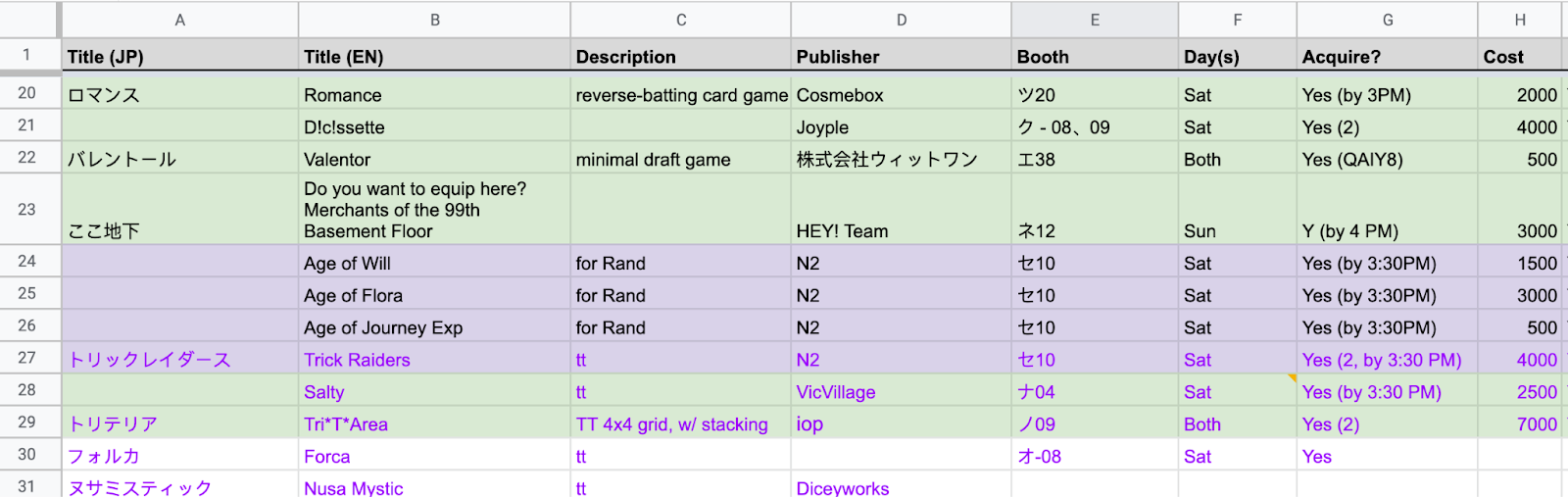


Fall Tokyo Game Market 2022 Anticipation Post
This is partly my usual Tokyo Game Market preview post of titles I’m looking forward to. It also marks my first trip to Japan. Earlier this week I talked about what the Game Market catalog is like and gone through a bit of the prep I do for each Game Market. Today I want to talk about some of the interesting games being released in a matter of hours. Some are things I’m excited to play, some I just think are notable, and others that please me simply because they exist. (The images used below are promotional images from the designer/publisher’s Twitter accounts, website, Game Market website, etc., unless otherwise noted.)
I’ve asked Rand to help me and highlight some titles of his choice, so from here down, we’ll label who’s adding which bits.
Red Thunder (Booth: ア04, Saturday)
Designer: Kenichi Tanabe
Publisher: COLON ARC
James Nathan: I’m very taken with the recent trick-taking game, “Roulette-Taking Game” (review is scheduled for November 23rd). In it, the winner of each trick places a bet on a roulette-style betting mat to reflect what card the player thinks will win the last trick. It’s a wild conceit, and one I think the game pulls off despite all odds. There’s a subtle and elegance to the trump mechanic that does a lot of heavy lifting. Part of why the game sticks with me is the pressure and excitement that builds during the game – it’s a game that comes down to overtime. Extra innings. It will be a walk-off trick – guaranteed each hand.
It also has me on the lookout for gambling themed games I might have otherwise overlooked. What other non-card casino games could be turned into rad card games? So along comes Red Thunder – a solo slot machine game! I have a soft spot for solo card games (such as Goritaire or Finished!), so I don’t mind that piece. I can’t quite tell how the rules work yet, though yes, it starts with reveal 3 cards. The designer has a sufficient track record for me, that I trust they’ve made it fun.
パチスロシミュレーター (Pachislot Simulator) (Booth: イ37, Saturday)
Designer: Party Taro
Publisher: Saispiel
James Nathan: Continuing the theme of slot machine themed games is Pachislot Simulator. It is a sort of stochastic deduction game where there are a number of different potential wheels in the slot machine, and as the game progresses, you try to narrow down which wheels are in play – but you won’t be able to do it with logical deduction skills. The game’s intent is to force you to make rough and quick inferences from the probabilities. I’ve left out the box cover, but I think the player screen and deduction sheet should suffice!
Domino Plant Company (Booth: ノ06, Both)
Designer: Kawakami Yuito
Publisher: Domino Plant Company
Rand: This game is played in two parts. Some players set up dominoes in the forest, adjusting their angle and position within the growing circles on the board. Then one player operates a domino-toppling hammer gadget trying to fell as many dominoes as possible to fulfill scoring objectives. There is also a on-time use meteorite that can be dropped from above to aid an attempt at felling the dominoes. You can also get in trouble by knocking down too many dominoes. In that case, you have overworked your employees and they retire.
Share this:
Like this: