
Compounded – The Peer reviewed edition
- Designer: Darrell Louder
- Publisher: Greater Than Games
- Players: 2-5
- Age:14+
- Time: 45-60 minutes
- Played with review copy provided by Flat River Games (distributor)
- Amazon affiliate link: https://amzn.to/3UcgVlH
Compounded is a game about building chemical compounds through careful management of elements, a fair bit of social play and trading, and just a bit of luck. In Compounded, players take on the roles of lab managers, hastily competing to complete the most compounds before they are completed by others – or destroyed in an explosion. Some compounds are flammable and will grow more and more volatile over time; take too long to gather the necessary elements for those compounds and a lot of hard work will soon be scattered across the lab.
Although Compounded does involve a fair share of press-your-luck tension and certainly some strategic planning, the most successful scientists will often be those who strike a good trade with their fellow lab mates. Players are able to freely trade elements, laboratory tools, and even favors – if there is truly honor among chemists!

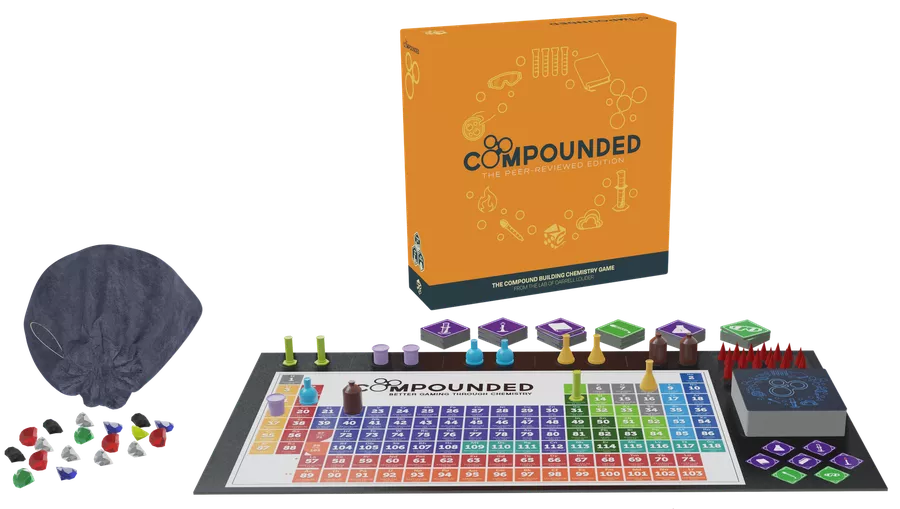
Each person starts with their own workbench board and all the pieces in their color. One is placed on the central scoreboard and 4 are placed at the bottom of the experiment tracks on the workbench board. Each player starts with 3 random elements (drawn from a bag) to start on their workbench. A 4×4 grid of compound cards is laid out on the table. Each card has a chemical formula, shown graphically on the card. The state of the compound is at the bottom (liquid, solid or gas). The point value and the risk of fire are seen in the upper right.

Each round is made up of four phases:
1] Discover – players discover a number of elements equal to the number seen to the left of where their meeple is on the blue track; draw this number out of the bag. Then, you can trade elements with the other players. When all trades are done, each player then keeps elements on their board equal to the number to the left of the meeple on the purple track.

2] Study – Players can move their claim tokens onto unclaimed compounds or a tool icon (which refreshes a previously used tool token). The number of claim tokens that can be placed/moved is equal to your progress on the orange track.
3] Research – you can trade 3 of one element to choose any other single element from the bag. Then, players can place elements onto any compound card on the board, one at a time in player order. The total number that you can place is equal to your progress on the green track. If you place the last element on an unclaimed compound, you can move a claim token there to claim it. If you complete a compound claimed by another player, you will not score points for it, but you will be eligible for the bonus of that compound.

4] Lab – Score completed compounds in player order; scoring the points on the card minus two points for each flame token on it. There are no ties on the scoreboard, so you move to the next unoccupied space on the track. Finally, increase on the track on your board that corresponds to the color of your compound. If there is a bonus in the bottom right, you claim it now (also, if another player had been the one to finish the compound, they also get the bonus) – they are usually tools which are one-use special effects. When all compounds are scored, they are removed from the table and new cards are dealt in their place. As cards are dealt, Lab Fire cards may be drawn. If any player chooses to use their Fire Extinguisher, the fire is put out, the Lab Fire card is discarded and a new card is dealt. If the Fire is not put out, all flammable compounds on the table gain a Flame Token. If there is not a space for the token, the compound explodes and is removed from the grid.

The game end is triggered when someone has scored 88 points. There is one more full round, and then the player with the highest score at that time wins. Players do score one point for every two elements on their unfinished compounds.
My thoughts on the game
Well, if you didn’t know this about me, I was a Chemistry major in college (well among other things), so the theme of this game pretty much immediately appealed to me. This game, which was new to me, reminded me of something I had played in the remote past, and as it turns out, it was probably an earlier version of this game! The original version of the game came out back in 2013, and it has gone through a few revisions and re-releases since then – The version I have now (2023) is called the Peer-Reviewed edition. From what I’ve read online, the original version has been streamlined into this new set; game length used to peak at 90 minutes, now 60 is the max time rating. (I’m glad that I didn’t encounter the game prior to the streamlining, or else I definitely would not have played this version…)
Overall, it does feel a bit old-school, but as it is essentially an 11 year old game, that’s honestly not surprising. There is a bit more luck involved in the Discover phase that I’d like. You’ll do really well in the game if you’re able to draw out the desired elements from the bag. Sure, the game gives you the option to trade for things you need; but similar to our Catan games, there’s not much trading unless it is truly advantageous for both people. More often than not, successful completion of compounds awaited players pulling a rare element out of the bag through dumb luck. Success can also be had by avoiding the ire of your opponents and being targeted the least by bunsen burner induced lab fires.

Speaking of lab fires – I like the way the little cones look, but that are extremely hard to pick up and they are apt to fall over and roll around. I would have really preferred simple red cubes here that would be more functional.
I like the visual aspect of building the compounds on the cards as the game progresses. The workbenches do bring back fond memories of my days in the lab as well. Using the periodic table for the scoreboard is a pretty sweet touch; though people not used to the actual table might screw up the scoring near the end of the game. Sure, the numbers are on the spaces, but I always have to remind people about the two rows of transitional metals that are out of place at the bottom of the chart.
The game itself is pretty simple to navigate, and the player board does help to keep players organized and focused on what they are able to do each turn. Early in the game, turns are short because you don’t have so many options, and you might find yourself more likely to engage in trades in order to allow yourself to complete compounds to jumpstart your engine. Once you have completed a few though, you’re mostly self-sufficient, and the likelihood of trades goes way down – at least that’s what happens around here.
For those who have an affinity to Chemistry (like myself), it’s likely that this will hit a soft spot and will appeal to those folks. Without that, it is a bit dry and slightly outstays its welcome on the table taking about an hour or just more to complete. That being said, if your group thrives with games that rely on trading (such as Catan), this one may work better for you.
Amazon affiliate link: https://amzn.to/3UcgVlH
Until your next appointment,
The Gaming Doctor


