
Propolis
- Designers: Molly Johnson, Robert Melvin, Shawn Stankewich
- Publisher: AEG
- Players: 1-4
- Age: 10+
- Time: 15-30 minutes
- Amazon affiliate link: https://amzn.to/4sBCue6
- Played with review copy provided by publisher
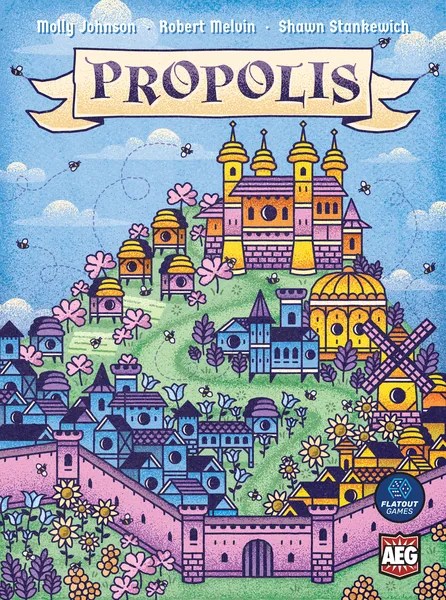
Propolis is a worker-placement, engine-building, area-control, and tableau-building game. Players take on the role of competing medieval bee colonies and take turns deploying worker bees to collect pollen, fortify their positions, and construct their hives to appease their queen and become the most glorious in the land!
As bees compete over the realm’s floral landscapes, they will be collecting pollen to create the propolis they need to build their hives. Attaining dominance in different realms provides additional glory and building materials. As hives expand, new structures provide additional resources, new scoring opportunities, and the prerequisites to construct a glorious palace for the queen. The player who dominates the realm and builds the most prestigious home wins.
Each player gets a player board, a resource marker of each color, and 12 worker bees in their color. 3 of the bees go in the center of the table, while the rest remain in a personal supply area. The Structure/Landscape deck is shuffled and a 3×4 grid is made on the table. Ten cards are placed next to the deck to form a market. A Queen’s Palace deck is shuffled and a market of cards is dealt from this deck. Each player also gets one Queen’s card to start with – flipping it over to the Starting structure side, and gaining the resources shown on the bottom of the card – marking these with the resource markers.

The game is played in a number of turns until a player has 10 total Structure cards. On a turn, the active player can do one of five possible actions:

1] Deploy Worker Bees – choosing any empty Landscape card, place any number of bees onto the spaces on the card to gain the rewards that you cover. Generally, this is gaining resources, exchanging resources or getting bees from the center supply. If you place on the last remaining open card in a row, gain a Wild resource immediately as a bonus. Place these Bees standing up to denote they are regular bees.
2] Fortify Worker Bees – tip up to 2 of your previously placed bees onto their sides. Again gain the resource from their space. This doubles their value when considering row majority (more on this later). If you fortify a card which has no unoccupied cards, you also gain a Wild resource.
3] Retreat Worker Bees – remove any number of worker bees from any cards in the display. You do not need to completely vacate a card when you retreat.

4] Construct a Structure – build a Structure card from the market, paying the costs on the bottom of the card – this could be resources (Decremented from your player board or used from previously build cards) or bees (placed from your personal supply into the central supply). Put the card in front of you, gain any bonuses printed on it.
5] Construct a Queen’s Palace – you are limited to one of these per game; these must be built with Bees and with permanent resources (only found on previously built Structure cards).
At the end of your turn, look at the card array on the table to see if any of the rows are occupied (all cards have at least on Bee on them). If so, resolve that row if there is a majority (1 per normal bee, 2 per fortified bee). The player with the most bees removes all of their bees from that row and returns them to their personal supply. If that player is NOT the active player, they also get 1 Wild resource. Now, remove the right-most empty card, slide all the cards to the right and add a new card at the left. If there is a tie, nothing happens now, and you must wait for someone to fortify a bee in order to gain a majority.
The game end is triggered when any player has 10 structure cards in their area. Play until the end of the round so all players have the same number of turns. Players now score points based on the Structure cards they have built.
- Each structure card has a scoring rubric on it or simple straight VP values
- 1VP per 5 resources left over
The player with the most points wins. Ties broken in favor of the most unused resources left over.

My thoughts on the game
When reading the rules, I thought this would be an upper level family tableau game – I have found that many of the games from this design team are good in that “family-plus” complexity area – Point Galaxy and Point Salad being good examples. Once I set up Propolis on the table and started a game, it felt really familiar. It took a few turns to figure out that Propolis really feels like an insect themed version of Splendor.

On your turn, you either gain resources or buy a card from the market. When you buy a card, you use your collected resources or you use perma-resources that are provided from previously collected cards. As the game progresses, you then use those perma-resources to buy special Nobles cards, oops, I mean Queen’s buildings.
The resource gathering is different as you can’t simply just say what you want – you have to place your bees on empty cards in the resource grid. Timing can be important here on a number of levels. First, it really helps if the color you want is available when your turn comes up. Second, you have to have the bees available to place on the cards at that time.
The whole majority aspect of a finished line in the resource array seemed a bit complicated at first, but after a few games, I can see where players have really leveraged those majorities into getting “free actions” as they did not have to spend an entire turn trying to take their bees back from the board, instead getting them back when they had majority of a full line.
Some of the cards offer simple straight VP amounts, while others do have more complex scoring formulas that require you to collect certain types of buildings in order to score them.
As you would expect, there is a bit of a game arc here – very slow at first when players don’t have many perma-resources, thus a lot of time is spent gaining two or three resources a turn at the start. Having the double sided cards is pretty neat, and it definitely ensures that each game plays our differently. If you flip up a lot of high priced cards in the initial display, the game can be glacial as everyone has to spend a number of turns being able to afford anything.

This is one place where having a tiered set of cards would be nice. It would also be a nice safeguard to push players into buying resource producing cards from the start. Once you have a few buildings that provide things, the game transitions to regular slow. Even when you have a few built in resources, it does take awhile to scan the ten buildings on offer to see what you are close to being able to build (and what you might be competing with other players to build). However, things stay slow here because you also have to scan the resource grid to see what types of resources you might even have available to collect – as this might change what you try to get from the market.
Further, as you also have to manage your bee population, you have to figure out how many bees you will have free to both gather those resources and then have available to sacrifice if you are trying to build buildings. In general, buildings that provide resources cost bees – so as you build your resource engine, you lose bees from the other half of the equation. So then, you’re on the search of either resource spots that make bees or building other buildings that generate bees.
When you get to the endgame, you should have lots of resource producing buildings, so you’d think that the game would at least move into average speed, but now you’re having to consider the extra Queen’s buildings as you can now possibly build those. Also, as far as the regular buildings go, you may not want to simply build anything within reach because you might need a particular type of building for another card’s scoring OR you might be discouraged from building a particular building because you don’t have the other cards needed for that one to score.
If you’re in the market for a more complex game that feels like Splendor – Propolis fills that niche very well. There are certainly more decisions to be made in both the collection of resources as well as the buying and scoring of buildings. If you want a game that feels like Splendor but comes in closer to 45 minutes – Propolis fills that niche very well too.
Until your next appointment,
The Gaming Doctor
Amazon affiliate link: https://amzn.to/4sBCue6


Is there a reason the font size keeps changing?
Louisa, the font is stable when I look at the post on my phone. I can’t check it further until I get to a desktop. I really don’t have any idea why the font would change
We started calling it Bee Splendor after our first play. But that’s not pejorative; we like it more than Splendor.