
Deckers
- Designer: Richard Wilkins
- Publisher: Deep Print / Pegasus
- Players: 1-4
- Age: 12+
- Time: 60-90 mins
- Played with review copy provided by publisher

In Deckers, you will hack into a network of five servers, either solo or co-operatively as a team of up to four, winning or losing together. The network is operated by one of the available super-massive computers (SMCs), each with a different level of complexity and its own unique style of defenses that you will need to overcome. Once jacked into the servers, you will assume decker profiles, each with a special ability, moving across the server’s spaces and uploading decker pieces onto the network to expand your control while removing as many of the SMC’s pieces as possible. Each round, you get a new objective you try to fulfill to gain the upper hand. If you manage to complete the final objective, you ultimately claim victory.
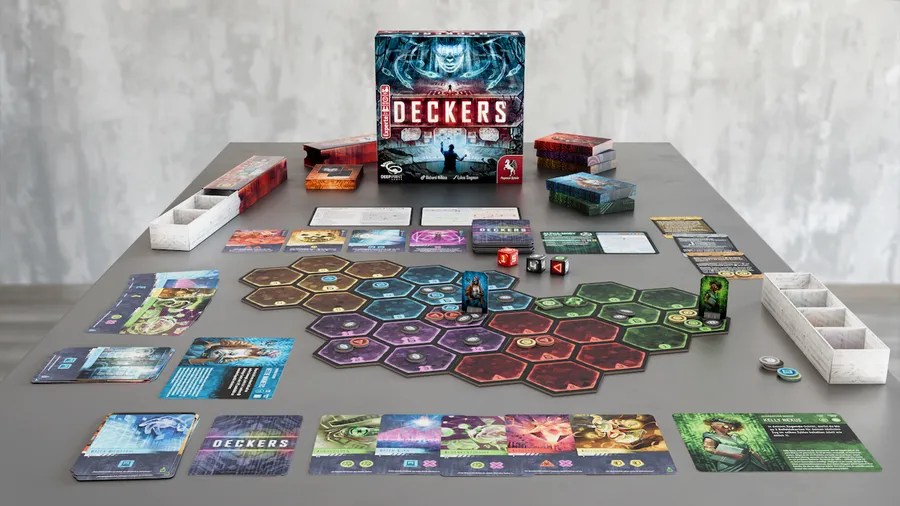
To set up the game, generate the server board by assembling the five tiles. The players should collectively choose which of the 5 SMCs they will go up against, and pull out the matching card. Based on the setup criteria on that card, randomize the appropriate number of goal cards (in three levels) to make up the objective deck.

Each player chooses a Decker, takes the deck of matching color, shuffles it and deals themselves a hand of 5 cards. The non-starting action cards are shuffled and a market of 4 cards is laid out on the table.

The game is about to start – the maximum length determined by the SMC card that you chose. In this cooperative game, the group wins if they are able to meet the gold Goal card in the final round. The team loses if they cannot do this OR if they are asked to place a Spark or Guardian token and none is available in the supply.
Each round, called a cycle, is played in four phases:
1] Intel Phase – Read the goal card for this cycle, and reacquaint yourselves with any special rules for the SMC.
2] Command Phase – In this phase, each Decker must take 3 turns, but those turns can happen in any order that the team prefers, even if this means a particular Decker takes multiple turns in a row. At the start of each turn, the SMC will spawn Sparks on the board (location usually based on a die roll). Sparks are the SMCs main defense, and they prevent some actions in the spaces they inhabit. Further, if three Sparks are on the same space, they transform into a Guardian, removing all other pieces from that space. New sparks entering a Guardian space will explode and place Sparks on ALL adjacent spaces.
The active Decker then gets to take as many Actions as they like – each done by playing a Command card from their hand. Each card can be played for their keyword ability or their command symbols. You need the appropriate number/color command symbols in order to perform actions:
- Standard – upgrade cards (exchange one from your hand with one in the market), upload programs (add pieces to the board) or Install programs (convert 3 programs of the same color into an Installation)
- Blue – move through the network or if you start on a Blue Installation, teleport somwhere else in the network
- Red – infect SMC pieces to remove them
- Green – shift pieces from one space to another. If you are on a Green Installation, you can ghost an action (do an action as if you were standing on a different space)
- Yellow – Modify SMC pieces to turn them into Decker pieces
(If you don’t have the correct color icons, you can always convert any 3 icons into one of your choice).

When you are done with your turn, you may keep one card for the next turn, and you must discard all other cards from your hand. You draw 5 cards into your hand (meaning you could have a max of 6 for next turn if you kept one from the current turn). You will know when you are done with your actions for the cycle as you will have no cards left in your deck.
3] SMC Phase – First, the SMC fights your red programs in any hex that it also inhabits with Sparks or Guardians – this occurs via a die roll. Do this for every contested hex on the board. Next, check to see if you have met the Goal Card or not – flip the card over and read the appropriate Success or Fail section. Finally, migrate the Sparks on the board using the chart found in the middle of the Goal Card back.
4] Refresh Phase – Reveal the new Objective card. Each Decker shuffles their deck and draws a new hand of 5 cards.
The game ends at the end of the final cycle. The team wins if they are able to succeed at the goal in that final round. Note that you do not have to succeed for all the goals in the game, just the one in the final round.
My thoughts on the game
Deckers is apparently a remake of an older game, Renegade from 2018 – but I had never played that one. Back in 2018, I was definitely still in my “I hate everything cooperative” era of my gaming life. Admittedly, I haven’t ventured too far from that stance, but I have come to appreciate the genre a bit more. The hacking theme caught my eye, and an enthusiastic demo at the Pegasus table in Essen sold me on the game – well at least to try it out. The idea of some deckbuilding ensconced in my cooperative game was a compelling reason for me to try it.
Each game will be quite different as there are so many variables in the set up – which SMC will you play against, which combination of hackers will you use (and which side of their board – thus determining which special abilities), which goal cards will you draw, etc. Through the course of the game, each player can also shape their fifteen card deck a bit with card upgrades.

I really liked the deck building aspect of the game – you could try to craft your deck into a machine concentrated on your base color to maximize your character’s unique ability. More likely, you’ll add cards to your deck because sometimes the upgrade simply gives you more flexibility on your turn – say you need a green icon on your turn as you simply have to push something to a new hex… if you didn’t draw one in your hand, you can trade cards with the market and grab that needed icon. Sure, this might upset the balance of your deck for the next round – but man, it can save your turn in the current round. In our games, there has been a fair amount of card improving with most decks ending up with six to eight non-basic cards in them by the end of the game. There were even a few times when a player would buy a card only to help refresh the display so that the next person possibly could find a better card for themselves.
The lack of a turn order is a refreshing change, really allowing for some great plays to happen if someone gets an especially lucky draw for their next hand. The lack of structure to the Action phase does add a little bit of time to the process though as this is one more thing that the group has to discuss – both figuring out what they can do on their turn but also in what order the players should go… and the discussion needs to be had at the end of each player’s turn as that player could actually go again immediately.

Overall, I would consider this a very challenging cooperative game. Maybe not quite to Spirit Island or Black Stories difficult, but close. It helps if your goal cards lead you down parallel paths so that meeting the silver goal actually moves you a bit towards finishing the gold goal in the next round. There is definitely plenty of room for imaginative turns, and you’ll have to carefully use your cards for both their icons as well as their special actions to maximize what you can do on your turn.
Surprisingly, I’m rating this as “I like it” – which is rare for me to do with a cooperative game. That being said, it’s a game that quickly left my game collection as it is not the sort of cooperative game that I’m ever going to suggest and I don’t think it would do well with my local gaming groups. It’s a bit on the long side for me (60-90 minutes would not be abnormal) and frankly, I don’t want this level of difficulty. It’s pretty much the same reaction/rating I gave to Spirit Island for the same reasons. So it’s not for me in the keeper sense, but I like it in the I respect what is does as a game sense.
Ratings from the Opinionated Gamers
- I love it! Lucas H
- I like it. Dale Y
- Neutral.
- Not for me…Dale Y


