
May 2024
Games I played for the first time this month, from worst to best, along with my ratings and comments.
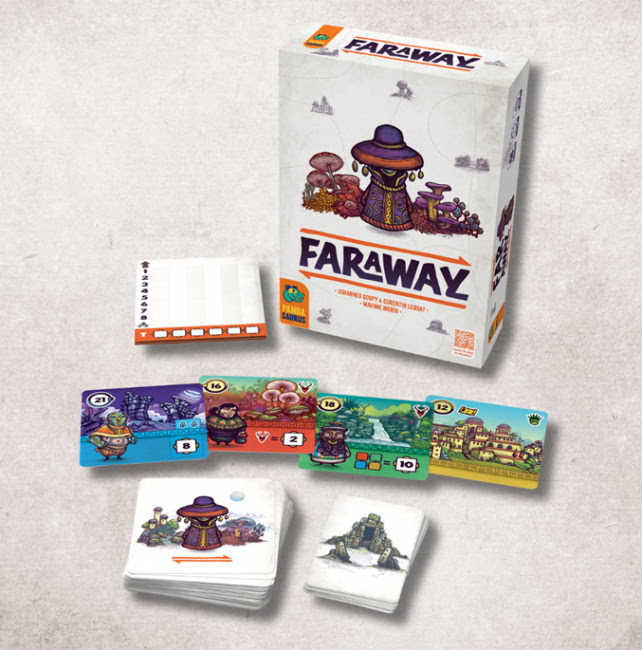
Faraway – 5/10
Faraway is a filler game about exploring a mysterious land. You play cards into a line that represents your journey’s path. Once each player has played eight of such cards, they are resolved in reverse order, scoring one by one, and then the game ends.
The challenge is presented by the cards themselves: in order to score points, a card requires a certain number of symbols to be present on cards played after it. So ideally, you would start by playing cards that grant lots of points, and then play cards with lots of symbols later in your line.
But, it’s not that simple. Each card also has a numeric value. If you play a card that is higher in number than your previous card, you get to draw a bonus card that grants extra points or symbols. But invariably the high point cards have high numbers and the cards with lots of symbols have low numbers. So each turn, you will be making trade-offs between ideal sequencing and getting bonus cards.
Undoubtedly, this creates tension and meaningful choices. But it does so in a way that feels somehow artificial instead of elegant. Rather than the difficult decisions emerging organically out of the board state, each individual card seems to mock you saying “see, there’s no good time to play me, isn’t that clever?”
Faraway also doesn’t give a real sense of adventure; it instead gives a sense of running a program and trying to sequence resources. A lack of thematic integration is forgivable in a 15 minute filler like this, but it still manages to feel more frustrating that satisfying. Please note, any “complaints” that I have here are mere matters of taste; some players love the feeling of making the best of a bunch of poor options. Those players probably also like barely winnable co-op games. You know who you are.
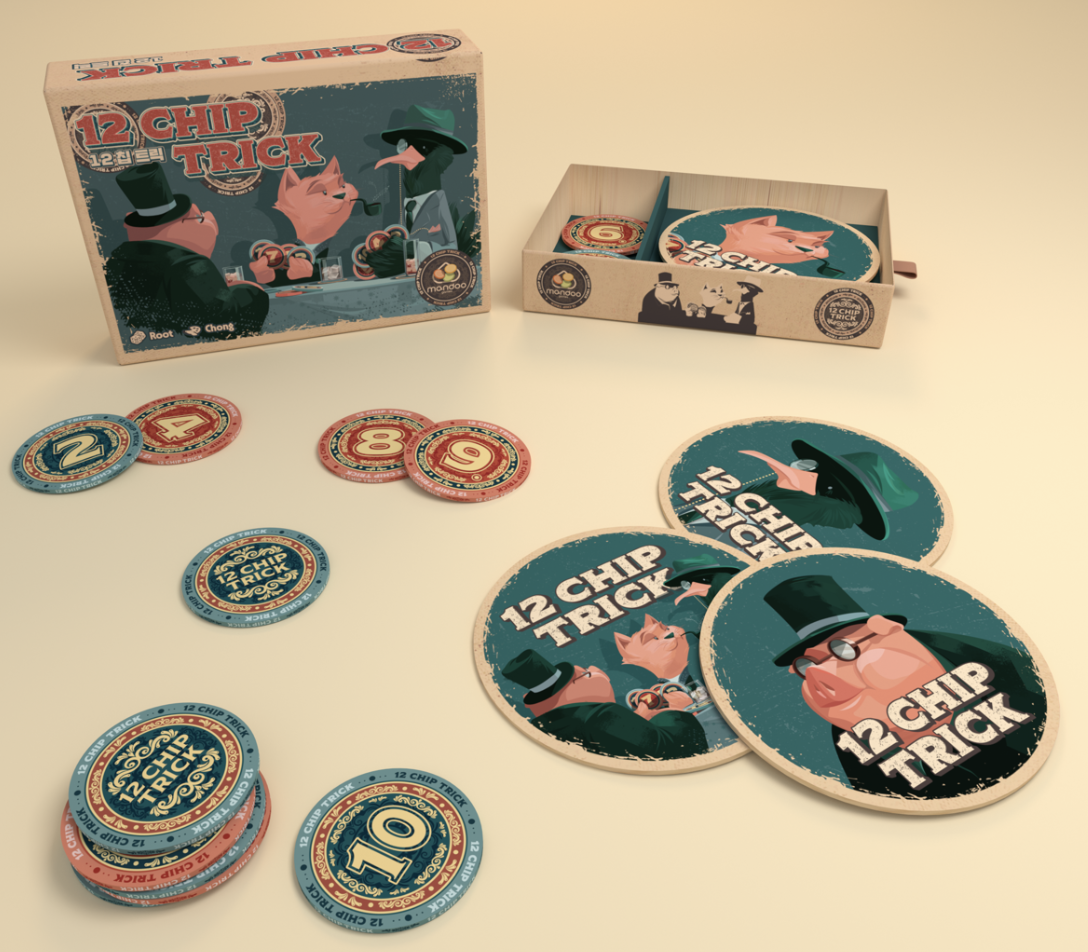
12 Chip Trick – 6/10
Can a trick-taking game with only twelve cards really work? It sounds ambitious, but 12 Chip Trick manages to pull it off. The small quantity of required components means the twelve “cards” are instead twelve poker chips, increasing the durability and tactile satisfaction, if slightly reducing the overall usability. (Chips stacked on the table can’t be readily viewed by the owner, but chips held in hand can’t be easily assessed by the opponents, leading to lots of “what do you have left?” moments.) The only other components are some cardboard coasters, which serve as trophies for the winner of each round. The first player to collect three coasters by winning three rounds wins the game.
There are no suits in the game, though the cards do come in two flavors: blue for the high and low cards (1-3, 10-12) and red for the middle ones (4-9). Each player, in turn, plays one chip from their hand, and the high chip wins the trick. The winner chooses a chip from those played as their scoring reward, but must choose a red chip if possible. The ultimate winner of a given round is the player who scores closest to 21 points. But a player who exceeds this value scores only half their total. This means that low chips are helpful for locking in your low total, while high chips are helpful if you know you’re going over 21 and just want to go as high as possible. Thus the blue chips are more useful, but often harder to acquire.
Players who don’t win the trick also each receive a chip from those played, but this chip is returned to their hand instead of scored. The round ends when one player has four scored chips (i.e., they’ve won four tricks). As a player draws closer to this mark, their scoring chips become locked in (good), but they have fewer and fewer chips in hand to choose from (bad). When the round ends, each player totals all of their chips, both those in hand and those locked in. So each player will ultimately score the total of their four chips, whether they’ve won any tricks or not.
There are tactical elements that feel comfortingly familiar here. You will quickly learn how to stick the trick-winner with something useless, or to put yourself into a position where whether you win or lose the trick, you still benefit. And yet after just one game, those elements begin to feel a bit rote. Now there is certainly a place for that; I love a good game of Euchre, even though 90% of the hands practically play themselves. But 12 Chip Trick somehow feels too chaotic to revel in this simplicity. Wild swings of fortune can occur, often without much player agency, and the difference between a winning hand and losing hand can feel capricious as you are nudged just past the 21-point barrier. Nevertheless, if you’re in the market for a casual bar game to play over drinks and conversation, maybe give this one a whirl.
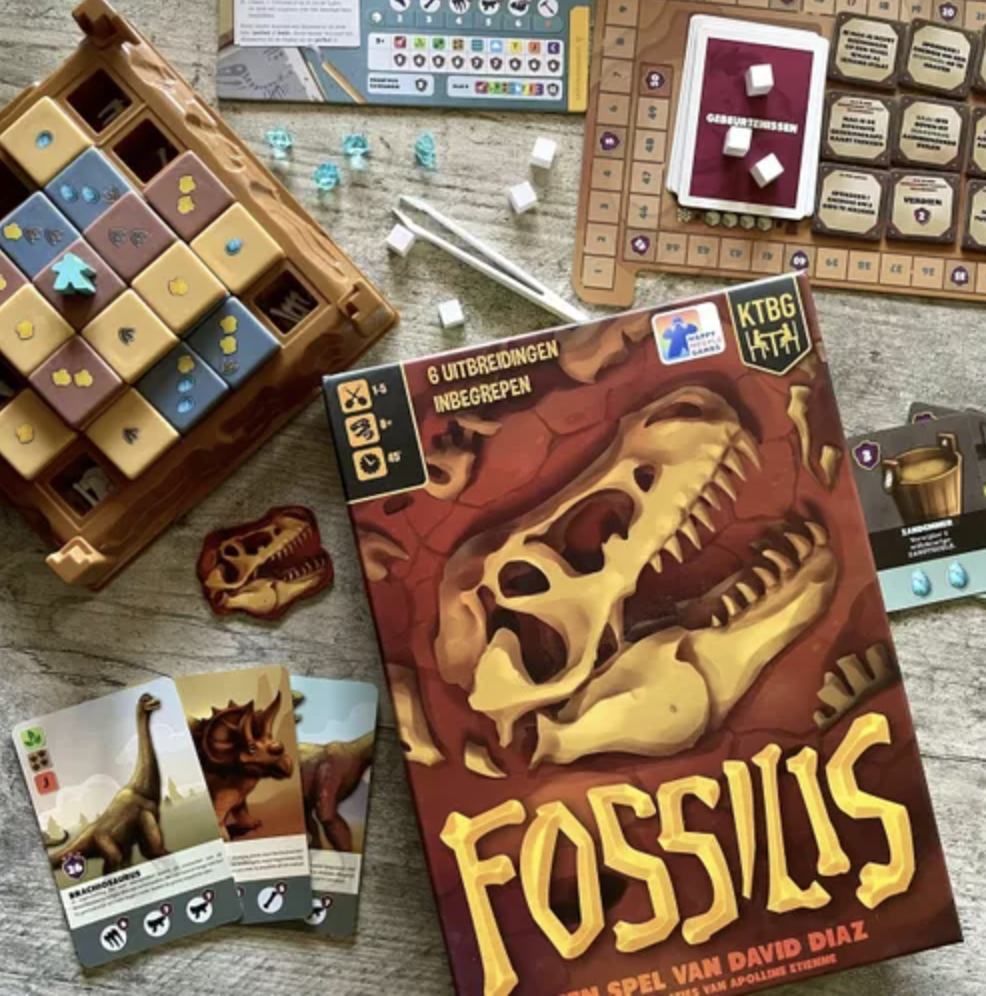
Fossilis – 7/10
If you’ve ever wanted to be a paleontologist (and what kid hasn’t?), Fossilis gives you a chance to live out that fantasy. Though I rather suspect that real paleontology involves less shoving rival paleontologists into sand pits. In the world of Fossilis, fame is king, and your paleontological success must come at the expense of others.
Setting up the game involves shaking dozens of tiny plastic bones, sight unseen, into a plastic board full of pits (think Boggle). After this, chunky plastic tiles representing sand, clay, and rock are stacked semi-randomly overtop of these pits. Players will need to excavate by moving these tiles in order to get at the valuable bones below. Heaver materials take more actions to move, but also grant better rewards.
Each turn, you get four actions (called energy). Actions include moving around the board, moving nearby tiles (collecting them if they fall off the board), gaining plaster, and spending plaster to excavate a bone from a nearby open pit. This last action is, rather amusingly, performed with tweezers. To be clear though, these are simply a thematic (and pragmatic) touch; there is no dexterity element to the game.
There is something here reminiscent of Potion Explosion, another gateway game with a strong “toy factor”: the tactile activities and chunky plastic components belie the tactical depth at play here. It’s not without reason that the box says ages 8 and up, and yet this is a game where 8-year-olds are likely to meet only with defeat if matched against merciless adult opponents.
Bones score points inherently, but can also be cashed in to form partial or complete dino skeletons. These are the main source of points in the game. Whether to complete entire skeletons for bonus points versus instead pursuing set collection of many incomplete skeletons is an important decision. Collected tiles can be cashed in for special abilities from tools or supplies. These can also grant bones or even points. There is also a way to acquire various ongoing special abilities. There are a lot of things to consider.
Every rule in Fossilis is warranted; each one creates an additional option for a skillful player. And yet collectively, it can feel like a few too many things to track and remember for a game of this weight. This, combined with a copious amount of setup and teardown, may produce barriers to getting the game to the table. But these aspects are merely what hold Fossilis back from true greatness. This is still a well-designed, 45-minute romp that never forgets why we play games: they’re fun!
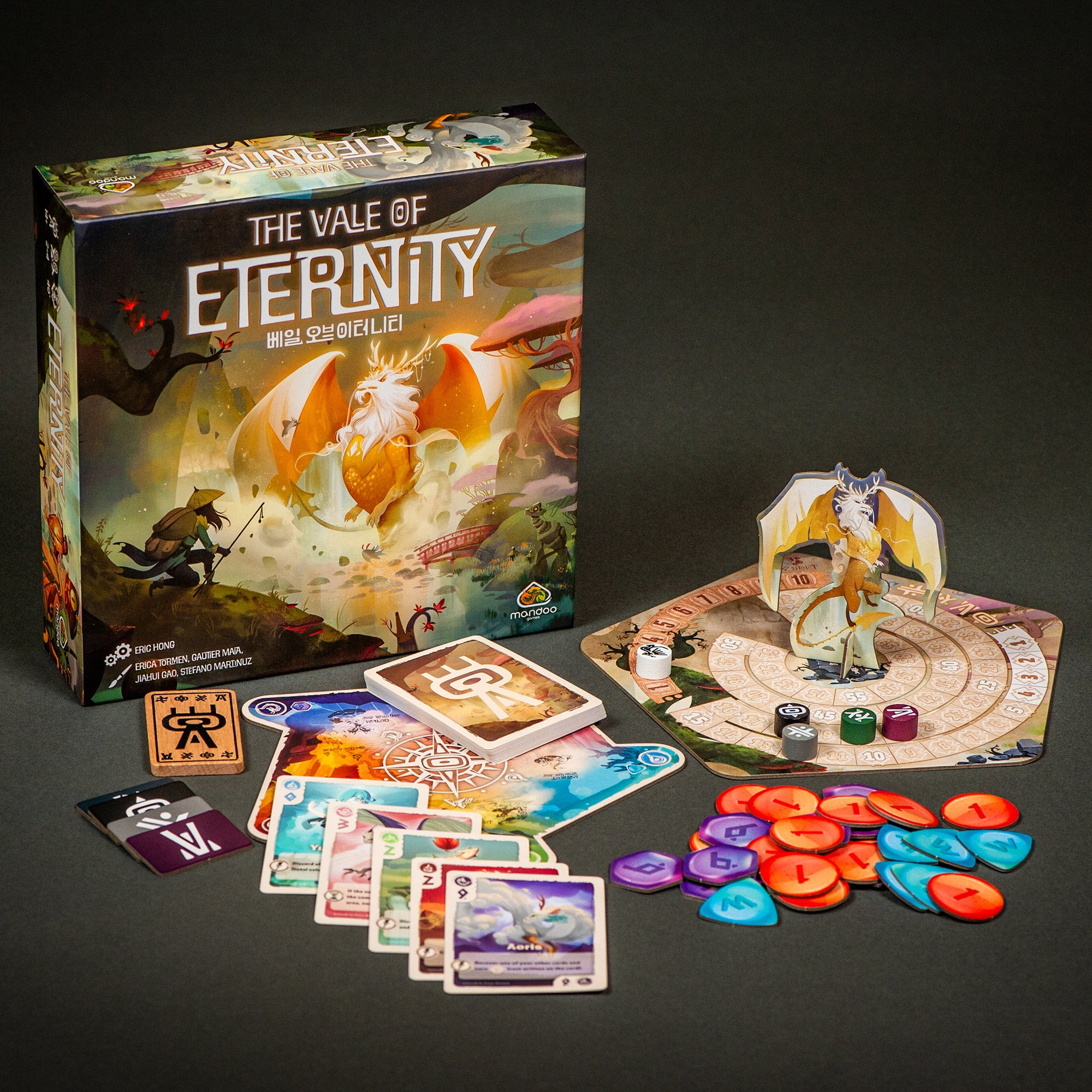
The Vale of Eternity – 7/10
The Vale of Eternity is a card-drafting game that uses open drafting. In other words, every card available to be drafted each round is visible to all players. Each player will select only two of these, in “snake draft format” (i.e., the last player chooses twice, then in reverse order such that the player who chose the first card also chooses the last card).
Once each card has been reserved, the players will take their turns. Oftentimes, this means simply picking up the cards you selected and putting them into hand. But in order to actually play each card, you must pay its cost. And the primary way to get money is by discarding a card you’ve selected instead of adding it to your hand.
The combination of open drafting and the fact that you will discard a significant portion of your selected cards means that “hate drafting” is rampant here. If you don’t enjoy drafting cards for the sole reason of keeping them from other players, you might find The Vale of Eternity a bit too nasty.
The money itself has some interesting restrictions. It comes in three denominations (1, 3, and 6), but you can only ever hold a total of four coins at a time. So if you only have 1s, the most expensive card you can play would be a 4-cost. But the higher value money comes with drawbacks as well, because you don’t get change when paying it. So if you plan to play three 1-cost cards, a 6-value coin will only pay for one of them. This system works very well, offering just enough of a value-maximizing challenge without feeling frustrating.
The game is essentially a race, with the first player to 60 points triggering the endgame (and usually winning). Some cards you play will generate points every round (the slow-and-steady approach) while others will generate large quantities of points, but only one time. And of course, as with all drafting games, finding synergies between your existing cards and the cards you draft is crucial to success.
The Vale of Eternity 45-minute gateway game that offers a bit more complexity than games like Sushi Go! or Splendor, yet you can see echoes of both of those games here. Draft cards, manage your money, and find combos to score points faster than your opponents. Oh, and cry a little bit when they consistently draft the one card you needed right before you could take it.
Knarr – 7/10
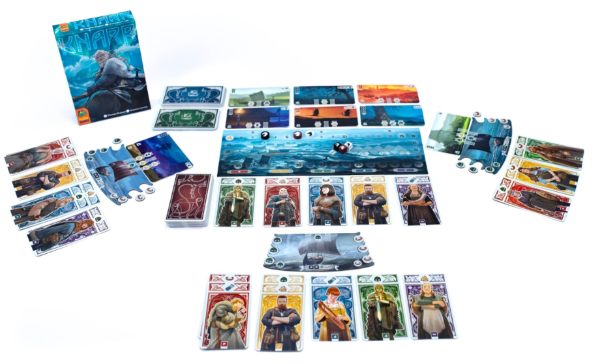
It’s unfortunate how often the “Splendor comparison” comes up, but it really is a good shorthand for 30-minute light engine builders. And like Splendor, Knarr is a race to a set number of points, meaning it’s easy to get so caught up in building your perfect engine that you can lose to a person who is less efficiently but more quickly scoring points.
On your turn, you will choose between two options: either you will play a card and draw a replacement, or else you will trade in cards you’ve previously played in order to buy ship upgrades. In addition to either of these options, you can always choose to cash in silver bracelets to activate your ship upgrades.
Playing card and buying upgrades will give you some assortment of different rewards. The most straightforward are simply points. But you might instead gain reputation, which moves you along a track for which you get points at the start of each turn based on how far along you are. Some cards will grant you silver bracelets that are used to activate your ship. Others will give you helmets, which serve as wild cards when trading in for ship upgrades. Each of these rewards is quite simple and straightforward.
When you play a card, you get the reward on it. But you also get the reward of each card of the same color that you’ve previously played (assuming they are still on the table and haven’t been discarded for ship upgrades). This creates some nice tension between wanting to keep all the cards you’ve played on the table versus trading them in for big rewards when upgrading your ship.
The production quality is very nice here, and it also includes some variants and mini-expansion options right in the box. The amount of options and twists put this just slightly above Splendor in terms of complexity, but it’s still solidly filler-weight. After just one play, it’s hard to know how much longevity the game will offer. But there’s Knarr way I’d turn down playing again.
Pulsar 2849 – 8/10
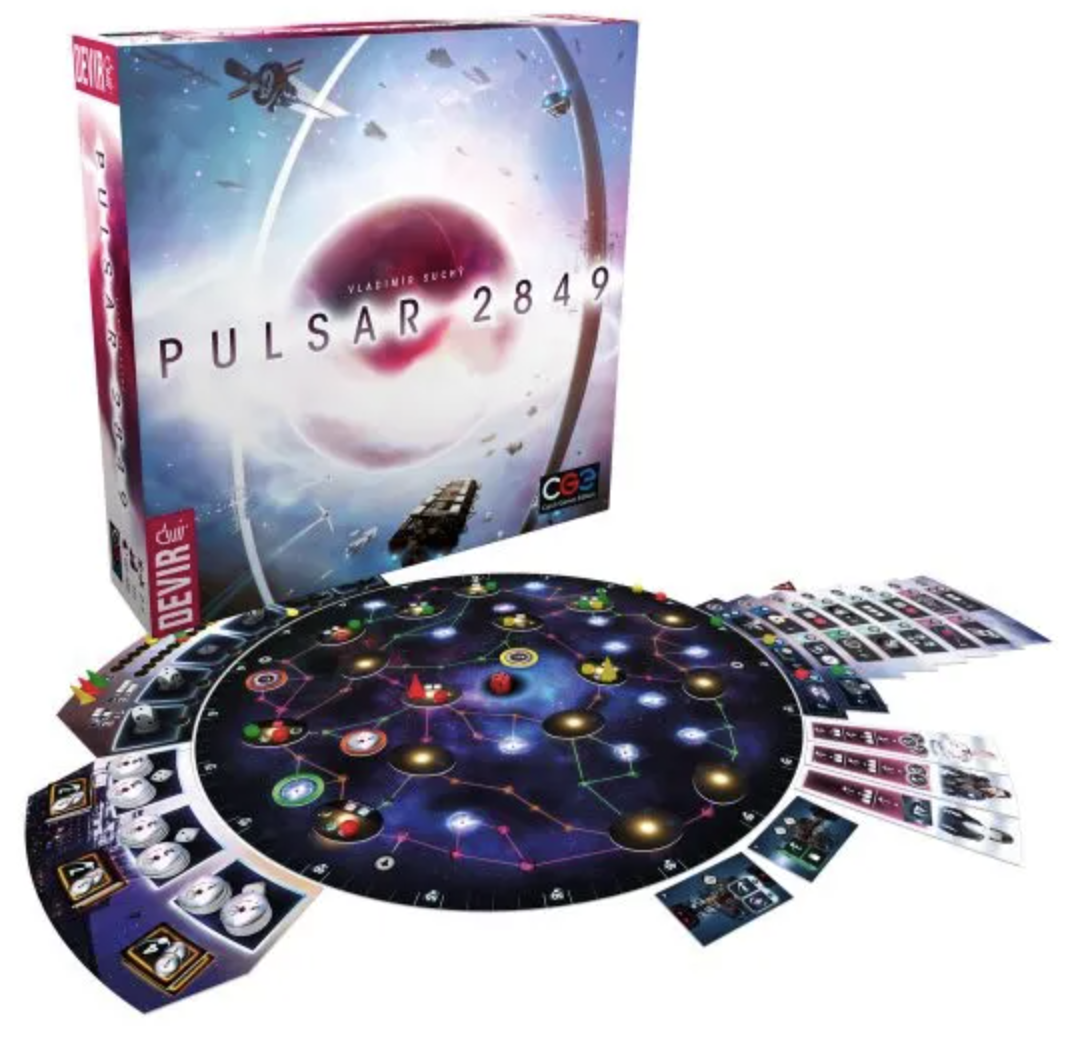
Pulsar 2849 is a dice-placement game that really bucks the trends when it comes to dice-placement. Ever since the earliest iterations, games like Yspahan and Kingsburg have mitigated the randomness of dice results by offering a plethora of combinations and values to carry out actions. (Maybe this spot you need two matching dice, this spot you need a straight, this spot you need odd numbers only, etc.) Pulsar 2849 dispenses with all of this. Each spot can only accommodate one die, it must be a specific value, and higher numbers are just better than low ones. It’s shocking how refreshing this simplicity feels.
But hold on, doesn’t that mean the players who pick their dice first will just scoop up all the high values? Well no, and that’s because the randomness of the dice rolls is mitigated in a different way. There are two tracks: one for initiative (i.e., who gets first pick next round) and one for production of engineering cubes (where the further up you are, the more you get). In order to take high-value dice, you will have to move down on one of these tracks. But by taking low-value dice, you get to move up. These tracks are both quite important, very nearly as much as the dice themselves, which makes each die you choose a very significant decision.
One of the more common actions you can take with a die isn’t to place it on an action space at all. Instead, you simply use it to fly your spaceship the exact amount of spaces shown on that die. Merely flying past planets will let you explore them (a significant source of points), but landing on them is even better, providing additional bonuses. And landing on a pulsar means you can establish a gyrodyne there (this game’s fanciful method of harvesting energy from neutron stars). Gyrodyne setup is a multi-action process, but provides points every single round, in a fashion that often rivals the points received from exploration. Deciding whether to slowly grind towards massive gyrodyne point production or to rapidly expand throughout the galaxy for exploration points is an important strategic consideration.
Pulsar 2849 is one of those games that has a long teach just by virtue of all the available options you have. But in practice, it’s quite smooth and not overly complex. In contrast to gateway games which usually provide you only a couple options on your turn, the meatiness here is in the vast array of possible choices. Contrary to some players who feel that the game is too dry and mechanical, I found this openness to lead to the kind of intuitive-instead-of-calculable decisions that I enjoy. If you don’t mind some heft to your rulebooks and a point salad in scoring, I think you’ll be pleasantly surprised by how this game subverts the usual tropes of other dice-placement games.
Last Light – 8/10
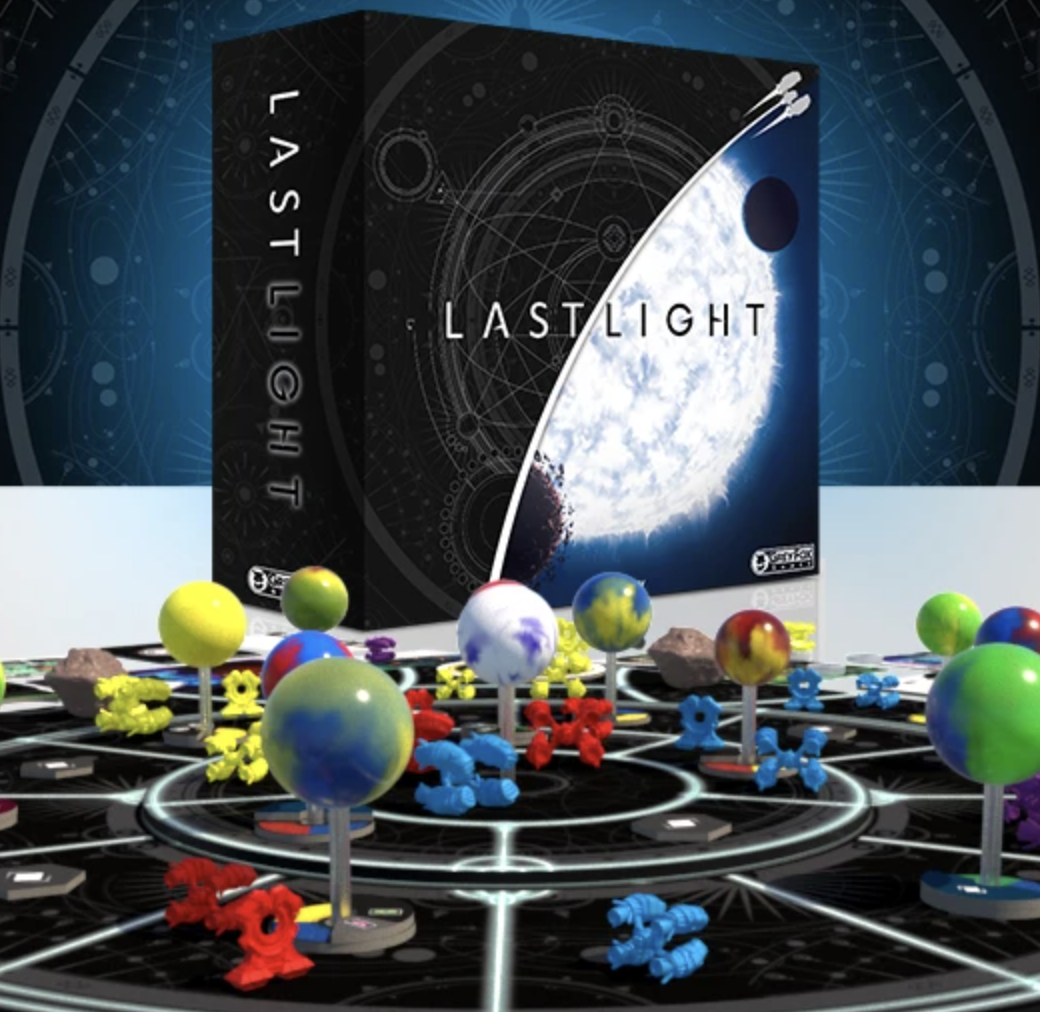
As the star at the center of their solar system dies, the alien factions of the system must compete with one another to harvest what final light they can before it is finally extinguished. It’s a race to twenty light points, and only one faction will triumph. Last Light promises a sci-fi themed 4X game that plays in under 90 minutes. And it delivers on this promise, with all players likely to undertake some mix of combat, exploration, and resource generation as they spread throughout the board.
Players choose their actions simultaneously by selecting one of seven cards. Each player has the same set of cards, and each card specifies an action that is carried out. These include gaining resources, spending resources to build ships or technology upgrades, and moving and fighting other players with the ships you’ve built. There are various other subtleties and ways to improve upon each of these actions, but those are the basics. Once you have selected an action card, it remains in your discard pile until you select the refresh action card, which can score you some points but is mostly skipping your turn to get your cards back.
Once all players have their refresh card in their discard pile, the round ends. At this time, points are scored based on control of important planets, and then the board sections rotate, simulating the rotation of the solar system. This can shake up your movement plans, but it also serves to ensure relatively equal access to important planets and to other players. It also looks cool.
The technological improvements you can make become available by drawing technology cards. Depending on the cards you draw, you may be steered in a particular direction with how best to score points. Likewise, each alien faction provides a player with a unique special ability, often setting out a recommended path to victory. These elements create variety as well as opportunities for long-term strategic planning. This is in contrast to the more tactical nature of fighting for planets, which requires a degree of opportunism and reactiveness.
There is a lot to explore here, not just in terms of hidden planetary bonuses, but in the gameplay itself. Even on turn one, it’s not at all clear what the best opening action is. This is a strong perk for a game like this. Last Light does an admirable job of streamlining a 4X game like Eclipse into a more reasonable length, much like Massive Darkness 2 has done for campaign dungeon crawlers and Nexus Ops has done for dudes on a map area control games. Now you’ll just have to decide for yourself if the sacrifice of complexity is worth the time trade-off.

A highly recommended game that I have most certainly played prior to this month, probably many times.

Wingspan – 9/10
You could argue that it’s not really necessary for me to wax poetic about the joys of Wingspan. It’s in the top 10 most-rated games of all time on BoardGameGeek and holds the number one spot for most plays logged. In other words, if you’re reading this, you’ve almost certainly played it already, and you probably even own a copy. But it’s a classic for a reason. Robert Graves once said “A remarkable thing about Shakespeare is that he is really very good in spite of all the people who say he is very good.” And the same could be said of Wingspan.
Most complaints that are leveled at Wingspan about balance or randomness or a particularly overpowered bird are met by its fans with “such and such an expansion fixes that.” And this may well be true. But I don’t immediately purchase every expansion that comes out so I can have a more elegant experience; I do it because MORE BIRDS. With all of the expansions mixed in (as you should) there are over 400 unique bird cards, of which you are only likely to draw a couple dozen in a given session. Which of course means that you need strong tactical adaptability and can’t ever rely on simply following the same path to victory you did last time. But it also speaks volumes for the design that it’s able to still generate tons of opportunities for synergy no matter the cards that are drawn.
True, mid-weight euros with strong thematic integration and pretty components are basically my catnip; I’m inclined to enjoy this type of game more than others might. But even in this specific design space, Wingspan always delivers a thoughtful yet satisfying experience, cloaking its optimization puzzles with thrilling dice rolls and a never-ending parade of avian card stock. No two cards are exactly alike, and no two players will approach the situation before them on the table in quite the same way. Wingspan provides both replayability as well as depth beyond what you’d expect from its rule set. An all-time favorite that will never leave my shelf. |