Played with copy provided by Horrible Guild at SPIEL 2022
“In The Great Split, you draft cards to collect riches such as gems, gold, artwork, and tomes, adding them to your collection to make it the most prestigious of all! You start each round by splitting your cards into two groups, then you pass your wallet to the player on your left — but only one group of cards will be given back to you. You split, they choose! Don’t despair, though, because while your opponent is looking at your split, you also receive a similar offer from the player on your right, so choose wisely. When your hand is complete, play your cards to add all those riches to your collection. Each type of riches awards you prestige points in different ways, so maintain a balanced collection of gems, keep an eye on the value of the art market as it evolves, and pile up priceless tomes. Depending on how each player builds their collection, different riches will take on a different value for each of them. Show off your best haggling skills in crafting your split, and create the perfect offer to push your opponent to take what you want them to take…leaving you with the tastiest loot!”Continue reading →
Played with review copy provided by publisher, 5 times so far
Says the publisher:
“Who will be the best fisher in Pupapupa Island? In Push Fish, you will be a fisher who come to this island to find the legendary fish with your own stories. Take your fishing rod, and throw the baits (literally throw, this is a dexterity game!) to successfully put on your bait on the fish you want. Then, you should flick the token on your rod (of course, by your finger!) to decide you successfully hook up the fish! Try to catch specific fish that match your mission cards, which will bring you the victory points. 6 unique characters and various item cards bring a game fun more. When someone gathers 7 fish cards, the game enda and the player who has highest score wins. Or, when a player fish up the golden fish or Kraken wins immediately!”
In this game, each player takes on the role of a character – getting their character card with some special ability printed on it. The Fish cards are shuffled, and a 4×5 array of cards is set out on the table. Place the mission cards nearby as well as a display of 5 face up missions. The starting player is decided by everyone flipping over a fish card, and the highest number revealed goes first.
Designer: Yusuke Sato (佐藤 雄介) Publisher: New Board Game Party (新ボードゲーム党) Players: 3-5 Ages: 8+ Times Played: 14 on purchased copies
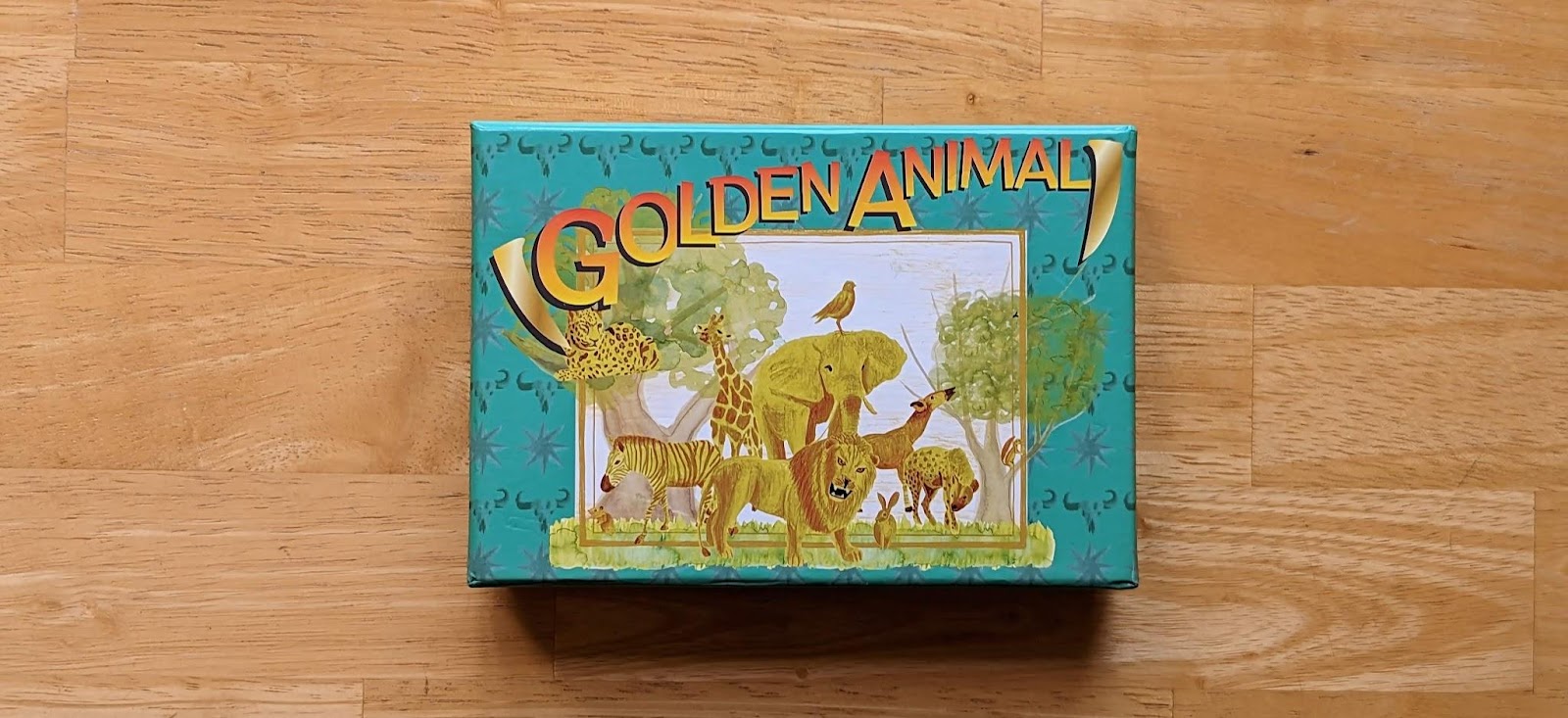
I’m writing this as a “review” of Golden Animal, but there are a few things you should know before we get started. It is scheduled today because I helped license the game for Allplay (boardgametables.com) and they are launching it on Kickstarter today, under the new name and theme, Couture. I will financially benefit if you back it.
I don’t enjoy auction games in general, but it’s more that I don’t enjoy the predominant type of auction featured in board games – as we continue around the table in slightly increasing numbers until all players have passed. For auction games which exist outside of this space (or turn that model upside-down), I often adore them – as in the case of Suroboruos, Strasbourg, or Gossip and the City.
In Golden Animal, there’ll be three lots to bid on each turn. (It’s unlikely you’ll win the whole lot, but the highest bidder will take the first card from the lot, then the second highest, and so on.) You begin the game with 4 cards in your hand representing the money you have to, uh, “spend” (but more on that later), and you distribute those 4 cards as you’d like across the three lots.
On the table, the lots are separated by a card showing mountains and one showing a river. Hey, that’s how they’re separated in your hand too: in addition to 4 money cards, you have a mountain and a river. Simultaneously, players arrange their hands to align their money with the location of the lot(s) they’d like to bid on, and when ready, reveal them. As you each began the game with the same amount of money, you’re likely to have a few ties. Each money card also has a tie break number printed on it, and the lowest number present among tied players will take priority.
We’ve already had so many of the auction twists and we haven’t even left the first round or talked about what you’re bidding on – but they also went by a bit fast, so let’s review. You have 4 money cards with which to bid: a 3, a 2, and two 1’s. Divide them across 3 bids as you’d like, but there are no other denominations (yet) or change. Also, everyone has the same amount of money!
But! Your two 1’s aren’t equivalent – one will have a lower tie break number. Which lot are you most concerned about tying for? Can you put your best tie break there? This also means that 2+2 ≠ 3+1 – both mean you bid 4, but the tie breaks will be different. There is a cascade here which shouldn’t be understated: if you want to bid 4 on the mountain lot, but decide for tie break purposes to swap out a plan which had involved 2+2 for 3+1, your other bids must now be adjusted, as wherever you pulled a 2 from is being replaced by a 3 (increasing that bid) or a 1 (decreasing it). Maybe we’ve gotten too far into the tactics of the auction puzzles for this point in the explanation, but I just love it so much.
OK, where were we. We’ve all arranged our hands and revealed. Lot by lot, determine who bid the most, second most, and third most. Then, by rank, each player takes 1 card from the lot. (Once everyone has taken one, any leftovers go to the highest bidder.) The game takes place over 7 rounds; In the first round, there are 3 cards available in each slot, but the remaining rounds will only have 2 cards in each.
Designer: Akiyama Koryo and Kozu Yusei Artist: Gonke Kengo (ごんけ 賢吾), Onodera (オノデラ) Publisher: YUTRIO Players: 2 Ages: 10+ Times Played: 9 on a purchased copy
I’m writing this as a “review” of Hameln Cave, but there are a few things you should know before we get started. It is scheduled today because I helped license the game for Allplay (boardgametables.com) and they are launching it on Kickstarter on Tuesday, under the new name and theme, Sail. I will financially benefit if you back it.
This is my favorite 2 player trick-taking game.
YUTRIO decloaked suddenly in the Tokyo board game scene a few years ago, with their releases TWO ROOMS in Fall 2020 and CARTA MARINA in Spring 2021 – with both inaugural titles being highlighted by the Arclight Game Award in 2021, Carta Marina a finalist, and Two Rooms an honorable mention. HAMELN CAVE, a two-player only cooperative trick-taking game, was their third release, from Fall 2021.
In theme, the game continues from Carta Marina, with the two players working together to navigate their ship out of a ghost filled cave.
It’s a game of balancing your priorities. You must move your ship forward – that’s the only way to win. There’s a “goal” space down yonder where you can exit the cave. But there’s an onslaught of ghosts boarding the ship – when certain actions happen and more when the turn ends. Like all good cooperative games, the designers present you with a singular way to win and a buffet of options for losing.
If you need to add ghosts and cannot? Lose.
If you’ve added ghosts too many times? Lose.
If you don’t make it past certain milestones in time? Lose.
The levers the game gives you to operate are the “must-follow” rules of the trick-taking piece and the symbols on the cards (which match their rank.) One player leads a card and the other player follows. Then, compare the symbols on the cards you’ve played. Most symbols will help advance the boat – but in the direction of whomever won the trick. (Some of those “most symbols” which advance the boat will also let a ghost aboard.) Other symbols let you stab a ghost with your sabre.
Designer: Nao Shimamura (シマムラナオ) Artist: Yamauchi Rock Boy (ヤマウチロックボーイ) Publisher: ハレルヤロックボーイ (Hallelujah Rockboy) Players: 1-100 Ages: 10+ Times Played: 14 on a purchased copy
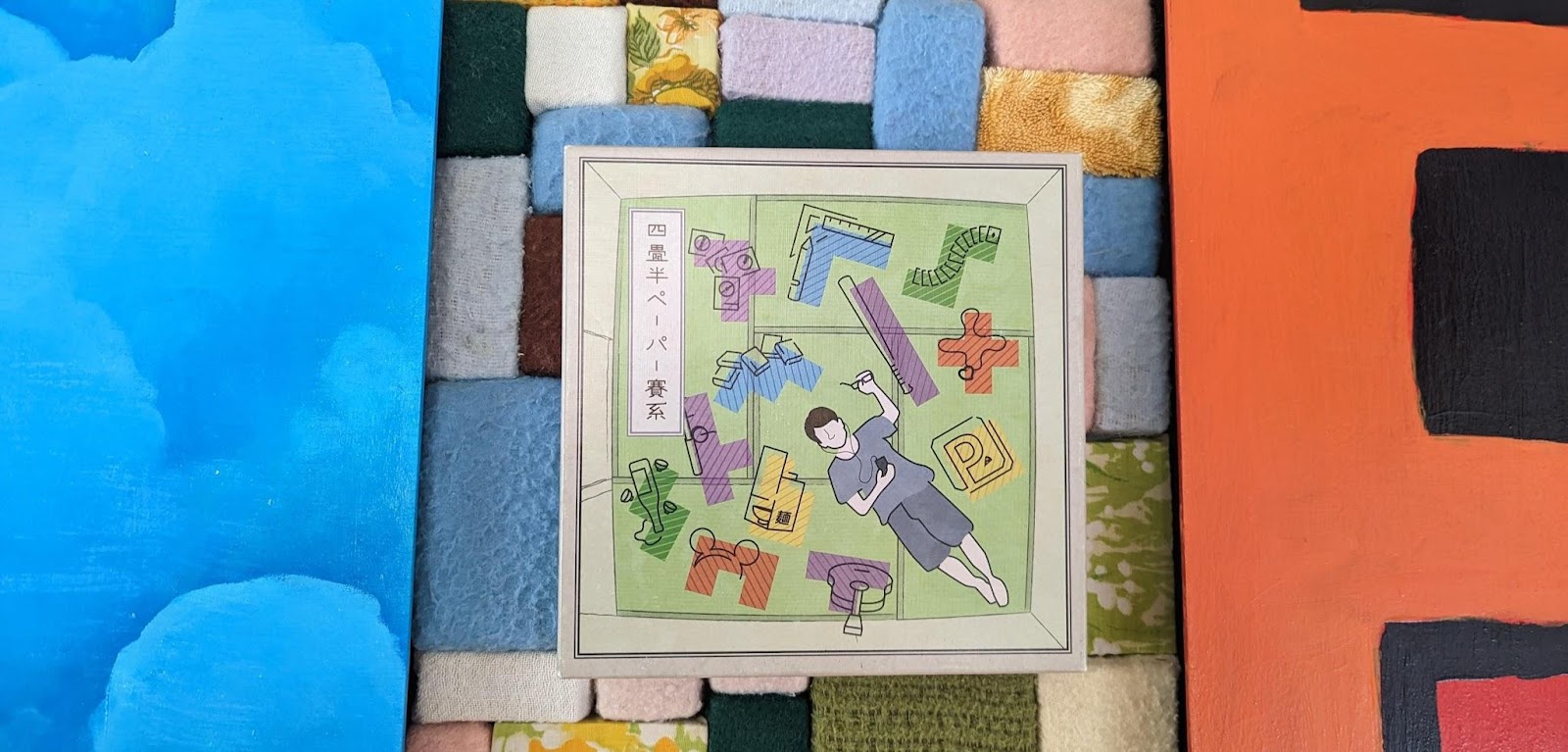
This will be a sort of review of a game I first reviewed in April of 2020. I’m writing this as an updated “review” of the game (and will skip most of the detailed rules here), but there are a few things you should know before we get started. It is scheduled today because I helped license the game for Allplay (boardgametables.com) and they are launching it on Kickstarter on Tuesday, under the new name and theme, Mind Space. I will financially benefit if you back it.
This is my favorite roll and write game.
At first glance, it has many of the colored polyomino tropes which pervade the space, but it separates itself from the crowd for me – both in mechanics and in theme integration.
In theme, the game takes place over 12 months of college, and for each month, you’d draw one shape in your tatami door room. The shapes you can choose from are mostly the polyominoes you would expect, but they arrive on a conveyor. There are always 5 shapes available, with a 6th as a consolation prize of sorts. Each month, dice are rolled for the five colors used in the game and assigned to certain positions of the conveyor. At the end of the month, the shape in the 5 slot is removed, the others slide down a position, and a new shape is added to the 1 slot.
As I think about it now, I didn’t properly couch my original discussion of the game in enough of a modern sports analytical lens. There’s a certain WAR aspect to considering the 12 shapes you’ll draw during the game. For each yellow shape I draw, I’m _not_ drawing something else. What are the best food pyramid proportions of each color? It’s not that easy of course – maybe it’s 1 yellow, 1 blue, 1 red, 3 orange, and 2 purple, and 4 green. But what happens when the reality of that hits the conveyor?
In the original review, I glossed over it, but I had a friend who thought the yellow shapes were categorically never worth drawing. I’m not involved in any of the art, theming, development work, etc. that Allplay does, but occasionally a question comes back to me. They too had a question about the yellow shapes (now green, but I’m still going to call them yellow for the purposes of this article).
So I threw all of the score sheets I’ve kept into a spreadsheet and looked at the correlations between how many times shapes were drawn, the points the player earned from them, from the bonus cards, and overall scores.
The game will always give you a way to score points – even a yellow shape which doesn’t directly provide points will cover up spaces which would otherwise subtract from your score. But when I inevitably must veer off my personal ideal course, what is the swap I’m making? How do I maximize the switcheroo. Which color will get less shapes.
From the Publisher: Detective Rummy is a rummy-style card game with a storytelling element revealed in a series of seven different cases. Players take the roles of detectives vying to solve the cases and gain fame. The story begins at the legendary Rummy Detective Agency, and each case takes you to various locations to solve a crime, including the diner with the best doughnuts in town, the cozy “Quarter to 3 Bar”, a ritzy fashion emporium, the circus, the most elite jazz nightclub in town, and more.
The cases in Detective Rummy can be played in two different ways: Campaign Mode and Case Mode. In Campaign Mode, you play all seven cases in order. In Case Mode, you can play cases 2 to 6 as standalone Detective Rummy games one at a time. Since new “Game Changer” cards are discovered in each case in different orders (if at all) each time you play, cases will never resolve the same way twice. You can play both the campaign mode or the individual cases as many times as you like.