Once upon a time, I bought a RPG system from a wargaming company – SPI’s Dragonquest – which I never actually played with any other live human (despite my role as the primary DM for my group of fantasy/sci-fi nerd high school student friends). What I did do with Dragonquest is generate characters – the system made much more sense than early D&D’s “roll 3d6 six times and hope for the best”. So, armed with percentile dice and a pencil, I happily built characters for a game I would never play.
Fast forward almost 40 years and I had the joy of playing Brotherwise Game’s Call to Adventure, which turns my lonely (but enjoyable) RPG character creation pastime into an actual game. It was one of my favorite games of 2019 – and I’ve praised it multiple times for the beautiful illustrations, the quirky but solid rune-throwing randomizer system, and the nice balance between assisting and messing with other players.
Designers Chris & Johnny O’Neal followed up this success with an expansion based on The Name of the Wind fantasy series (yes, I’m waiting with the rest of you for the author to finally finish the last book) and a stand-alone version of Call to Adventure based in the Stormlight Archive universe (which is on my list of things to read).
If you’d like to know more about how the game system works, our Fearless Leader (Dale Yu) wrote a great First Impressions preview that covers all of the basics… which leaves me with more time to tell you about the newest addition to the Call to Adventure family.
Played with copy provided by Taiwan Boardgame Design
The Three Little Wolves is a compact family game which takes the story of the 3 Little Pigs and turns it on its head somewhat. It was presented (again) at SPIEL 2022.
Per the publisher – “Centuries after the famous story, the Swine family has learned a precious lesson, and become the greatest landlord in the world (They love houses!). The Wolf family, however, becomes the best architects of all time (They hate lousy houses!). The three little wolves now work for the Big Bad Pig to build all kinds of houses. Can you help the wolves build the highest house and find the best home for them?” In this game, players work to build three different houses – trying to build the tallest houses to gain the most points; however each player also needs to send their Wolves at the right time to achieve victory
Recently we had the opportunity to speak with some game designers from Japan about their upcoming projects.
itten-games known for their wonderfully innovative games with fantastic 3D components such as “Tokyo Highway”, “Moon Base” and “Stonehenge and Sun”. They started crowdfunding for the new international edition of their “Funbrick Series” on Kickstarter. The Series consists of 5 games. Each game comes in a slim and portable box packed full with components. https://www.kickstarter.com/projects/itten-games/funbrick-series
Two of the games were designed by Reiner Knizia. The first is “Viking See-Saw”. It is a balancing game but instead of the usual all wooden components, it has several items of various densities like metals and glass. Players need to try to be the first to rid their area of all the booty by placing it carefully onto the boat so as not to unbalance it. If the boat tips to the opposite side of the cargo placed, they need to take one of the treasure chests from the center into their hand.
The other game designed by Mr. Knizia is “Ninja Master”. Ninja Master is a dice and speed game with sophisticated rules about gathering the desired components shown on the dice. In a round, after all the dice are rolled into the Dice Dojo area, players race to grab up to 2 tokens (ninja, katana, shuriken) depending on the criteria of what is shown face-up on the dice. In this game, multiple items can be grabbed to score points, so multiple people have a chance to earn points rather than usually speed grabbing games where only 1 person can earn points in a round. As soon as a player calls out their guess for the sum of ninja icons visible on the dice, players must stop grabbing items. Scores are given or deducted on the accuracy of the token grabbed, and 1 point is scored for the first person who calls out the total ninja’s visible. When a player reaches 20 points the game ends immediately.
“3 Second Try” is an interesting game where the timer is rolling a marble down a ramp and players bid on the chance to complete different goals. One type of goal is mental challenges and the other type of goal is physical. I think you also have 3 sec to complete these goals. The first player chooses a card from either the “Brain” deck or “Action” deck and reveals it. They roll metal marble down the ramp, and players call out their bids for how well they think they can do before the marble reaches the bottom (3 seconds). The player who called out the highest attempts the challenge first. If they succeed they win the card. If they are unsuccessful the player who bid the next highest gets to try and so on. The strategy lies in when to bid high, or when to bid in the middle, and hoping those that bid high will fail the challenge so you can have a turn.
In “Stick Collection” players bid for sticks that will be of differing heights of 5 mm. You try and get a run of different heights or 4 the same size. In each round, one stick is randomly drawn from the box and placed in the center. Players in a clockwise order, take turns to bid 1-10 gold, the person that bid the highest (or 10) will get to keep the stick. Then the next player will draw the next stick, and bidding starts again. Continue revealing one stick and bidding, until either someone has 8 sticks in their hand or they have 4 sticks of the same, or someone runs out of Gold. Players that have over 22 gold on the track score 22, and players below score the number of gold they have. Then check to see the longest run of sticks that are 5mm apart from each other and score 10 points for each stick in that run. For example a run of 4 sticks that are 5mm apart, will score 40 points. The player with the highest points wins. But if a player has collected 4 of the same sticks they win the game immediately.
“Judge Domino” is a remake of Chicken Domino. You take turns setting up dominos and then vote if they will all fall or not. If someone votes ‘no they will not all fall’, the player knocks the dominos over and if they do fall, players who voted yes will score. The game is played over 3 rounds, and starting with the #6 Domino standing in the play area. In clockwise order, players take 1 of the remaining 10 domino tiles from the stock, and place it on the table in a line. The dominos can be placed in any orientation, vertical or horizontal. Players can place the dominos at the start, end, or middle of the line. If there are no more available to take, players must take a domino from the middle of the line, and place it on either end. When someone calls out “judge!”, the judging phase begins. Players simultaneously reveal their judging token with the success side or failure side face up. Then the player that was last to place the domino will start the topple by pushing the domino at either end, which has the lowest number. Players that judged correctly will earn points based on the players that judged incorrectly. If 2 players were correct and 3 were incorrect, the 2 players will get 3 points each.
With all the fun portable games from the Funbrick series hitting Kickstarter, itten also announced a new game “Nuts A GoGo!” will be featured also at the Game Market.
Charles Ward from EX1ST GAMES will be back with a new Cthulhu Coinsides which has also started crowdfunding on Kickstarter. Coinsides are a combination spinners/counters/dice that can be used in a multitude of ways in game related matters. The new Cthulhu Coinsides has all the features loved in the first version, with a lot more extra features. There are now 9 dice in 1 Coinsides, as well as a Yes, No, Maybe spinner. Players can also use it as a game or life tracker, with the ability to track up to 70 using the 3 pointed marker. Charles also designs RPG games, and added a cyphering feature on the new Cthulhu Coinsides, with letters and numbers that border the outside of the coin. It can be used as a decoder to hide secret messages for RPG games. Charles Ward is a solo indie game designer living in Japan. This will be his 3rd Kickstarter project.
Taboo Code is a card game designed by Kenta Murayama who has released a beta version with a smaller sample of cards which has been made available here in the US via Amazon. It’s a party game where each player has a rule which is known to other players but not themselves that they try to guess while other players try and get them to break the rule. Shuffle and deal out one card per player but they cannot see their own card. The cards are revealed to the other players, like in the game of Coyote. Players try to lead other players to do or say their taboo so they drop out. If a player manages to guess and announce what their own taboo is, they win because they have broken the “Taboo Code”. Each game goes for 5 minutes. Kenta’s Taboo code is actually played online by gamers from Japan.
Kenta recently finished his Kickstarter campaign of Escape Route. Kenta is a solo indie designer from Japan.
The final game presented was “Gin Crafters” designed by Mr Miyazaki from Waza Games, which is being published by Jugame Studios. Gin Crafters involve acquiring recipes and purchasing the botanicals-herbs and spices to flavor your gin. Players need to use their multiple actions to collect ingredients to make the best Gin. You can also borrow ingredients from other players. More information will be revealed on their launch page, so it will be very exciting to see more information about this game. This game will be available in English and Japanese.
A sample copy of the game was also displayed at the Game Market at the Jugame Studio & Waza Games booth.
Each year there are many games coming from Japan due to the inspiration of the Game Market conventions. This year in particular we have seen a lot more tabletop games, gaming accessories, and digital games from Japan launching on Kickstarter as well. It’s a very exciting time to follow these creators as they launch more games in Japan and internationally.
Played with review copy provided by blue orange USA
Disc Cover is a new cooperative party game from blue orange – I saw a few raucous demos of this in the halls at SPIEL in Essen this fall, though the noisy atmosphere was maybe not the best one for the game. From the back of the box: “Turn up the volume and explore your music through images!”
Horrified: American Monsters is a standalone game that features gameplay similar to 2019’s Horrified, which challenges players to overcome the “Universal Monsters” from classic films. In this co-operative game, you face off against classic American nightmarish beasts: Bigfoot, Mothman, the Jersey Devil, the Chupacabra, the Banshee of the Badlands, and the Ozark Howler. The more creatures in the game, the harder the challenge, with players needing to use their unique powers to figure out how to defeat each monster.
Designers: Helge Meissner, Eilif Svensson, Anna Wermlund, Kristian Amundsen Ostby
Publisher: Aporta Games
Players: 1-4
Time: 90-120 min
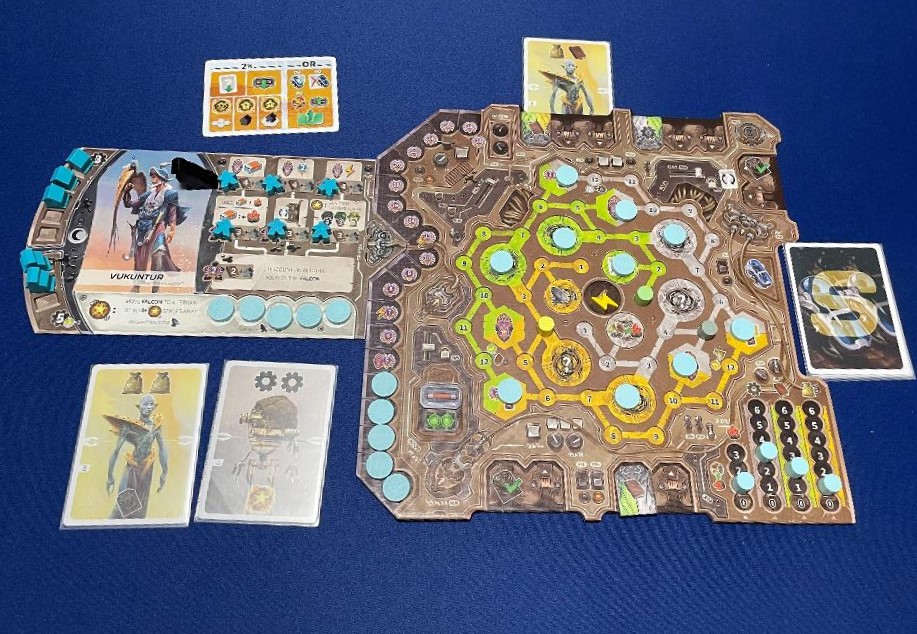
Revive is an interesting strategy game with multiple mechanisms set in a post apocalyptic world. You play different factions of survivors striving to renew technologies and explore the frozen planet.
Goal: Earn the most points by repopulating and rebuilding the world. The game end is triggered when the last
Components: Main game board which represents the planet and individual player boards which are dual layered. Faction boards which aren’t dual layered but completely functional and numbersis standard diles, disks and meeples.
The main game board consists of face up starter iles around the central chasm which is the starting point for exploration. The 4 corners of the map have Ancient Location tiles which if populated by your faction will score end game points. The main board also has a score track, a Hibernation track and it holds the major artifacts. As you progress up the tracks certain values have rewards.
The player boards hold your faction. There are 6 factions included and all are double sided with a basic and an advanced version. (Note I have not tried any of the advanced versions.) The factions hold your meeples and your small and large buildings. The player board consists of several slots 2 above, one on the side and 2 on the bottom to hold cards. The slots can be modified by adding modules. The central portion of the player board has 3 paths which intertwine and each path connects to a number of covered different technologies. As players progress on the tracks, the machines become available for use.
Each player starts with an identical deck and there are additional starter cards for drafting options. Each player will also start with an Artifact card for end game scoring. Players can earn major artifacts as multipliers for these cards.
Gameplay: On your turn you may do either 2 actions (the same or different) or hibernate.
The first possible action is playing a card from your active card display. Players start with identical decks. Cards have simple icons along the top or bottom. You play a card to a slot and follow the icons, most have to do with gathering resources.
The next action is to use your switch. Each player board has a switch which you can use once per round to gather a resource in the base game.
Explore is the next action. You must pay “range” the distance from the chasm or one of your tokens already on the board to the tile you wish to explore in food. Then you must pay food and possibly books to flip the tile which earns you points and a new card for your deck. The below picture is courtesy of one of the designers.
You may also populate. You pay books to place one of your meeples from your faction board into a location space on the main board. This also unlocks one of your faction abilities. Having your meeples in the ancient locations will give you end game points.
Finally you may build a small or large building. If you build next to certain terrains you also advance your markers on your machine unlocking new technologies. You may use these technologies as a free action if you have energy.
If you don’t choose or can’t do any actions you may hibernate. Hibernation lets you refill your active card display, clears your card slots, resets your switch and recycles your energy to be used again. You also advance on the Hibernation track.
As you advance on the machine tracks you uncover technologies, the disks covering these technologies are placed on a point track which will add to your score at endgame.
There are a lot of small additional details that occur during the game like earning bonuses as you progress along the score track and hibernation track, but this is the gist of it.
My thoughts: I did not receive a review copy, I purchased Revive while at Spiel 22. I like mid to heavy weight strategy games and Revive fits that bill. I like the multitude of choices in building your machine- you can choose modules, draft cards and decide which paths to progress on. I also like the exploration aspect of the game as well although it is a smaller part of the game. The factions are also interesting and I look forward to exploring the advanced powers as well. There are a lot of working parts to this game and some people might feel it is complicated for complexity’s sake but I feel like the different parts of the game mesh and flow well. I have played games with 2 players and more players and I find it works equally well, the main difference being less exploration occurs. This naturally leads to a smaller area to build on so I don’t feel it should really impact the game.
Thoughts from other Opinionated Gamers:
Simon Neale: This was my most anticipated pre-order at Spiel and after 3 plays I am not disappointed. As Lorna says the mechanics mesh smoothly together and I really like both the exploration and engine building aspects to the game. Along with multi-use cards the game holds interest throughout.
Simon W (2 plays): a lot of possible ways to try and score points in this game. You can build up your card collection, go for early or late scoring, and develop your machine paths on your player board. As with other games where you have a reset, the timing of hibernation brings tension to the game – do you squeeze everything out of your cards or just hibernate more often to re-use your best cards? The slot upgrades that you can pick up give the cards you use a boost (ie extra resources) if they match the colour, and are worth collecting in the long-term. In my second game I was slow to move up the scoring track as I explored tiles less, but instead concentrated on getting more slot upgrades and deploying buildings to develop newer machines, and interestingly ended up with a similar score to the other players who had taken a different approach. This game will get a lot of play in.