Played with a full campaign with review copy provided by Red Raven Games (total 13.5 hours)
(This will be mostly spoiler free – but I will talk in vague-ish terms about our campaign experience. I will be sure to leave out any major spoilers, but it would be impossible to not give some details along the way. If you don’t want even mini-spoilers, I’d recommend not reading further).
“Are the stars unfamiliar here?” she asked, and the sky grew suddenly dark, the star’s patterns alien and exotic. “This is the Wandering Sea. The gods have brought you here, and you must wake them if you wish to return home.”
In Sleeping Gods, you and up to 3 friends become Captain Sofi Odessa and her crew, lost in a strange world in 1929 on your steamship, the Manticore. You must work together to survive, exploring exotic islands, meeting new characters, and seeking out the totems of the gods so that you can return home.Continue reading →
On July 10, 1911, the Winnipeg Tribune in Manitoba reportedly published one of the earliest known uses of the phrase “everything but the kitchen sink.” To describe a less-than-enjoyable meal, the newspaper provided this description:
“First of all we had caviar. It was the real imported article, and it tasted not unlike bird shot pickled in hair oil. With the aid of a white dinner wine (also imported), I was able to wash down the first course without much of a struggle. The next course was more difficult. It was a thick, sour soup, and I am sure that it had everything in it but the kitchen sink.”
This is strikingly similar to how it feels to play Carnegie by Xavier Georges and Quined Games.
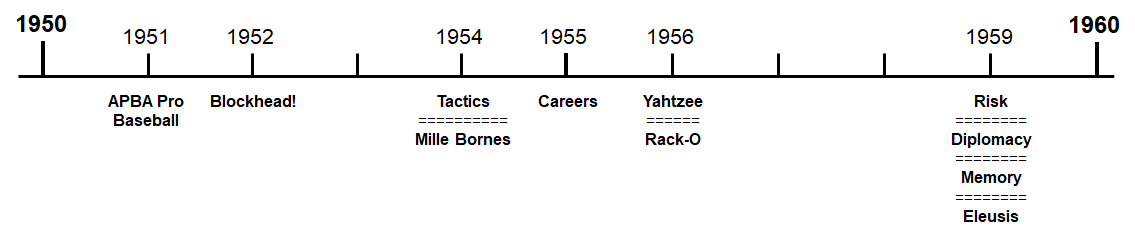
The fifties were dominated by the Cold War, but also by the rise of the middle class. More disposable income and a greater amount of leisure time were all good things for the gaming industry. And, in fact, we start to see more recognizable names on the Timeline, games that continue to be played today, or at least ones that many of us played in our youth. Here is the story behind some of them. Larry
APBA Pro Baseball (1951) APBA Baseball was the first popular “realistic” sports simulation. It was designed by a fellow named Richard Seitz. Seitz originally created it back in 1931 for a boardgame league that he played with 8 other high school classmates from Lancaster, PA. He derived it from a game called National Pastime that he had played earlier. (National Pastime was a simpler baseball sim designed by Clifford Van Beek–he patented it in 1925 and sold it for only one season, in 1930. As luck would have it, Seitz was one of his customers.) APBA originally stood for American Professional Baseball Association, the name of that original league. (For some reason, in later years, the company always insisted that APBA was not an acronym and that it should only be pronounced “APP-bah”.) Seitz continued to play his game from time to time and in 1950, excited by the pennant-winning play of his favorite team, the Philadelphia Phillies, he and his wife decided to resurrect it. They enjoyed it so much that in 1951, Seitz decided to sell the game through the mail, working out of his living room. Sales increased steadily and in 1957, Seitz decided to work on the game full time. It continues to be popular today and APBA now has games in multiple sports and sells both tabletop and computer games.
I played APBA, along with a bunch of other sports simulations, during my teenage years (while I continue to enjoy sports, I was a real sports hound as a teen). APBA, Strat-O-Matic (its main competitor), and Sports Illustrated all had fine baseball games, but my game of choice at that time was a reasonably obscure title called Big League Manager. I felt it was the most sophisticated and logically designed game of its time and I played it a good deal with my brother, as well as solo, during the early 70’s. Once I hit my adult years, my sports sim days basically ended, but they were an important, and very enjoyable, part of my youth. Larry
Like Larry, one of my first gaming discoveries was sports-related games, especially baseball. I would invent my own games using dice and baseball cards. I had a friend who owned APBA and I was blown away at the realistic outcomes compared to some of the other games of that era. In my early teen years I discovered the Strat-O-Matic games and eventually had my own copy of Strat Baseball. I played that (mainly solitaire) through my early 30’s. Mitchell T
Osaka/Tokyo Game Market Previews from Mandy aka MissMerc and Lorna
Spring is here and one of my favorite times of year for many reasons but 2 of the best for board gamers are the Osaka and Tokyo Spring Game Markets. More information about the markets and games that will presented there can be found here: https://gamemarket.jp/
I recently had the honor of joining my good friend Mandy for some demos.
TRAPEZ (トラペーツ)
Ms. Erisa Ichidai introduces her game
Lorna: Trapez is a nifty 2 player abstract designed by Ms. Erisa and Mr. Ichidai. The game is played with bicolor hexes where one half is light and the other half dark colored. The goal is to be the first player to connect 7 pieces via your own color.
The game starts with the center hex filled then players alternate placing a new hex anywhere on the board. The hex may be placed in any orientation. When a hex is surrounded by other hexes including the edge of the board, the player whose turn it is must rotate it 60 degrees to either side. If a piece is completely surrounded by other hexes, the player can choose either the middle surrounded hex, or the hex in the 12 o’clock position of the surrounding tiles to rotate.
It’s a nice challenging abstract.. The rotational element definitely makes it more interesting as you try and set yourself up but not too much so as your opponent may get the advantage.
Mandy: It is so great to see more female designers in the board game industry in Japan. Trapez can be played with anyone. Players can think play it lightheartedly or play it more strategically. Since the game is easy to learn and fast to play, it’s easy to play the game several times in a sitting. What’s interesting is when playing the game, players should sit next to each other so they both look at the board from the same direction.
I love how many options there are to place the hexagonal token. Making a connected line of 7 tiles looks easy, but you need to be strategic also and think ahead. Even though it looks like an Abstract game, it gives me the Tsuro feel, and I love Tsuro. I was so happy to have played this game. I can see how fun this game might be at a game day to use it as a gateway game, or have multiple copies of this to make a mini tournament.
Trapez will be at the Tokyo Game Market at booth :ケ12
TrumPen (トランペン) by Kujiradama
Lorna: TrumPen is pretty cool. It’s really kind of a game system. The components include 54 whiteboard “cards” and erasable pens. Players will provide the number and suit of each card. The designers included rules for 3 common and well known card games types with the TrumPen twists – Poker, Speed and Trick taking. In our play test session, TrumPen Poker was played. Players secretly wrote numbers and suits matching poker hands and then the poker hands are called out Royal Flush, 4 of a kind, etc. If a player had that hand, they show it and if any other players have chosen duplicate cards, the person with the highest hand drops out. The last player left will earn points for their winning hand.
I think TrumPen may appeal to a lot of people, from people that love card games to those who wish to try a bit of designing. It’s a really clever game. I’d love to see people post the variations of traditional card games.
The TrumPen we played at the Tokyo Demo Day event – by Kodansha & Kickstarter Japan
Mandy: The Kujiradama team is a wonderful wife and husband team who have created many games in the past. TrumpPen is their newest release for 2021. Even though players are writing their chosen cards, it is a very clever spin on trick taking. We tried out the Poker version and it was a lot of fun. The first player to 5 points was the winner, or once 9 rounds have been played the game ends.
With the Poker version, players can only use the numbers A – 7, in any suit. Each time players must choose and write 5 cards : the number, and the suit. There are some restrictions. E.g. The A card cannot appear twice in your hand, (you can only use the Ace once). Ace cannot be at the end of a sequence run e.g. 4,5,6,7,A is not permissible. But with the variety of trick combinations you can choose, it is a lot of fun.
In TrumPen poker, you gain points depending on which combination of cards you win with. I tried writing a Full house for my first couple of turns, but failed to win any points. As a Full house is one of the tricks called out earliest in the rounds, it has a high risk, but it also has a high reward. A straight flush can earn you 7 points, whereas a 2 pair combination will only earn you 2. Then I decided to try 2 pairs, but was also caught out. Finally I tried a single pair, and the rest random cards. After playing it, it really left a positive impression. Basically I wanted to play it again and tell my friends about it.
I love anything to do with erasable whiteboards, but this time it’s erasable cards! How clever. I think it’s such a fun social game. Also for those that like trick games or games like Big 2 (deuces) you should enjoy this also. I loved trying to make a set of cards. I had to think about what others played in previous rounds, and try to choose a set of cards that no one else would use. This game made me laugh a lot. Also it’s playable online, which is perfect for this new social norm.
TrumPen will be at the Tokyo Game Market (4/10 – 4/11) at booth : カ11
Kodoku no Rondo (コドクのロンド) (Dance with the Last One) by MadeInPocket
Lorna: Kodoku no Rondo is a fun bluffing game. In the game there are 5 magical girls each represented by a color, black, white, red, blue and green. At the start of the game, each player receives a secret card with 2 of the magical girls differentiated by their color. The goal is to be the player whose magical girl(s) is left standing.
On a turn, the active player rolls the dice. The highest numbered die or dice is placed on the matching color magical girl. If it was a 6 you can damage any other magical girl if it was not a 6 you may damage adjacent magical girls. If more than 1 die had the highest number you resolve all of them.The magical girls have life points of 4 or 5. If both magical girls matching the color of your secret card are eliminated so are you. You can prevent damage by giving up one of your three starting coins. The winner is the player with the card with the magical girls that remain. Another way to win is by guessing which secret card another player has left.
In the advanced game the magical girls have an additional power that can be used.
We played the base game. It’s a fun little bluffing game to try and decide when to prevent damage and which magical girls to attack.
Mandy: The base version of the game without using the girls special abilities took us about 35 minutes for 3 players with rules explanation. The rules were easy to understand, and the game was a lot of fun. The game can be played with 2-6 players, and can take anywhere from 10-30 minutes.
5 magical girls (witches) are battling over a wish. Each player is a guardian and is in charge of protecting 2 of the girls. The players (guardian) interfere with the fate of the dice to make sure their girls survive. Players have a chance to save the girls lives up to 3 times, but must be strategic in who they use the saving tokens for. In order to hide which girl they are protecting. On your turn after rolling the colored dice, you will need to choose which girl to attack or defend. Every time a player dictates their fate dice to attack a girl, that information is recorded with the girls life token. Over the course of the game you can gain more information about which guardian is protecting who. But if the guardians play well they can fool others. So players need to watch and see what moves are taken in order to try to find out the 2 girls of the opponents before it is too late.
I now have this game on my radar. I thought it was such a fun deduction game. Even though there are dice there are lots of choices to be had. Watching everyone use different strategies was a lot of fun. I thought one player had the red & green girl card, but it was all a ruse. They played so well tricking us into thinking it was those cards. Even after the game ended, we wanted to guess what cards each other had. You can play this game without the magical girls abilities to make the game shorter and easier. It usually takes about 45mins with the rules explanation, but we were able to play the shorter version in about 30 minutes. This is a beautiful game I want to play again.
Kodoku no Rondo (Dance with the Last One) will be at the
Osaka Game Market (3/28) at booth: F02
Tokyo Game Market (4/10 – 4/11) at booth : タ37 on Sunday only
From Yucata, at some point we slid (not into DMs but) into Boardgame Arena. The BGA interface for creating games is horrible compared to the simplicity of Yucata and it’s a real barrier to entry. But the drive for gaming variety led us to overcome. BGA is much slicker for card games and bidding games with its ability to provide one-touch turns (Yucata insists on extra end-turn urgh-I-forgot-again clicks) but for the heavier games, Yucata seems to provide better, more intuitive experiences.
Anyway, our online hero game over the last year has been Russian Railroads, and that’s our spotlight game this time around. Yucata gave us the chance to explore German Railroads and American Railroads, both of which I prefer over the original, with the former being my favourite of the three due to the ability to tailor your own track. All held up well to multiple replay and I’m glad I’ve had the chance to explore them more fully.Continue reading →
Designers: Franz-Benno Delonge and Phil Walker-Harding
Publisher: Grail Games
Players: 2-4
Age: 8+
Time: 30-45 mins
Normally, I don’t do Kickstarter previews, but I am making an exception for Fjords as the original is one of my favorite 2-player games. Prior to his passing, Franz-Benno Delonge and I were good friends, and this is possibly his best game design IMHO (though Big City is a close second). I honestly haven’t played Fjords in a few years, but that is mostly because my opportunity for 2-player gaming has diminished. I used to explain Fjords to people as – something similar to Carcassone, but with hexes and a little more complexity. That short review still holds true…
Fjords is a tile-laying game that takes place in two phases. First, the players explore the fjords around them by laying hexagonal landscape tiles. Previously, you would draw a tile, and then place it in a legal spot on the board – such that it touches at least two previously placed sides (and all landscape features match). If it could not be placed; the tile was set aside and a new tile was drawn. Of course, there was an interesting bluff element going on as well because you might claim that a drawn tile could not be legally placed in order to avoid having to put it in a bad place; but if your opponent found a legal spot, you were obligated to play the tile. In the new version, there is a display of four tiles for you to choose from – thus giving a bit more flexibility and planning. After placing a tile, you may put one of your longhouses on the tile played (on the land area). This phase continues until the tile supply is exhausted or when all remaining tiles cannot be placed legally.
Second, beginning from the encampments placed during phase one, players will walk the landscape, claiming as much of the plains and cliffs as possible. On a turn, you must place a viking on a non-occupied tile that is adjacent to one of your longhouses or a previously placed viking. If you no longer have a legal place to play a viking, you no longer participate in this phase. The game continues until the board is full or no player has a legal place left to play. The winner of the game will be the player who has claimed the most land – this is a count of hexes with your viking or your longhouse in it – or simply look at the supplies and see which player have fewer pieces left over. There is no tiebreaker.
This new edition of Fjords differs from the original release in the following ways:
The game now plays up to four players. There are more terrain tiles included in the box to allow for players to have the same game feeling even with more players.
The game contains five new variants/modules designed by Phil Walker-Harding. These add optional variety and flavor to the game.
The new content has been created by Phil Walker-Harding, whose games usually hit my sweetspot. The modules use the new Rune tokens, 8 different types included in the game. Each of these runes comes with different rules associated with them, and it appears that you can mix and match them in any combination to change up the game.
Some runes give increased scoring to hexes adjacent to them – others allow for “sea travel” which let you place a viking 1-3 hexes away as long as it is connnected by water to the particular rune. This seems to be especially helpful in a four-player game when it will become extremely easy to get cut off due to the higher amount of competition as well as the fact that you now have 3 turns between your moves instead of 1 – thus making it harder for you to respond to moves made by your opponents. In any event, I look forward to trying the game with more players and with the runes to see how things change!
For me, the best change will be the ability to play this with more than 2 players. I had always though this game would be a great multiplayer game, and now I have the chance to see. The addition of the runes gives some extra flexibility to make sure that no one gets shut out too soon from the settling… If you want to learn more, the Kickstarter campaign just launched – check it out here: https://www.kickstarter.com/projects/grailgames/fjords-a-grail-game





Patrick Brennan: Game Snapshots – 2021 (Part 2)
From Yucata, at some point we slid (not into DMs but) into Boardgame Arena. The BGA interface for creating games is horrible compared to the simplicity of Yucata and it’s a real barrier to entry. But the drive for gaming variety led us to overcome. BGA is much slicker for card games and bidding games with its ability to provide one-touch turns (Yucata insists on extra end-turn urgh-I-forgot-again clicks) but for the heavier games, Yucata seems to provide better, more intuitive experiences.
Anyway, our online hero game over the last year has been Russian Railroads, and that’s our spotlight game this time around. Yucata gave us the chance to explore German Railroads and American Railroads, both of which I prefer over the original, with the former being my favourite of the three due to the ability to tailor your own track. All held up well to multiple replay and I’m glad I’ve had the chance to explore them more fully. Continue reading →
Share this:
Like this: