In an effort to kind of blog along with everything that is going on at Spiel in 2020, I’m trying my best to participate from home, which is kind of difficult as I am working while most of Spiel is going on. Don’t get me wrong, there are some demos that go on 24 hours, and the availability of some games on Tabletopia or Tabletop Simulator makes it easier for folks like me, as long as the rules are readily available, and not in German. So most of my first evening was kind of getting used to the interface of Spiel Digital and learning what is out there, what isn’t out there, and what I can do from my cozy, if a bit squeaky, home desk chair.
Well, the Opinionated Gamers are located in 7 or 8 different countries and we’re all trying to experience SPIEL as we can. The nice thing is that this year everyone has the opportunity to participate – not just the ones who were able to travel to Germany. A few more reports…
From Simon W:
I’ve played all day and had great fun. I managed to get 3 game explanations in and watch another – So 4 new games in a day which is better than I do in Essen.
Overall he experience was excellent. The first half an hour in nothing worked, but I guess they did some rapid fixes and we were in and playing by about 10:45. At Essen I love sitting down and being taught games, chatting to the explainer and the others at the table. Here I was able to do the same thing and it felt great to be participating!
Using Discord and getting into a game was a little bit messy: Often on the spieldigital website itself, at an Exhibitor’s page, there were no tables available but i found that if you take the discord link and then poke around in the Exhibitor’s channels you can talk to explainers, watch a game on Tabletopia or sometimes muscle in to play. It wasn’t that hard once you understand that everyone is using discord to talk to each other.
Here is a very quick summary of the games I played:
Monster expedition – Pfister does Splendor plus the Worm game. Roll dice and push your luck; then take a reward (monster card) which gives you points and often a small benefit . It has some extra touches, like a clever scaling mechanism for how many dice you roll which also compensates for low rolls. Timing on when to buy a cage for a monster (basically a draw of a random monster card instead of buying it from the display and the card is worth about half) becomes important towards the end of the game. I liked it.
Renature- superb abstract very Kiesling orientated product of the Kramer-Kiesling partnership. The components look superb from new company Deep Print. It’s a majority domino placement game, with a lot of depth in a small amount of time. Play a domino, possibly plant one of your wooden plant pieces; the size of the pieces you play in neighbouring areas will earn you points immediately and in a majority face-off when the area is surrounded by dominoes. So many clever choices in a small game. A must buy for me, I love it.
Traintopia – short 30 minute filler with a Carcassone flavour but I would say it loses the simplicity of Carcassone for not much benefit. Place tiles or place meeples to score for certain things on your tiles or on your railroad. I wasn’t impressed but it is aimed at gateway gamers. I can take it or leave it.
Tawantinsuyu- It’s good but I am not yet convinced. We were kicked off after one round so I couldn’t tell how it would go in a full game. I am a bit allergic to anything that feels like a worker placement game with resource churning but this one has the twist of worker placement being affected by where you place your worker and how far from your priest the worker is. The colour of the worker also impacts the benefits you get. You start with two workers and can buy one each turn for a resource. Otherwise you are just collecting resources or cards which give you resources; and then use them to score points The physical aspect of the temple shape was interesting and the game looks good. It does feel complex and the explanation took a good 45 mins, but I can’t yet judge how much of a point salad resource churned it is. Ideally I’d like to play again first but I will probably buy it. I like it.
Simon
From Chris Wray – more of a report coming… but first a single comment
I liked the “theme worlds” page. Clearly I like seeing all of the new product releases, although the BGG preview is a better way to do that. I guess having pages for publishers is good, but it really isn’t that much extra work for me to just go to their web pages. Few events interest me.
I know this was put together in a few months, and in that regard, I guess I am impressed, but this seems like a slightly more organized version of what Gen Con did.
to which RJ replies: “I would point out this is the Germans we’re talking about.”
Finally, my group is skimming the online stuff, but we’ve decided to play games at home. Thus far, on the first day –
Publisher: Hans im Glück, distributed in English by ZMan Games
Players: 2-4
Age: 10+
Time: 45-60 minutes
Played with review copy provided by ZMan Games (US Distributor)
In Paleo, players work cooperatively to help their Stone Age tribe survive through the many challenges that they face on a daily basis. Times back then were hard. They weren’t worried about finding a 5G Hotspot and a nice latte with a foamy woolly mammoth drawn on top – instead, they had to make tools, find food and invent fire!
In this game, each player controls their own group of people, as shown with their own individual hand of people cards. There are plenty of other cards in the game, but you will not use all the cards in each game – there are ten different modules in the box, and in each game, you will usually only use 2 of those 10. The game will be played over a number of days, each with a Day Phase (where you collect stuff, make tools and solve challenges) and a Night Phase (where you feed your people). If your group can collect the five victory point markers, you’ll be able to finish your cave painting and prove that you can succeed in the harsh reality of the Stone Age. Otherwise, if you collect 5 skulls, you’ll lose the game. Remember, the game is played cooperatively, and players will win or lose together. In this game, there is no restriction in communication, you are able to share whatever information you like and plot strategy together.
Times Played: 2 times to three wins and a handful of random plays (Not played Solo)
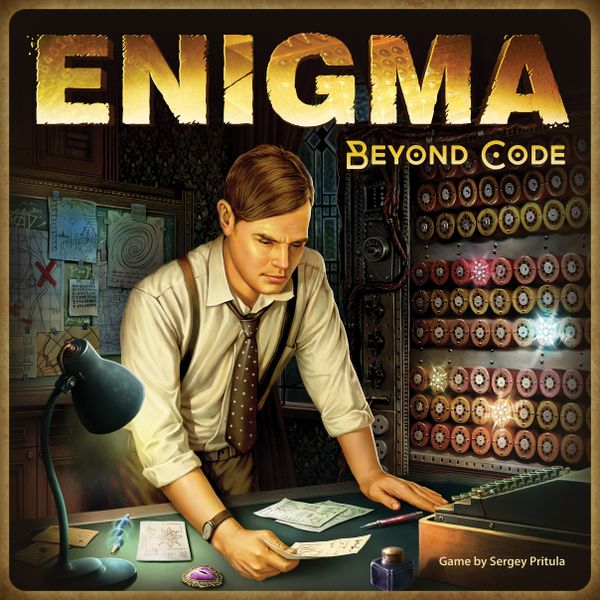
During World War II, the Germans were using the Enigma Cipher Machines to communicate in a way that only they, the ones with the Enigma Machines, would understand. Enter a group of code breakers, who hole up in an old Victorian Mansion who are trying to break the Enigma Code while in a Mansion that seems to evolve and change all the time. Everyone has their goals, all of them are surely good, right?
In Enigma Beyond Code, up to five players will be taking turns looking into rooms to discover where they are in the mansion, and taking actions based on where they are. This is all in an attempt to gain the knowledge that your role needs in order to end the game. Be careful though, use too much time and chaos begins to descend on the players and the mansion.
Schotten Totten is a classic Reiner Knizia 2-player “suits and numbers” card game that debuted way back in 1999. A number of OGers are big fans of the game. Recently, IELLO announced that they would be releasing the game’s sequel, Schotten Totten 2, in time for Essen. As a result, the new game found its way onto the Spiel Want Lists of quite a few of us. The online rules were just posted, so I thought it would be a good idea to summarize them and explain how they differed from the original game, for all those Knizia fans out there.
The basics of the game remain the same. Two players are trying to place the highest ranking melds at various locations on the table. After that, though, everything is pretty much different.
To start off, the new design (which I will refer to as ST2) is an asymmetrical game. One player is the Attacker, who is trying to conquer a castle via a siege. The other player is the Defender, whose job is to hold off that siege. (In the game, these roles are represented by figures of a Cook and a Chicken, respectively, which is pretty bizarre, but still an improvement on the insulting stereotypes of Scotsmen from the original Schotten Totten, so I guess we shouldn’t complain.)
There is a deck of 60 Siege cards, consisting of five suits (colors), with ranks from 0 to 11. There are also 7 Wall tiles, which are laid out between the players at the start of the game. Finally, there are three Boiling Oil tokens, which are given to the Defender. Each player starts with a hand of 6 Siege cards.
As in the original game, each player’s turn consists of playing a card to their side of one of the Wall tiles, and drawing a card to replenish their hand back to 6. However, unlike the stones in Schotten Totten, the Walls in ST2 are all different. The size of melds needed to claim the Wall varies from 2 to 4 cards. In addition, some of the Walls require specific types of melds—at some, you can only play Straights; at others, only Flushes; at still others, only n-of-a-kind melds. For these Walls, if a meld isn’t of the specified type, then it can only win if the opposing meld also doesn’t qualify, in which case you see which meld has the higher sum of cards. For the Walls with no restrictions, the rank of the melds is the same as in the original game: straight flush, n-of-a-kind, flush, straight, other.
Another difference is that only the Attacker can claim a Wall tile. If she can show that her meld at the Wall is either higher than the Defender’s meld, or that it cannot be beaten, no matter what active cards the Defender plays, then she damages the Wall tile, by flipping it over. The cards on both sides of the Wall are discarded and both players can once again play cards at it. The damaged side of the Wall may show a different type of meld that has to be played there.
The biggest change in the game comes from the special ability each player has. At the beginning of every turn, the Attacker has the option of Retreating. If she does so, she can discard all of the cards she has played from any of the Walls she wishes. Since the Defender has no such ability, the idea is that if the Defender is in an advantageous position at a Wall (because you, the Attacker, played some low ranking cards there), you can start over by scrapping your cards there. This, of course, is completely different than the original game, where the whole point was to delay committing to a stone for as long as possible. In ST2, for the Attacker at least, there is no final commitment and you can start over (in theory) as often as you like.
The Defender also has a trick up his sleeve. At the beginning of his turn, he can play a Burning Oil token on a Wall and force the Attacker to discard the card closest to the Wall (which is the earliest card she played there). This can only be done once per turn and the Defender only has the three Oil tokens for the whole game, but this is obviously a way to take down even the strongest of positions.
There’s one other quirky rule. If a 0 card is played at a Wall when there’s an 11 of the same color on the opposite side, both cards are discarded. The Attacker doesn’t have to take this possibility into account (nor the possibility of a Oil token being played) when showing that her meld at a Wall cannot be beaten.
There are two ways in which the Attacker can win. Either she damages 4 Wall tiles or she damages the same Wall tile for a second time. The Defender wins by keeping these from happening. If the last card of the deck is drawn, the Attacker gets one more turn to try to win. If he doesn’t succeed, the Defender wins.
ST2 also comes with a built-in variant that is reminiscent of Battle Line, the souped up version of ST that is also 20 years old. The new game comes with 11 Tactics cards. These are similar to the Tactics cards from Battle Line. If the players want to use the variant, the Tactics cards are shuffled to make their own deck and each player has a 7 card hand. When drawing, the players have their choice of which deck to draw from. Either a Siege card or a Tactics card can be played on your turn, but the total number of Tactics cards you’ve played can only exceed the number your opponent has played by one. All of these rules are the same as in Battle Line and the specific Tactics cards are similar to the ones in the older game as well.
So there you have it. Two games that share a name and some basic concepts, but which appear to have very different gameplay. I’m definitely looking forward to trying this out and I’m sure many a Knizia lover feels the same way!