Editor’s note – Normally we don’t write reviews here that include spoilers. This is going to be an exception.
THERE WILL BE SPOILERS HERE ABOUT SOME OF THE LEGACY PARTS OF MY CITY! PLEASE CONTINUE READING ONLY IF YOU ARE OK WITH SPOILERS!
But, the spoilers will be hidden (hopefully). If you’re planning to play this game on your own, I’d suggest either skipping the spoiler text or maybe skipping this whole review! A lot of the enjoyment of legacy games comes from the surprise of dealing with whatever comes in those sealed envelopes, and we’ll be discussing some of those things below.
Here is a test of the spoiler block that we will use. Click on the arrow here to un-hide the spoiler text. (If you can read this without clicking on anything, the spoiler text does not work on your browser, and you should only proceed further at your own risk).
This game seems like it is perfect for remote play, and part of the reason that I wanted to write this up was to help people realize that this is possible, and how it would be best to organize the game. If you want to skip all the possible spoilers and simply figure out how/when to send things, scroll all the way to the bottom of this post and I’ll have a summary at the end.
I will do my best to hide all the spoilers behind a spoiler tag, and if there are any incriminating photos, those will hopefully also be hidden behind them. In this new era, I think trying to figure out how to play games remotely is the next frontier, and while this game wasn’t specifically designed for it, it seems to be fairly suitable.
OK? Last chance for me to warn you that spoilers are found below the jump! Time to tell you about our game!
To call Everdell a success would be an understatement. It is currently the 38th highest ranked on BoardGameGeek, an impressive accomplishment for any game, but a remarkable feat for a game that was just released in late 2018. Everdell has won or been nominated for numerous gaming awards. More than 22,000 BGG users own Everdell, but given that many BGG users don’t log their collections, and given that many gamers don’t use BGG at all, the true total is far higher.
The franchise has earned millions of dollars. The original Kickstarter had 6,775 backers and earned more than $473,000. The first expansion, Pearlbrook, had 8,012 backers and earned more than $609,000. The second and third expansions, Spirecrest and Bellfaire, had 11,900 backers and earned more than $989,000.
But we here at The Opinionated Gamers had never covered Everdell. And, in fact, I had never played it until I traded for it earlier this year.
But this week, as summer officially turns to fall, I wanted to cover this game about changing seasons in detail. Welcome to Everdell week. Today I review the base game, and over the next three days, I’m reviewing the expansions. But the coolest day will be Friday, where I make the case that Everdell can tell us a considerable amount about gaming in 2020.
This is the story of a great game that I overlooked, even if the rest of the hobby didn’t.
Times Played: >20 combined between German version received as a gift as well as English version provided by Stronghold Games
Divvy Dice was one of the games that I learned about from some of my friends over in Germany – namely when they sent me a copy in the mail as a present. The original title “Man Muss Auch Gönnen Können” seems to have a bunch of varying translations when run through the different online translators, so I was hoping that the new US version would clarify the situation. The short answer – nope. But, the new title Divvy Dice does seem to be a nice riff on the alliterative German title.
So how do you play? From an earlier review by Brandon Kempf here…
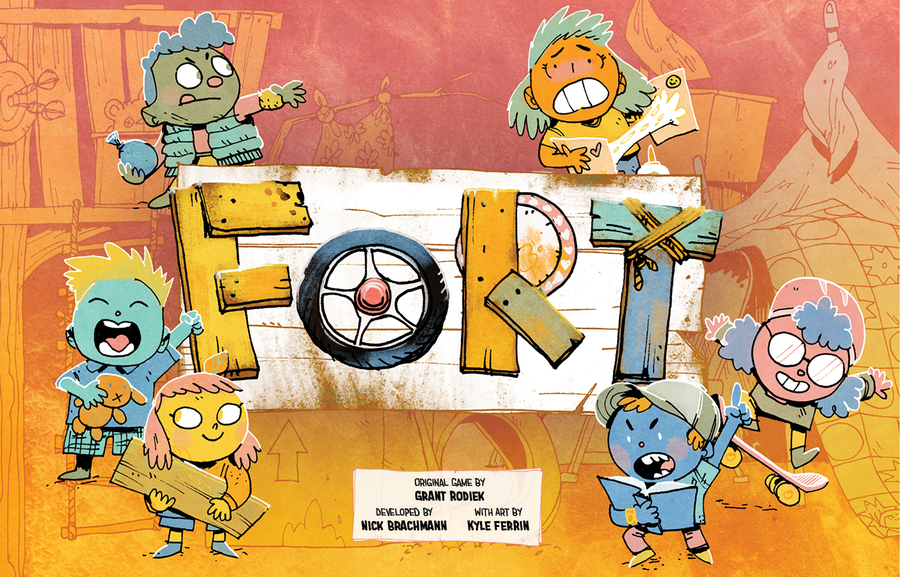
Deck-building games have come a long way since the days where the only choice was Dominion. Most of the time though, even today among those myriad of choices, I’ll still take Dominion over any other deck-building game. Nowadays it seems that you need to integrate your deck-building into games with other mechanisms. I honestly don’t think that a pure deck-building game will ever come along again like Dominion and even if it did, it wouldn’t be nearly as successful. So many challengers try to step up and knock the king from its throne, and one by one, they all fail to get that top spot. Enter a new challenger, Fort, from Leder Games, who are better known for their asymmetric lineup of games with cute and cuddly art from Kyle Ferrin, and designer Grant Rodiek, better known for his corgi, Peaches and his ability to just keep talking, along with game designs like Cry Havoc and Hocus.
As the summer comes to a close, along with the board game industry award season, and as we ramp up for a new year in gaming that begins with the slew of new releases timed to the Essen game fair in October, I thought it would a good time to take a moment and look back at games played, games loved, and games loathed. Rather than a crown a single champion though, I’d like to acknowledge a variety of games in different categories. Of the 249 different games played over the past year, these are the handful of games that I’ve played that merit special recognition.
Most Played Game: Railroad Ink | Runner Up: First Monday in October
My most played game is Railroad Ink, but a close second is the prototype for the game that I’ve been designing called First Monday in October. These games could not be more different, but I’ve been enjoying both immensely in different ways. While I was initially skeptical of the roll-and-write and flip-and-write genre, I think what I actually disliked was the numeric focus of many early games in the genre, epitomized by Ganz Schon Clever and later compatriots like Dizzle and Metro X. In practice, I’ve turned out to be a huge fan of certain games in the genre, such as Railroad Ink and Cartographers, which allow players to relax, draw, and plot out their area — trying to simultaneously plan ahead and adapt to unpredictable circumstances. The combination of variability and predictability in Railroad Ink, along with the ratio of its duration to its luck, make this a perfect package for me. I love that the game works so well in its base version, but that it comes with additional dice and rules to mix things up and keep it fresh. Railroad Ink feels like a game that really rewards playing it dozens of times, but at the same time manages to be accessible and rather non-intimidating to teach or learn. With several hundred possible games on my shelf, Railroad Ink has proven to be such an easy one to pull out over and over again when feeling undecided or tired at the end of a weekday.
First Monday in October is a close second (although beloved Root is second if you don’t count my own prototype). I’ve already spilled plenty of metaphorical ink about First Monday, but for anyone that missed it, I’d encourage you to check out my initial designer diary about the gradual years long development process and many different gaming influences, along with my subsequent detailed write-up on one of my favorite aspects of the game, or there’s the GeekList format about the game’s inspirations if that’s more your speed (which includes some recent late-breaking additions). Given how much the game has evolved over the past year, it’s hard to say if all of the plays could reasonably be counted as the same game. But as daunting as it is to say, the game is now done, and in the hands of the wonderful publisher and artist to eventually reach anyone that happens to be interested in checking it out.
Best New Game: Q.E. | Runners Up: Mandala, Silver & Gold, Fox in the Forest Duet
I think the best new game from the past year is an easy call for Q.E. I know it had a 2017 version and all, but I was not introduced to the new version until December 2019. Having played it five more times in 2020, I’m confident in saying this game is a masterpiece. Having even played it with a researcher at the World Bank, and hearing that the game is scarily realistic, just makes the game all the more compelling! I’ve long adored auction games like Ra, Princes of Florence, and Keyflower, and now Q.E. joins that pantheon as a remarkably fresh take on the concept. The idea behind Q.E. is so radical that you think it’s a joke when the game is being taught to you. An auction game where you have infinite money and can bid any integer that you can think of? Yeah, okay, sure. But it doesn’t just work, it truly sings. It is a psychological thriller in a box, and a game where you are really playing the other players in one of the most tense board games out there. I would never want to confine this game to a cloistered game group (although that might be fascinating in its own right to see the group think that could develop over time) because I think it shines brightest when you bring it to a meetup and see its utterly topsy-turvy nature at its finest. Back-to-back plays are even better if you have time because of the added layer of psychological uncertainty that becomes more poignant in that second play.
Designers: Molly Johnson, Shawn Stankewich, Robert Melvin
Publisher: AEG
Players: 2-4
Age: 14+
Times played: 3, with review copy provided by AEG (and played while eating chocolate truffles also provided by AEG)
In Truffle Shuffle, players compete with each other to make the most valuable collections of chocolates to sell. The players will draft cards from a smooshed pyramid of cards. The top of the pyramid is 4 cards (all faceup) covered by the row below having one more card but face down, and continuing onward until there are 9 face down cards at the bottom. Some bonus coins are put at the bottom, the number of which is based on player count.Continue reading →