•Times Played: 3, with a review copy provided by Tony Boydell
My wife Shelley loves tea. Almost every day starts with the ritual of tea making: filling our electric kettle, selecting the type of tea she wants for the day, steeping the tea, and then pouring some for breakfast and the rest into her thermos for the day. Therefore, when Tony Boydell announced that his next big-box game would be entitled “A Nice Cup of Tea” my ears perked up; I’m lucky enough to have a gamer for a wife, but if the theme ties into something she loves, that is always a plus.
Time: 60-180 minutes on box; our game took about 180 minutes
Times played: 1, with review copy provided by Asmodee NA
“In TIME Stories Revolution: The Hadal Project, a standalone scenario in the “blue cycle” of TIME Stories, you and your fellow agents journey to the year 2099. Rediscover the TIME Stories universe with TIME Stories Revolution, a new cycle of missions. The rules have changed but the Agency’s commitment to preserving humanity and the space-time continuum hasn’t. As all the TIME Stories Revolution scenarios, The Hadal Project is a complete, standalone game. The scenarios can be played in any order. In 2099 NT: While a terrifying virus is devastating the world’s population, a scientific base immersed in an oceanic abyss makes a strange discovery that could decide the future of humanity. Conduct an in-depth investigation and crack the secret of the HADAL project.”
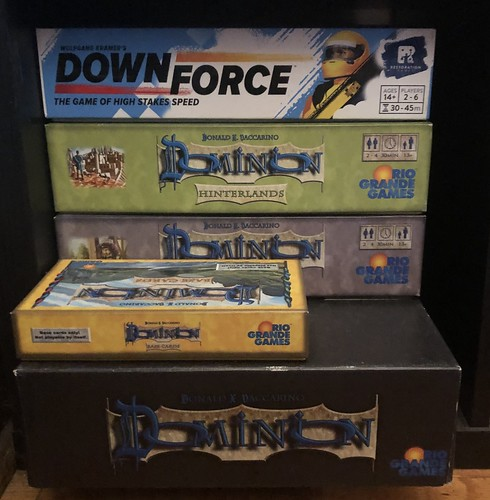
Over the next few months, instead of going with my Three Games articles, I am going to take a look at my collection and try to discuss why certain titles survived the great purge of 2019. During this process I may take a look at some games that didn’t survive, but only as a measuring stick for what did survive. Since I am silly, like a lot of gamers, I use Ikea Kallax shelves to display the games that we own. This makes it pretty easy to break things down cube by cube, so that’s what we’re going to do, twenty-four cubes, plus a top shelf for games that don’t fit in the cubes, over the course of a few months. I hope you enjoy!
Designers: Wolfgang Kramer, Rob Daviau & Justin D. Jacobson
Artists: Tavis Coburn & Michael Crampton
Publisher: Restoration Games
Players: 2-6
Playing Time: 30 Minutes
Times Played: 11
What do you get when you combine an auction, racing and gambling? Well sure corruption is a possibility, but we’re asking in the board game sense right now. What you get is DownForce, a newer release, or rather re-release and re-working, done by the folks over at Restoration Games.
It’s that time of year again, when we take a look back and do lots of Top game lists, but this year’s end is a bit special, it’s the end of a decade. A decade that started with 7 Wonders, Hanabi & Forbidden Island, and is ending with the likes of Die Crew, Wingspan & Res Arcana. There were lots of hits, even more misses and a lot of games over the decade that got lost in the continuous shuffle. So while a lot of outlets are going to give you their favorites of each year of the decade, we thought it may be a fun idea/experiment to take a look at some titles that have held the interest of folks here in The Opinionated Gamers. So for the next few weeks we’re going to take a look at these games and share our love of some of these off the radar titles. Feel free to participate in the comments and share your thoughts on games that we’ve overlooked.
I am a fan of Uwe Rosenberg games, so when a new one comes out, it is pretty much an automatic buy for me. Sure, I’ve been burned a couple of times in the past (I’m looking at you, Reykholt), but more often than not I enjoy them. One of the many things I like about them is that they usually work very well as 2-player games; since more than half of my gaming is 2-player, it is a definite plus. Robin of Locksley is specifically a 2-player game, so I was especially interested.
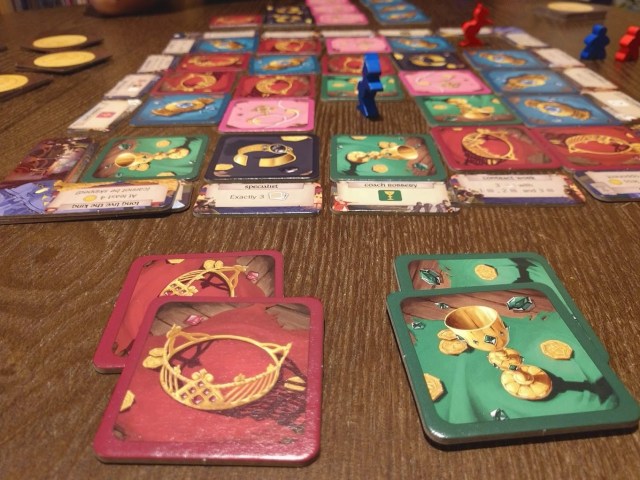
There are 60 loot tiles. 25 of them are laid out in a 5 x 5 grid. The rest are put face down nearby to serve as a draw pile.
There are 8 corner-shaped fame tiles. Two of them – The Beginning (start) and Long Love the King (end) are always used and are put together on one corner. The rest are shuffled; you draw three and put those on the other corners, and put the other three back in the box. There are 16 smaller fame tiles; you draw 12 and place three on each side of the board; the rest are returned to the box. Some of the pieces are labelled as day (easy) or night (harder), and you can choose to use the day pieces to make the game easier.
The game contains 2 pieces per player – one Robin, which is used to move on the tiles, and one Bard, which is used to move on the fame tiles.
Before the start of the game each player chooses a tile from the corner of the board and then places their Robin in the now-empty spot. The tile is placed face-up in front of the player, in their personal supply.
On your turn you move your Robin in a knight’s move as in chess – the shape of an L. You take the tile you landed on and place it into your personal supply, and draw a tile to replace the one you took. Sold Loot collections are discarded to form a discard pile that is shuffled and re-used when needed (more on selling loot collections in a minute).
After you move your Robin you have the choice to move your Bard on the Race Track, which is made up of the Fame tiles. Each Fame tile has a task on it; if you have fulfilled that task you may move onto that tile. Most of the “tasks” relate to your personal supply – have 2 collections, have at least one tile of a particular color etc. If you cannot meet that task you may also spend 1 gold coin per space to move.
How do you get gold coins? Well, all the tiles are double-sided. Any time during your turn you can sell a Loot collection that has three or more tiles of the same type. Two of these tiles are discarded to the discard pile and the remaining tiles are flipped to their gold side and remain in your supply as gold (much like in Bohnanza). However, unlike Bohnanza these gold coins are not victory points; they are currency that is used to travel the Fame track.
The game ends in one of two ways – if one player laps the other player (meaning they pass their bard a second time), that player wins immediately. Otherwise the player to complete two laps and fulfill the task on the end tile wins.
MY THOUGHTS ON THE GAME
The components are of good quality. The icons are distinct and the text is clear. It can be a little hard to read the text on the fame tiles from across the table, which requires asking the other play to remind you what they are, which is not ideal. It does get easier to remember with repeated plays, but there is still a lot of asking “what’s that next tile say?”. All information is public, so you aren’t giving anything away; it’s just annoying.
The rules are clear and provide some good examples.
The box is double the size it needs to be; aside from space concerns, this means that the tiles fall all over the box every time you move them, and you have to reorganize everything each time you open the box. I have now bagged everything, even though a better, smaller box would negate the need for that.
I enjoy the game play. Using the knight move from chess adds to the puzzle of trying to plan your move to maximize your collections. You also need to be thinking about how that positions you for future moves, which makes it more challenging.
Gold not counting as victory points is a nice twist. It is essential in helping you move around the board and possibly prevent the other player from moving too far ahead of you; you have to find the balance of not spending it carelessly and not hoarding it too much, and that can change from game to game based on the fame tiles that come out and the layout of the loot. You also have to monitor the other player to see if they are about to rabbit ahead and end the game.
I do not anticipate ever needing to make it easier by using the “easy” tiles, as the goals are pretty straightforward, but it could be useful with a younger player or less experienced gamer. I think this could easily be played by children much younger than 14.
Overall, I enjoy the game. There is a lot of strategy built into this game that is not obvious on the first read-through of the rules. If this game had a smaller box it would likely see more play, since it would be more easily portable. However, with a play time of 20ish minutes on average it likely will get pulled out often at home when we want a quick game.
THOUGHTS OF OTHER OPINIONATED GAMERS
Mark Jackson (1 play): My only complaint is mentioned by Tery… the size of the fame tiles (especially since the box is large enough for bigger fame tiles). Otherwise, I enjoyed my one play immensely and am looking forward to adding it to my collection.







Unheralded Games of the Past Decade: 2018 & 2019
OG Unheralded Games of the Decade 2018 & 2019
It’s that time of year again, when we take a look back and do lots of Top game lists, but this year’s end is a bit special, it’s the end of a decade. A decade that started with 7 Wonders, Hanabi & Forbidden Island, and is ending with the likes of Die Crew, Wingspan & Res Arcana. There were lots of hits, even more misses and a lot of games over the decade that got lost in the continuous shuffle. So while a lot of outlets are going to give you their favorites of each year of the decade, we thought it may be a fun idea/experiment to take a look at some titles that have held the interest of folks here in The Opinionated Gamers. So for the next few weeks we’re going to take a look at these games and share our love of some of these off the radar titles. Feel free to participate in the comments and share your thoughts on games that we’ve overlooked.
2010 & 2011
2012 & 2013
2014 & 2015
2016 & 2017
Continue reading →Share this:
Like this: