Dale Yu: Review of Crown of Emara

Crown of Emara

  • Designer: Benjamin Schwer
  • Publisher: Pegasus Spiele
  • Players: 1-4
  • Ages: 12+
  • Time: 60-75 minutes
  • Times played: 5, with review copy provided by Pegasus Spiele
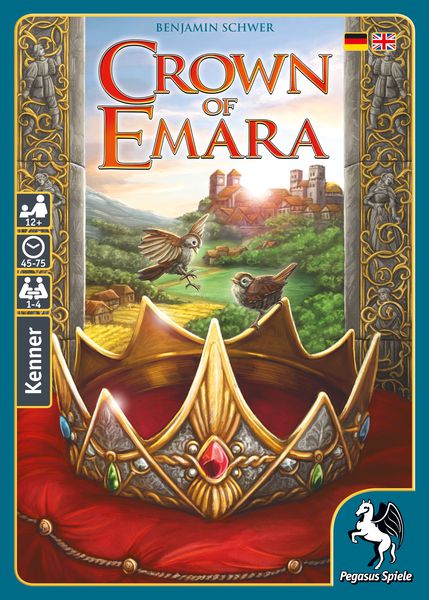
Crown of Emara is one of the new games from Pegasus from SPIEL 2018.  This was a game which I didn’t really learn about until close to the show itself.  In general, Pegasus co-produces many of their games, and I had been looking at the usual EN partners to check out their new releases.  However, this year, Pegasus is choosing to distribute two titles on their own here – Crown of Emara and Adventure Island. Pegasus has a track record of solid games, but some of their games which they have distributed here on their own haven’t gotten the exposure that they deserve (IMHO) – exhibit A would be Chariot Race, a fun Matt Leacock game from 2016.

There appears to be some sort of political crisis of succession in Emara, and unlike most kingdoms which use the easily understood but not necessarily fair system of primogeniture, the Crown of Emara is apparently going to be given to the candidate which is able to persuade the most immigrating citizens to support them.  Now, really – this makes no sense for a system of government. Why would you bring actual skill and/or ability into choosing your leader? But stranger still, why would you leave the decision making to newly immigrating citizens and not the existing people in the country, who you would assume have a much more vested interest in the leader of goings on of Emara?  Well, anyways, put that all behind you, because while it might not make any sense, it’s the basis for the competition that you’re going to be a part of… In the end, you have to satisfy as many citizens as possible; but you also have to provide enough housing for them or else those immigrants won’t be able to stay in Emara to vote for you.

Emara is depicted in two areas; 4 triangular wedges that make up the countryside and 4 wedges that make up the town; one of which is the Castle.  Each game, the wedges are randomized to give a slightly different setup each time. Each town location has 2 Advisors randomly dealt into that wedge.  Each player is given their own player board, colored bits and deck of 9 action cards – these are shuffled and players draw a hand of three cards. Each player will end up with one Councilor in the countryside and one Councilor in Town.  There is a score board with two tracks on it; all players start at zero on the Citizen track, and all players start of a value on the Building track as specified on the first Event card.

The game itself is played over six rounds, and in each of these rounds, players will each take three actions – based on Action cards that they play.  At the start of each round, an Event card is drawn – and the effects of the card are applied to the game. Then, the round moves into the Action phase.  Players look at their hand (starts at 3 cards), and in clockwise order, the active player chooses a card from his hand and then plays it into one of the three actions spots on his player board.  This play will determine both the card action and the movement action for this turn.

The three spots are numbered – and the number of the spot tells you how many movements you get with that action.  You move one of your councilors clockwise to a new Location, and then you do the action associated with the location where movement ended.  The picture of the action on the card tells you what the actual main action is for this turn – this could be gain resources, trade resources into gold or vice versa, move a councilor, use a Town action, etc.  The player can choose which order to take the movement action and the card action in.

Countryside board

The location actions in the countryside are easy – you can a resource that is associated with it, and then for each of your Craftsmen there, you can either take another resource or pay 1 grain to bake 1 Bread.  The city actions are a bit more complicated. In the cathedral, you can donate resources to get a book and a favor token. In the castle, you can make a gift to the king to get a Signet Ring, and you can also sell a book to get 5 Building points.  In the market, you can sell resources for Gold, and you can also sell books to get Citizen points. In the Construction site, there are three different ways that you can convert different resources into Citizen and/or Building points.

City Board

After those two things have happened, then the player can take up to three Bonus Actions.  You can progress up the Nobility scale (by paying Signet Rings and gold) to get a higher rank – and this comes with Citizen points.  You can Hire a Craftsman – this occurs in the Countryside region where your Councilor is, and you pay the cost for any empty hut, place your meeple and take the associated Citizen points.  Finally, you could recruit an Advisor. To do this, you choose an advisor card in the Town region where your Councilor is; pay the costs shown on the card, and then move the card next to your player board.  This will score you Citizen points.

Nobility Cards

At the end of the round, the three player action cards are discarded, and players deal themselves a new hand of three cards from their deck.  At the end of the third round, all 9 cards will be played, so a new deck is created from the discard pile. By the end of the game, you’ll have played each action card exactly twice.

At the end of the game, there is end game scoring.  You get points for each resource you have left (at varying amounts); and you can choose to make them either Citizen points or Building points.  At the end of the game, your final score is the lower of your Citizen or Building scores. Ties go to the player with the higher second scoring marker.

My thoughts on the game

I hadn’t heard much about this one prior to SPIEL, mostly because it wasn’t getting a US release, and I figured I’d take a look at it at the show.  Pegasus was kind enough to send me a copy after the show, and I’m darn glad that they did. This is one of those games that hits my Euro-sweet-spot.   The main reason for this is that I love games with a fixed (and limited) number of actions – in this game, you’ll get 18 turns, two each based around each of your nine action cards.

You’ll have to be as efficient as possible in each game as you only go through your deck twice.  The round system gives you the action cards in blocks of three, and you’ll have to be adept at crafting your plans in accordance to the random dealing of those cards to you.

There are plenty of choices open to the player, and to be honest, for the first game or two, a newbie might be overwhelmed by the choices – how many spaces to move; which councilor to move, which action to take, etc… and that’s not even considering the possible bonus actions afterwards!   In general, you’re going to need resources first to do anything else, so I would suggest that route as an initial exploration. Once you get some resources, then you can move into the more complex city actions…

As with all games that I like in this style; you are being asked to be efficient.  You have a very limited number of actions to get everything done. In addition, there is a bit of time pressure placed on you.  The interaction in the game is mostly indirect; but there are times that you need to beat your opponents to a particular spot in order to get a lower price or to get a specific Advisor that you want.  This might disrupt your plans a bit, but hopefully it’s worth it! You can also choose to spend actions to get a helper in the town or the countryside – this will help you out on later actions; but this will cost you resources in the short term… Will it be a good investment?

The game forces you to balance your actions given the scoring system – your final score is the lesser of your two tracks, so you will be working to increase both your Citizen as well as your Building points.

For me, now that I’m familiar with the game, I do enjoy the puzzle of being able to figure out how to take my actions as best as possible.  And, while there is a bit of thinking that goes on to decide upon my course of action, the game continues to move along quickly. My games have rarely pushed past the hour mark in play-time, and Crown of Emara gives you a great game in that short gaming window.

The game gives you plenty of variability – with the in-game dealing of the action cards as the main change.  Though the modular board as well as a number of official variants in the rules (such as being able to choose from all 9 cards at the start of the game) giving you a number of options. The boards are even double sided to give you a high-contrast side and a low contrast option. We’ve been happy playing with the standard rules, and I can see Emara keeping a place on my shelves in the gaming Basement.

Thoughts from Other Opinionated Gamers

Doug G: Shelley and I enjoyed this new Pegasus title quite a bit. The double rondel can make for some slow play as one attempts to figure out what move needs to happen first, then second, etc., but it worked quite well with 2 players. I’m surprised that someone hasn’t picked this one up for US release. We discussed it on Episode 648 of the Garrett’s Games podcast.

Lorna:  This was my sleeper from Spiel. Hadn’t heard much about it before the fair, didn’t even look at it while I was there. Upon return heard a little buzz so since I was still looking for a bona fide hit from Spiel I picked this up. I’m glad I did. There is not much new in this game, collect resources trade them in, a two pronged scoring mechanism where your winning score is the lower of the two, throw in cards for actions and a couple of rondels and boom! instant Euro.

So the key mechanism in this game involves playing your cards into one of 3 slots each round. The slots allow you to move one of your meeples ’round the rondel and take actions of the quadrant landed on as well as the action of the card played. This leads to some nice decision making. Lots of ways to score and trying to balance the scores is a nice feature. Everything’s I want in a Euro.

Crown is a nice concise gaming experience played over 6 rounds. Lots of interesting decisions to be made.

Patrick Brennan: Why settle for one rondel when you can have two! This had a neat mechanic of placing one of your action cards against one of your three available movement slots for the round, whereby you get the card power and then you get to move one of your dudes around a rondel of your choice by the movement option chosen, thereby earning a second power. This provided thought-provoking mini-decision trees every turn, and created many opportunities to pat yourself on the back after making an excellent series of turns. It’s otherwise a standard “resource gathering, build some production capability, develop a strategy to maximise their conversion into VPs via any number of means” type of game, but the action selection mechanism by itself was enough to make it fresh and win me over, especially as there seemed to be other routes to victory remaining to be explored.

Simon Neale: Similar to the other comments, this game missed my Essen preparation completely and it was by chance that myself and fellow OG’er Simon Weinberg sat down to play a demo of the game at the show. We were both taken with the game and bought a copy each.

The Crown of Emara really does encapsulate the Euro game with the double rondel, careful planning for card play driving the worker placement and optimising your victory point generation. The gameplay is fast and there is plenty to think about. With a certain amount of variable set up, each game does feel different enough to ensure a lot of future plays.

Dan Blum (2 plays): A pretty good middleweight Euro – a bit busy but not too much so, and the action selection is interesting. Some people were annoyed by the standard rules where your nine cards in each half are randomly divided into three hands, and having played twice that way I think I would prefer to play with the official variant where you choose your hands, but using random hands definitely speeds things up with new players.

Tery: This game was also not on my radar, and I have only played it because a member of my game group bought it and was pushing it. I wasn’t expecting much after the rules explanation, but once we started playing I warmed to it quickly.  There are different paths to optimizing your victory points but you have to plan carefully and develop a strategy given the limited number of turns you are going to have. Like Dan, I didn’t love the random hands and in one of my games I feel like it really hindered me, so I look forward to trying the variant where you select your cards; I think that will elevate the game for me.

Ratings from the Opinionated Gamers

  • I love it! Lorna, Doug G., Patrick Brennan, Simon Neale
  • I like it. Dale Y, Dan Blum, Tery, James Nathan
  • Neutral.
  • Not for me…
Posted in Essen 2018, Reviews | 1 Comment

Dale Yu: Review of Passing Through Petra

Passing Through Petra

  • Designer: J. Alex Kevern
  • Publisher: Renegade Gamers
  • Players: 2-4
  • Ages: 12+
  • Time: 60-75 minutes
  • Times played: 3, with review copy provided by Renegade Games

So… Petra has been part of my imagination since about 1989 – that’s when I first saw Indiana Jones and the Last Crusade… Indy, his dad and Sallah are seen on horses in front of the stone façade of the Treasury of Petra.  I remember the complete disbelief at learning that this was a real historic site and not some awesome movie soundstage in Burbank. I went home, pulled out my trusty Funk and Wagnalls encyclopedia (for you young’uns, the encyclopedia is a set of books which is like Wikipedia – except that the subjects are generally actually researched and the words presented on the page are generally considered to be truthful and cannot be edited by anyone who desires) and did in fact discover that Petra is a real city in Jordan.

Continue reading
Posted in Essen 2018, Reviews | 1 Comment

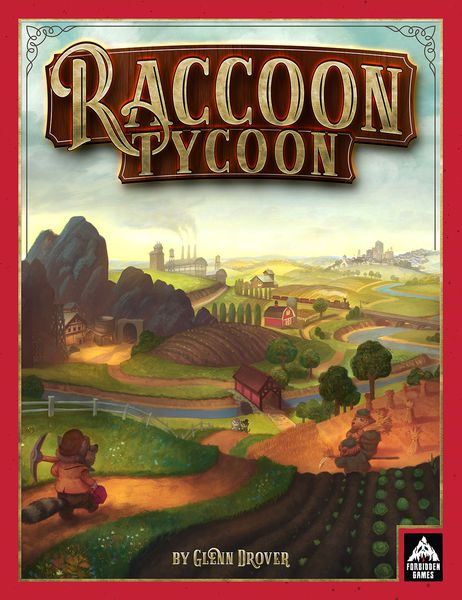
Raccoon Tycoon (Game Review by Brandon Kempf)

  • Designer: Glenn Drover
  • Publisher: Forbidden Games
  • Artist: Jacoby O’Connor & Annie Stegg
  • Players: 2-5
  • Time: 60-90 Minutes
  • Times Played: 3

Have you ever looked at a game, seen the title and had absolutely zero idea what exactly was going on? I mean, Raccoons are fine; they are wonderful creatures, if a bit moody. Adding Tycoon to them doesn’t really make much sense beyond the fact it rhymes, unless you were looking for a game all about trading and maximizing the value of your raccoons, which I am going to go ahead and assume that you weren’t. There aren’t many tycoons dealing in raccoons.

Raccoon Tycoon is an economic game for two to five players. You are a business tycoon in the town of Astoria, and through exploiting production of the goods available to you and the ever fluctuating market, you hope to make as much money as possible in hopes of profiting off the growth in the area. You are going to procure goods and turn those goods into the money that you need to purchase the lucrative railroads and towns that become available for purchase. All while populating your personal town with buildings to best suit your needs.

Continue reading
Posted in Reviews | Tagged , , | Leave a comment

Patrick Brennan: Game Snapshots –2019 (Part 5)


I keep a log of all my game plays in an Access database, and have done since I re-caught the gaming bug in 1999. Being able to *know* things rather than guess them (like how many times have I played that game) has always been of interest to me. One of my favourite books from circa 1980 was The Book Of Lists (for those who remember it!), full of facts, trivia, and opinion lists (eg list the top 10 people you’d have liked to have to dinner, and why). It was always fun to open up anywhere and just read a few lists..

All by way of saying that it’s easy for me to whip up quick lists. Let me throw one at you to give you an idea of what’s happening in my gaming life outside first-plays. For newer readers, it may provide a touchpoint on where our gaming interests align and how much weight to give my various first-play commentaries in each game genre! So, here are the ten games I’ve spent the most minutes playing over the last 6 months:

Continue reading
Posted in Commentary | 4 Comments

Dale Yu: Review of Rebel Nox

Rebel Nox

  • Designers: Helge Meissner, Eilif Svensson, Anna Wermlund, Kristian Amundsen Ostby
  • Publisher: Aporta Games
  • Players: 4-6
  • Ages: 12+
  • Time: 20-30 minutes
  • Times played: 3, with review copy provided by Aporta Games

Rebel Nox is an interesting card game that has a bit of trick taking, a bit of social deduction, a bit of shifting alliances, and a lot of influence point collecting.  It is a standalone game in the universe of Capital Lux, one of Aporta’s earlier releases.

In Rebel Nox, each round is played over six different locations, each with its own set of rules.  These locations are arranged in the shape of a pyramid with three cards at the base level. As five of the six locations are randomly drawn each round; it will always feel different.  There is a deck of cards which goes from 1-17 in 3 colors as well as 3 rebel cards. The deck is sized for the number of players and then each player gets a hand of 9 cards. Anyone who is dealt at least one rebel card declares that they are on the rebel side at the start of the round.  (Note that they do not tell you how many rebel cards they have – only that they have rebel cards).

Continue reading
Posted in Essen 2018, Reviews | Leave a comment

NEWTON

N

Designers:  Nestore Mancone and Simone Luciani

Publisher: Cranio Creations/CMON

Players: 1-4

Ages: 14+

Time:  90 minutes

Played: 4 times with a copy I purchased

Seeing Isaac Newton only makes me think of physics class; this was not a class I enjoyed, but I did have a good teacher who always told us various horrible Isaac Newton jokes. This might explain why I don’t remember much about physics at all, but thankfully no scientific knowledge is needed to play this game.


There are two boards in the game; a map board and a track board. There are various bonus tiles, location tiles, development tiles and other items that go on or near the board.

There are three levels of action cards that are stacked next to the board and the top 3 are flipped over.

Action Cards


Each player is randomly assigned a Study board; the boards are identical save the starting action symbol that is pre-printed on the board.

Player Board

Players also take player pieces and an identical starting hand of action cards in their preferred color as well as 12 books and 2 coins. There are also Master cards that give you a bonus; you can either deal 4 to every player and that’s what they get, or you can deal 4 and players keep 1 and pass the rest to the left, repeating until all players have 4 cards.

The game takes place over 6 rounds; the start player is randomly determined at the start of the game and then passes to the left. Each round starts with the action phase, during which players play card onto their desk to perform the related action.  Every card has a basic action symbol on the bottom and may have a special effect on the top half. You play the card, you take the action and any special effect that may be at the topand play passes to the next player. This will happen 5 times each round.

Before I get to the actions I want to give you a little information that is common to all tracks:

  • If you pass over a bonus token you take it and get the immediate benefit.
  • If you land on a space with a scroll you can play one of the Master cards in your hand; the card will give you a bonus as well as the VPs printed on the card.
  • If you land on a special space by exact count you can take that action or bonus immediately.
  • The last space is an objective; if you meet the requirements for the objective you can move onto that space and claim those victory points at the end of the game.

So what are the actions?

The Work symbol lets you move your marker forward on the Work track by a number of spaces equal or fewer to the number of work symbols you have showing on your board; you get coins equal to the value of the level of action you too (1 coin for 1 symbol, 2 coins for 2 etc.)

The Technology symbol lets you move your marker forward on the Technology track by a number of spaces equal to or fewer than the number of technology spaces showing on your board. The track splits into 3 different paths; since you can never backtrack you will either follow only one path or you will add additional markers $5 each later in the game.

The Travel symbol lets you move around on the map board the number of spaces equal or fewer to the number of travel symbols you have showing, paying the printed costs along the routes. If you land on a city, ancient land, university, master or objective space you place one of your travel cubes from your board on that space; it is important to know what locations you have visited for your bookshelf (more on that in a minute).

The Lessons symbol lets you take one of the available face up action cards into your hand; the level of the card you take must be equal to or lower than the number of lessons symbols available to you.

The Study action lets you take one of your bookshelf tiles and place it on a bookshelf space in a space of your choice; the space must be at most equal to the number of Study symbols you have showing and you must meet the requirements for that space (number of books in a particular color on the special effect spaces of cards you have played and locations visited on the map). When all the book spaces in a row or column have been filled you will earn the preprinted VPs for that column or row at the end of each round. Every 3 books that you place gives you a bonus.

The Joker action lets you copy any other action that you have at least one symbol of already on your board. Once played the joker reverts back to an unassigned status.

Before, during and at the end of the turn you can always spend coins to perform an unlimited number of quick actions at a cost of 1 – 3 coins, depending on the action; these include:

  • Turn 2 additional action cards over from a deck
  • Increase the value of a basic action by one level (you can only do this one once per turn)
  • Buy a potion token; these tokens can be used as wild resources for meeting objective and bookshelf requirements
  • Enroll a new student and put your marker on the start space of the technology track

After all players have taken 5 turns you enter the End of Round phase. You have to take one of the cards you played and put it under your desk so that only the action symbol is showing; that symbol will increase the value of future cards with that symbol being played. You take the rest of your cards back into your hand and score VPs for any completed rows and columns on your player board.  The revealed action cards are put back on the bottom of their respective decks, the start player passes to the right and play continues.

At the end of the 6th round the game ends. Each player receives VPs for the objective spaces that they occupy as well as the value of any Masters they have played. There are no tie breakers.

My Thoughts on the Game

The components of the game are well-made and the graphics are generally easy to read, even though you are looking at 3 separate tracks.


The theme doesn’t matter much here, at least not in my opinion. The Masters cards are all famous scientists, but that’s about it; I don’t get any sort of science feel to this. It does not affect my enjoyment of the game, however.  

Player interaction is fairly minimal; another player could take the action card or bonus tile you wanted, but other than that it’s fairly solitaire.

There are many special tiles included but only a few are used each game, which keeps some of the victory point and special action options different each game.

The action mechanism is pretty cool; there is definite tension in what cards to play and what cards to tuck – you don’t want to tuck a card with a good special effect, but you can only tuck a card you actually played, so you are always thinking about that when you choose your actions.

The game definitely has the tension of too many things to do with not enough time to do them in, so you have to choose a path and stick with it without getting distracted by other shiny options; it’s just not possible to pursue everything.

The first two times I played this game I was completely enamored with the game. I thought all of the things I mentioned above would keep the game interesting for a long time. However, the more I have played it the more it seems that the only path to victory is to fill in your bookshelves  quickly ; trying to score points by hitting the special tiles on one or more of the tracks is more work and doesn’t generate as many points. The Master cards can help make the tracks easier, but the points you get just don’t seem to be enough. I still like the game, but this makes me wonder whether I am getting close to wearing this one out. EDIT: After writing this and opening it up to comments I played it again. The other player pretty much ignored the bookshelf strategy and went full bore on work and technology and while the scores were close, that player won. So, I am changing my thoughts on that – it does seem there is more than one path to victory,

Thoughts of Other Opinionated Gamers

Joe Huber (1 play): Newton was not a game I strongly anticipated – while I believe the subject could make for an excellent game, what I heard about the game suggested that this was unlikely to have occurred in this instance, at least for me.  At the same time, the game was highly anticipated, so I did want to give it a try, in case there was something that I missed. However, for me the mechanisms just don’t mesh with the subject, and that’s rarely something that works for me – and this wasn’t an exception.

Nathan Beeler: Granted, I have only played once, and when I did I was in that beyond-tired brain space that always seems to hit at some point in a long game convention, no matter how much sleep I get. I did enjoy my one play enough to want to try again, but not so much that I’ve actually sought it out in the months since. Tery’s experience with a dominant strategy smacked me in the face during the game. I tried to zig and more or less ignore the bookshelf in favor of technology. (I think — it was a while ago. But I’m a sucker for tech tracks, so it probably was where I focused.) I was out of contention before the halfway point. Still, even with my addled brain I could tell there was something to Newton: a real game. There was even a hint that it could be a real fun game with interesting decisions, planning you could do turns out, and hidden depths to explore over multiple plays. In other words, I left with the possibility that it might be a great game, that too rare gem in my recent convention experiences. Still, Newton is quite long. And none of my groups have much clamoured for it when I’m around. My guess is the market will ultimately dictate if it really has legs, if it really is all that, and if I will ever be in a situation where I get try it again. For now it goes in my “not a disappointment, would play again” mental pile, which is still no small feat.

Patrick Brennan: Apparently we’re playing one of Newton’s splinter psyches each. Rich in theme is this one. Ok, park that. The action card implementation is nice in what’s otherwise a generic Euro. Apart from taking action cards (and different people will want different things from there anyway), and claiming first-there bonus chits on some tracks, the game is multi-player solitaire. I played out my round 6 while others were finishing round 5, as nothing I was doing was going to impact anyone else. I found myself engaged though, liking the puzzley challenge of optimising the points out of my action specialisation decisions, and I’d like to try other approaches. But I have a feeling that ultimately if you don’t invest heavily in books (and I formed this view prior to reading the above) you may be off the pace, and this one-dimensional suspicion may ultimately limit its replay. If others wanted to play I’d happily explore it to find out further, but I’m not otherwise jumping to over-invest in what’s otherwise a (let’s unpark it now) themeless Euro that doesn’t have an apple moment.

Dan Blum (2 plays): I keep hearing that books are the dominant strategy, but while I have seen books win (and have won with them myself) I have seen other strategies come very close and even win. (I’ve seen the ends of games I was not in so my sample set is more than two games.) So I am not entirely convinced.

Aside from possible dominant strategy issues I think the game is fine but not one that particularly stands out from the pack. The action card mechanism is good, everything else is average and somewhat fiddly. I’d be willing to play again but it’s not one I’d likely suggest.

Ted C (1 Play):  I ditto Patrick B’s comments.  I like the card action idea. The game was very busy.  I was given the cog board and as a newbie, assumed I should work more heavily on that board.  In the end, I only had two columns of books built for 5 victory points. My points came from reaching the end game scoring tiles.  I finished second at 95 points. The winner had 100.

Larry (3 plays):  One of my favorites from Essen; in fact, you might say it’s the apple of my eye (sorry for reusing your joke, Patrick).  Yes, the theme is thin and there’s practically no player interaction. But the different layout with each game (including the random way the new action cards come out) gives you a wonderful puzzle to solve as you try to figure out how to best play your cards to maximize your score.  I find it to be a very enjoyable process, quite challenging, without being overwhelming. Books are indeed strong, since they can provide the majority of your in-game scoring, but the requirements for placing each one are reasonably stiff, so you have to accomplish a good deal of other stuff in the game to do well with them.  Despite what many of the others are reporting, I have seen people win who didn’t focus on books, so I feel that the game is well balanced. I particularly like the way that your capabilities slowly ramp up, until by game’s end, you’re achieving a lot each turn, with cascading effects helping you along the way. It’s another terrific title from one of my favorite designers of the decade, Simone Luciani.

I Love it!:  Larry

I Like It.:  Tery, Nathan Beeler, Patrick Brennan, Lorna

Neutral:  Dan Blum, Ted C

Not For Me:  Joe H.

Posted in Reviews | 2 Comments