Amazon Prime Day 2025 – Post #1 – lots of games 50% off or more!

Again, apologies to anyone who isn’t interested in shopping for new games right now – but there are a LOT of great deals on games today on Amazon Prime Day.

Below is a list of some of the ones that caught my eye.  As a reminder, all of the links here are affiliate links and the Opinionated Gamers may generate a small commission from said links.

For this first list – here are some games that are at least 50% MSRP.  If we have reviewed the game, a link to that review is also included.


Galactic Renaissance (65% off) – 29.99  – https://amzn.to/4nK9KxB 

Rallyman Dirt (68% off) – $14.99 – https://amzn.to/3GE1nme

Continue reading

Posted in Shopping | Leave a comment

Dale Yu: Review of Money

Money

  • Designer: Reiner Knizia
  • Publisher: Allplay
  • Players: 2-5
  • Age: 11+
  • Time: 15 minutes
  • Played with review copy provided by publisher

Your goal in Money! is to trade currencies with the bank and other players so that you end up with more value than anyone else.

Continue reading

Posted in Reviews | Leave a comment

[Prime Day] Pre-Prime Day Deals – Carc and TTR at low prices!

As we have done in years past, we’ll try to bring you the best boardgaming deals we can find on Amazon Prime Day (starts Tuesday July 8). As with all of our affiliate links, we may make a small commission from you buying a game from a session that starts with clicking one of our links. 

Even if you’re not looking for one of these games, we’d appreciate a click on our links!


Though the huge sale doesn’t start until tomorrow, there are already two deals that look pretty great for building a game collection.


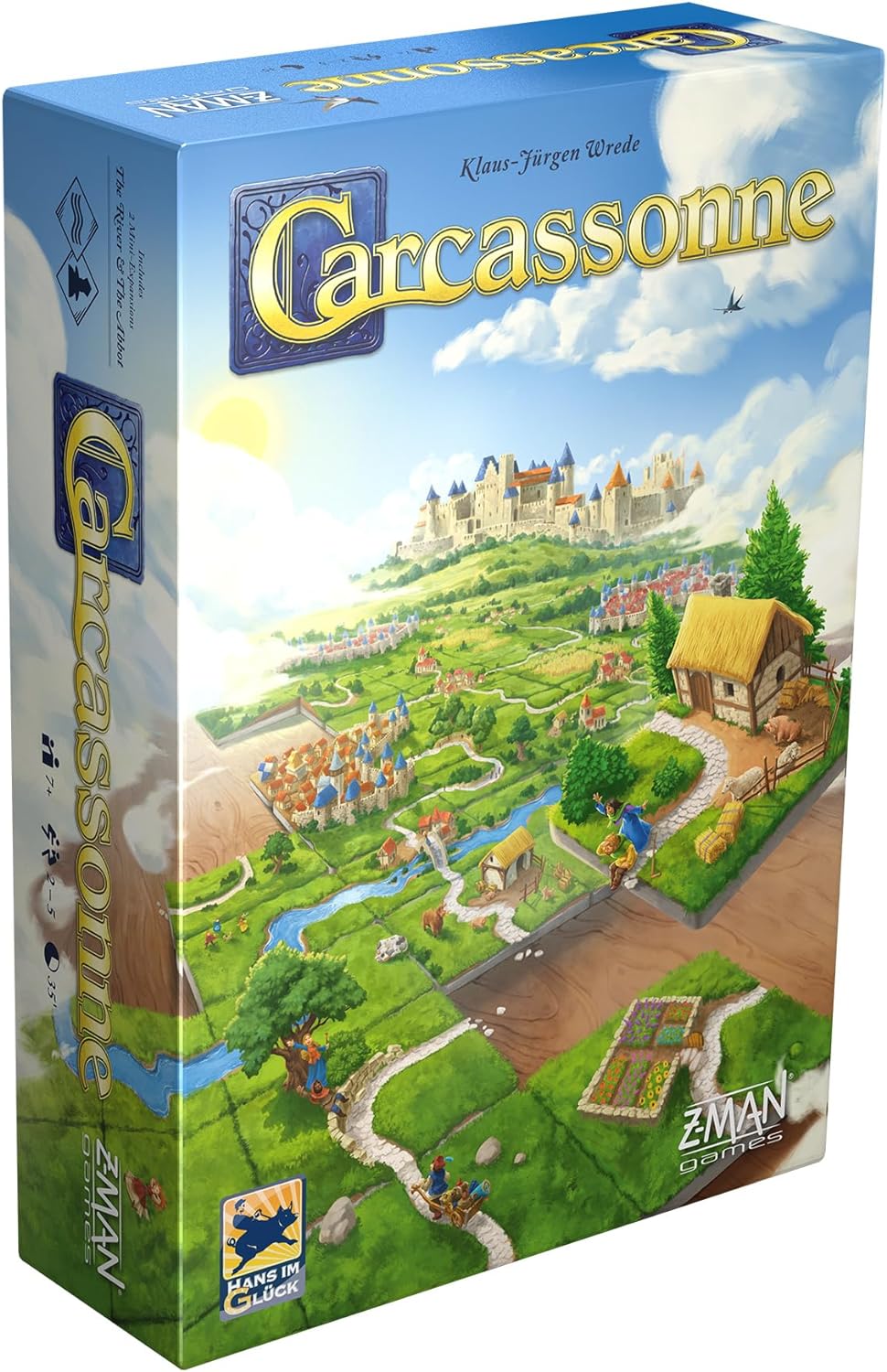
Carcassone – $20.15

https://amzn.to/3IfdTsU

Continue reading

Posted in Shopping | Leave a comment

Alison Brennan: Game Snapshots – 2025 (Part 17)

If we judge a Gathering by numbers, I set new personal bests by playing 89 new-to-me games with 143 different gamers. That was pretty cool. I did 53 new-to-me games in 2004 and thought that was good at the time but I’ve clearly levelled up since then.

High numbers usually indicate a paucity of meaty games though and while I did get some in (Endeavor: Deep Sea, Beer Pioneer, Marrakesh, Dead Reckoning, all of which I enjoyed, plus Tea Witches, which was one of the worst game experiences of my life), I would have liked to play some more (I had a list!) but found it tricky to organise/arrange without a ready-made crew on tap. So I’d wander the floor and fall into things as they were starting, hence the high player count (which I wasn’t pushing for, it just happened organically).

  Continue reading

Posted in Reviews | Leave a comment

Josiah’s Monthly Board Game Round-Up – June 2025

N/A

June 2025

Games I played for the first time this month, from worst to best, along with my ratings and comments.
­

Quarto – 6/10­

Quarto is a two-player abstract from the early 90’s. It boasts a playing time of barely ten minutes and has attractive wooden pieces that give it the look of a coffee-table game.

The board is a 4×4 grid which starts empty, but will eventually be filled with the sixteen available pieces. Each piece is unique and the pieces are shared by the players. The goal of the game is to get four pieces in a row that share an attribute (height, color, shape, and having-a-hole-in-the-top-or-not-ness).

The big twist comes from the fact that you don’t choose what piece to place, your opponent does. This means that in deciding where to place the piece you were given, you also need to consider what piece you will be giving next. For example, if the board already has three squares in a row, and you are handed a circle, placing it to create three circles in a row is a losing move, since you will then have to hand your opponent either a circle or a square, giving them the win. That is, of course, unless you also block the three squares in a row with your circle.

Speaking of blocking, how much of it you do is crucial to how the game unfolds. Players who insist on blocking everything at the first opportunity will create much simpler game, whereas players who take a more open approach will increase the amount of brainpower required to play well. Nevertheless, this is a solved game, a fact that I was suspicious of after only a couple plays. Indeed, as players improve, draws become more and more likely.

Quarto, especially the mini version, is a nice portable diversion to bring along to a restaurant or swimming pool. There is enough to explore to commend it for those uses, but it won’t hold up to serious regular play with intelligent adult opponents. Think of it as a more stately Connect Four.­
­

Deep Regrets – 6/10­

It’s hard not to be immediately captivated by the production and visual design of Deep Regrets. It has chunky, wooden dice shaped like buoys. It has evocative and slightly bizarre illustrations that are expertly executed by the very person who designed the game itself, Judson Cowan. And it has a theme that is simultaneously amusing and frightening. It’s just fishing, what’s so scary about that? Well, the deeper you fish, the weirder things get, until you’re landing unspeakable eldritch horrors along with your regular old fish.

The depth at which you decide to fish has a push-your-luck aspect to it, but there are broader strategic considerations as well. The weirder fish score more points, but also give you “madness”, so you’ll need to manage how much madness you are willing to gain. The player with the most madness at the end of the game has to give up their best mounted fish trophy before scoring.

This is a significantly smaller penalty than you might find in games with similar mechanics, such as High Society or Cleopatra and the Society of Architects, which cause the most corrupt player to be eliminated. And this, in fact, seems to be one of the weaknesses of Deep Regrets. The point values were such that it seems always correct to fish for bigger, deeper fish whenever possible, regardless of the consequences. You might even reach a point where you are so deep in the hole of madness that you simply ignore it, accepting that you will lose your best trophy, but easily making up for it by having better fish. A player being able to simply disregard one of the primary strategic tensions in the game is a design weakness, even if it doesn’t happen in every game.

My single play of Deep Regrets was two-player, and I acknowledge that this player count might make madness less significant. But the game takes about 30 minutes per player, and 2 to 2.5 hours is just too long for a game of this weight. And those time estimates assume experienced players; it’s much longer with a rules explanation and newbie thinking time. So is this only good at three players? I plan to try it that way next time. But even if that slightly improves my impression, that’s a very narrow player count.­
­

Castle Combo – 7/10

­In Castle Combo, players will each build their own 3×3 grid of nine cards they’ve drafted. Naturally, this process doesn’t take very long and games of Castle Combo last only about 20 minutes.

The draft of the cards themselves is quite interesting. There are two rows of face-up cards to choose from, but only one is available to you. If you wish to draft from the other row, you’ll need to first pay a key token to make that the active row. From then on, cards must be drafted from that row until someone pays to change it again. Perhaps you will even draft a card that gives you a key token, allowing you more flexibility on future turns. But then again, some cards give you points for leftover keys at the end of the game. Decisions, decisions.

Most cards will provide both an immediate bonus when played as well as a point bonus at the end of the game. These two bonuses are clearly delineated on each card. All the things you would expect are here: bonuses for a particular type of card in the same row or column, for collecting lots of a particular card type, for collecting none of a particular card type, etc. There’s probably nothing here you haven’t seen before and yet the simple decisions provide surprising depth for a game so light.

Castle Combo has a forgettable name, childish artwork, and contains no particular innovations of note. It joins at least half a dozen other games that have players draft cards or tiles and place them into a personal 3×3 grid, with bonuses given based on arrangement. Yet for all mundanity, this is a tightly-designed and well-paced experience. Always happy to play this one, and in fact I’d like to again soon. It has the potential to have even more depth than my single play revealed.­
­

Shipwrights of the North Sea: Redux – 8/10­

A mid-weight euro with card drafting and engine building is pretty much right in my wheelhouse, so it’s probably no surprise that I enjoyed trying Shipwrights of the North Sea. I played the “Redux” version, which reimplements the original, but having never played the original, I can’t really speak to any differences. 

The goal of the game is to score the most points, a task primarily accomplished by building viking ships. Each ship will require various resources and craftspeople to complete, so the card drafting often presents difficult choices about whether to take a high-value ship card or to prioritize the actual resources needed to build it. Fans of games like 7 Wonders or It’s a Wonderful World will likely find this dynamic comfortingly familiar. Though it should be said, Shipwrights is a bit heavier with a bit more rules overhead than either of those two games. 

From a interactivity perspective, there isn’t much the other players can do to mess up your plans. Players will compete to be the farthest along on three achievement tracks, and of course drafting has inherent interactivity, but if you’re looking for cutthroat competition, you’ll have to look elsewhere. 

Shipwrights of the North Sea: Redux was released in 2024 along with Ezra & Nehemiah from designer Shem Phillips. And to my mind, they are his two best games. This is a prolific designer who nevertheless seems to be only just hitting his stride. No doubt more exciting things are still to come!­
N/A

A highly recommended game that I have most certainly played prior to this month, probably many times.

­

Magic: The Gathering – 10/10

­Though Dungeons & Dragons is a close contender, it is likely that there was never anything more revolutionary in the history of tabletop gaming than Magic: The Gathering. Using collectible trading cards as game components was the spark of innovation, but there were many other mechanical elements to the gameplay itself that have ensured its longevity. The color pie, tapping, the mana system, the stack, top-down card designs; if you don’t know what any of those things mean, I’d be happy to talk your ear off about each of them and explain how influential each has been.

It’s often easy for people to conflate high-randomness with low-strategy. After all, games like Bingo are surely both. And at the opposite end of the spectrum, games like Chess are low-randomness and high-strategy. Yet we can’t forget about the Pokers of the world, with obvious high-randomness while also being high-strategy enough for the most brilliant players to become multi-millionaires on the backs of their prowess. Magic also inhabits that quadrant, with tales of devastatingly bad luck sitting proudly alongside unstoppable multi-year champions. Hand management and resource management are paramount here. It is much more tense and unforgiving than many other card games. Yet it also embraces its random elements with gusto.

But of course, both at its advent as well as today, Magic had its detractors, and not without cause. Even to play casually with a group of friends can get expensive, to say nothing of trying to compete in high-level tournaments (or, heaven forbid, to be a pure collector). And certainly there is no shortage of games that tried to “fix” any number of perceived issues with Magic. Yet the fact that they essentially had to bill themselves as “Magic, but…” instead of truly innovating on the genre is itself a testament to the solid foundation of Magic’s rules.

And from the revenue generated by that initial phenomenon, an empire arose. Every illustrator working today wants a Magic contract, and consequently, the art is unparalleled. Magic is also without a doubt the most well-designed and most-playtested game in modern times. It’s a testament to what devoted gamers can do with a limitless budget and full team of creative people.

Over time, I have come to appreciate more and more how much this is not just a game, but a system. Don’t like deckbuilding? Play pre-constructed decks. Don’t like people copying the best decks? Play booster draft. Don’t like spending money to draft? Build a cube. Don’t like 1-on-1 duels? Play Commander or Archenemy. Don’t like being so serious? Play Un-sets. A relatively simple rule set creates so many different ways to play. So much focus is put into making this game be something for everyone, that it can hardly help but succeed. There is something here for you, and you do yourself a disservice by not playing.
Posted in Reviews | Leave a comment

Dale Yu: Review of Purrfect Place

Purrfect Place

  • Designer: River Kang
  • Publisher: Korea Boardgames
  • Players: 2-4
  • Age: 8+
  • Time: 20 minutes
  • Played with review copy provided by publisher

Swap, flip, and stack the cats! Move cat cards from the sofa to the shelf, or the shelf to the playtime area. Make two rows match with each other and score minus(-) points. The player with the lowest score wins a bottle. Collect two bottles to triumph in this adorable and strategic cat game!

  • Packed with irresistibly cute (and totally relatable) cat illustrations.
  • Easy-to-learn gameplay with a clever stacking twist for added depth.
  • Stacking: Score double minus(-) points and an extra turn, but only at the risk of a big penalty!

Continue reading

Posted in Reviews | Leave a comment