
Neotopia
- Designer: André Santos & Orlando Sá.
- Publisher: MEBO Games / Arcane Wonders
- Players: 2-4
- Age: 8+
- Time: 60 minutes
- Played with review copy provided by Arcane Wonders
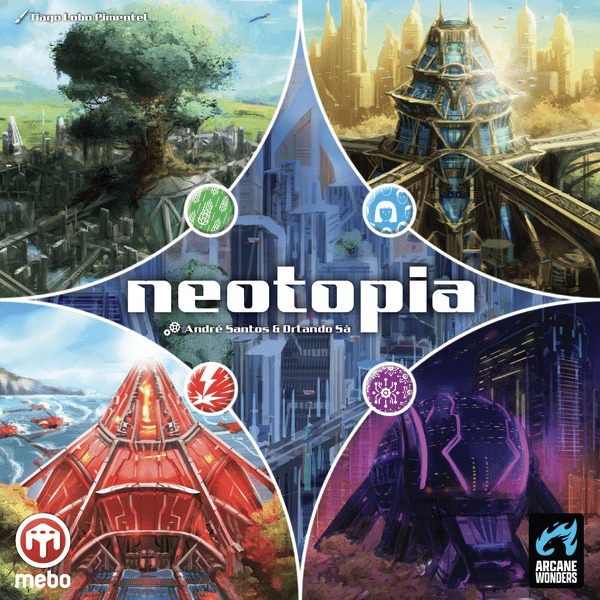
Says the publisher: In Neotopia, a competitive fast paced tile placement pattern building game, you are part of a team of Visionaries who are building a futuristic pilot city focused on the fields of Energy, Technology, Community and Sustainable food. You will be building elements on the three regions of the city in order to complete feature cards that you have in hand. A good combination of tile placement and card management can result in very impactful turns, where several cards are completed and the city expands. Interaction between players is important, because all players are building on the same board and can take advantage of what other players have built on their previous turns. You will try to build the most harmonious city possible, because that will be vital for your score: in the end of the game you will score normally the regions where you have your two highest scores but you will triple the score of your lowest scoring region. So be aware! Even if it’s tempting to build on regions that are more developed and where you have already scored a lot points, if you don’t start working on the development of the other regions you will not be able to win the game. Balance is the key point on Neotopia, just like the type of future that the players are trying to build.
The board in Neotopia is of a round city, split into three wedge shaped districts with a Factory found on each border between two districts, each starts with one Element token of each type. 4 Bonus tokens are seeded onto spots in each district and a stack is left near each score track. Each player chooses their color, puts one scoring marker in each district’s track, and gets 3 Project cards as their starting hand. There is a 4 card market of Project cards in a market. Finally, the start player places an Element token of their color in the center of an empty region. Going around the table, each player does the same, placing in the empty center space of a region or adjacent to a previously played piece. The production tiles are placed in a stack in the center of the board, and one element token is placed to match what is seen on the top tile.

On a turn, the active player must take three actions, and you only have two different options:
- Add a Project card to your hand – either from the face up market OR the top of the facedown deck
- Move an Element from a Factory and play it into an adjacent region – the Element must be played in the empty center space if unoccupied, otherwise it must be placed adjacent to at least one previously played Element in that region

There are some other things which may happen in the course of your turn.
- A factory is empty – immediately move the four Elements from the top Production tile into the empty market. Reveal the next production tile and place the matching element tokens on that tile.
- Build a Project card – if you have placed an Element into a region which completes a pattern on a Project card you hold, you can build that card, placing it in the discard pile of that region and marking the corresponding score on the track for that region. Note the artwork of the Project card, you cannot build a card whose art matches the top card in the discard pile for that region. You can only complete one card with any particular Element placement.
- Gain a bonus – you can gain a bonus tile if you cover up one of the four tokens placed in setup in each region. Additionally, as you pass certain spots on the scoring track, you can gain the top bonus tile from the stack near that region. There are 4 varieties, each with its own action. If you do not use the Bonus token, it will score points at the end of the game.

When you have taken all three of your actions, refill the empty spaces in the market of Project Cards and the next player goes. Continue this pattern until the final Production tile is discarded. This triggers the game end. Play continues through the end of that round, and then all players get one more turn. In this final stage, if a Factory is empty, you simply place one of each type of Element into that Factory.
When the final turn is done, all players look at each region and find the largest cluster of their color token, adding one point per token in that cluster to their score in that region. To calculate the final score, you multiply your lowest scoring region by 3 and then add that to the other two region scores. Finally, add 3 points for each bonus token not used at the end of the game. The player with the most points, ties broken in favor of the player with the highest scoring “worst” region.

My thoughts on the game
Neotopia is an interesting puzzle of pattern building and tactical play. The scoring system, though, forces you to consider not taking the “best” scoring chance each round, as the 3X multiplier on your worst area really pushes you to balance your score in the three areas.
Turns move pretty fast here, you only get three actions, and more often than not, you’ll have a plan in place to get a particular card or play particular colors in order to score a card. However, on the turns that you don’t have a set move in mind, you may have to sit and ponder a bit as you try to puzzle out your best move.

For me, this is often simply drawing cards. First, there is no hand limit, so it is nice to have a lot of scoring options in your hand. Second, I don’t like to open up the possibility of a Factory refill to my opponents. That being said, there are many reasons to play Elements on your turn even if you’re not going to score. You could be trying to set up one of your higher scoring Projects; these often need 5 Elements, so you sometimes need to do some advance work to set them up. Second, you could be trying to negate your opponent’s chances of scoring the same. Many of the Project cards are chosen from the faceup market, and if you can remember certain cards being chosen, you can try to play to prevent those arrangements from being possible. (I suppose if you were able to remember things like this, you could also try to play a Project card with the same background card as the one you were trying to negate – but this is impossible for me). Third, don’t discount the endgame bonus of 1VP per connected area in your color. When in doubt, just plunk your color Element into your blob in a region.
Finally, if you’re close to a Bonus tile – it could very well be worth it to ignore all the above advice and simply place Elements to get to a Bonus tile space. The extra actions/abilities of the tiles can be very strong when used at the right moments. I have especially found the Bonus to use the extra spaces outside of a Region as a great scoring tool – the only way to defend against using those spaces is for someone else to use their own Bonus tile to play in those spaces; and that would only happen if they were scoring themselves. If nothing else, the 3VP payout for an unused Bonus tile at the end of the game is pretty juicy on its own.
I would say, early in the game, you probably don’t need to worry too much about balance, but keep an eye on the Factory tile stack – once it hits the halfway point, it’s probably time to start even-ing things out. Remember that it doesn’t all have to be about projects; I’ve seen games where a player made almost no Projects in an area, but then took a 12 or 13 point bonus for a huge connected area at the end. Our group has toyed with the idea of using a colored cube to put near the scoretracks to represent the current “largest blob” score – so that players don’t have to continually calculate their scores each turn as the endgame nears. If anything, this is the one thing that seems to slow things down in Neotopia – as the balance of scoring is critical; players tend to calculate and recalculate their scores constantly as they determine what their best play is.

The artwork is pleasing to the eye with that pervasive futuristic look/theme; and the board turns out to be a colorful jumble of Elements. The cards also have great illustrations. The scoring chips are cut out to look like computer chips; which is fine – though my type-A brain didn’t like the fact that the chits didn’t match up to the outlines of the shapes on the scoring track – only the reverse +20 side does! As the chits spend most of the game on the other side, I would have preferred the printing to be reversed on these chits. But, a minor thing – otherwise, everything about the game looks great.

Our games have not taken as long as the box would suggest; we’re running closer to 30-40 minutes; which is a great length for this game. People new to the game are often surprised at how fast the end comes – we have certainly seen occasions where players start rushing to place Elements to lock in contiguous Element bonuses or finish Project cards as the Factory tile stack nears the end.
Neotopia has been a well received super-filler around here as it has a lot of characteristics that appeal to me. I like the puzzle of trying to score my Project cards, and I like the challenge of balancing out the scoring in the three regions.
Ratings from the Opinionated Gamers
- I love it!
- I like it. Dale Y
- Neutral.
- Not for me…


