
Shadow House: The Code
- Designer: Eros Lin
- Publisher: EmperorS4
- Players: 3-5
- Age: 8+
- Time: 15 minutes
- Played with review copy provided by publisher
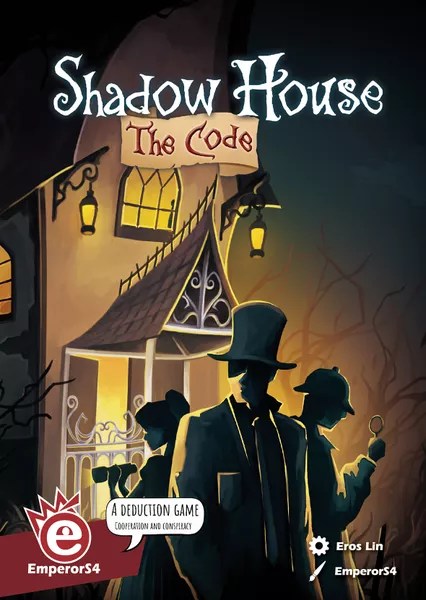
After a series of extraordinary events, Viscount Shadow met an untimely demise. With no designated successor, the family recalled the existence of the Viscount’s will, securely stored in a safe. The challenge, however, lies in the fact that nobody possesses the complete password to access the safe. The Viscount, known for his love of solving mysteries, had scattered clues throughout the mansion.
In Shadow House: The Code, players assume the roles of detectives, invited to the Shadow Viscount’s mansion to uncover clues that will unlock the safe. Throughout the game, you have already discovered some clues to make educated guesses about the password.
There are two modes in the game. In Faction Mode, the detectives take turns revealing clues and placing hints between their clues until someone deduces the correct combination in the Safe. Additionally, each detective belongs to a faction, and their competitors are also in the house. Although they need to hack the Safe, they have another objective: uncovering clues held by rival detectives to ruin their reputations. In Conspiracy Mode, the detectives work together to crack the Safe for reputations; however, the daredevil won’t earn any reputations, so be careful of the hints you provide.
To set up the game, the group must first choose if they want to play in Faction Mode or Conspiracy Mode. I will first explain the rules to Faction mode and then the alterations needed for Conspiracy Mode. The double sided player aid should be placed in the center of the table with the appropriate Mode side up.

Each player is dealt a random Faction card, and the safe is set up – two of the number cards (0-9, 2 of each) are randomly put unseen into the Safe. The rest of the clue cards are fully dealt out – going in Counterclockwise order, starting with the player last in turn order. All players now pick up their cards, arrange them in numerical order with the lowest value on their left and the highest value on their right. Their faction card has a value of 5 and is placed in the line of cards in the appropriate position – it is flipped face up so that every player can see the Character on it. Each player also gets a set of hint tokens – all of one color.
Turns happen in clockwise order, starting from the start player. There are two options to choose from – Have a Drink, Dig, Unlock
Have a Drink – Everyone draws one random Hint token from their own supply while the active player draws two. These Hint tokens are now placed face up next to cards so that the card to the left of the hint is equal or less than the hint token and the card to the right is equal or higher than the hint token. If a player is out of Hint tokens, they simply reveal (flip over) one of their cards. (If a player reveals their last card, they are eliminated).

Dig – The active player can point at another player’s card and announce the value that they think it is. If they are correct, the target player must reveal that card. The active player must then make a guess at another card. This continues until they are wrong. When they are wrong, their turn ends and the active player must reveal one of their own cards.
Unlock – announce the value of the two cards they think are in the safe, If this is the first Unlock attempt in the game, they pick up the safe and then check to see if they win. If they are right, the game ends. (Scoring in a bit). If they are wrong, they do not win, but they now become the Safekeeper. They now determine whether future Unlock attempts are correct or not, and they gain a Hint token from the failing player each time a wrong answer is given.
If, during a Dig, a player has his final card revealed, they are on the way to being eliminated – though they get a Last Chance. This is essentially a chance to take an Unlock action immediately. If they are correct, they win. If not, they are eliminated.
The round ends when one of three things happens:
- A player successfully unlocks the safe (2 points to that player)
- The Safe Keeper collects three Hint tokens for wrong guesses (2 points to the Safekeeper)
- Only one faction remains in the game – 2 points split between the uneliminated players of the remaining faction
If someone has 3 or more points, the player(s) with the most points wins. If not, setup the game again and continue.
The Conspiracy mode is a little different. Here, players try to gain information only by asking questions. There are only two possible actions on a turn: Ask a Question and Unlock

Ask a Question – the player draws two of their Hint Tokens and then gives them to any player – “How many of these values are in your row of cards”? The answer must be true, and then the hint tokens are placed in their card row following the usual procedure.
Unlock -as above, announce two numbers and see if you are right. If you are right, the round ends. If you are wrong, you are eliminated from the round. If you are the last player standing and you are wrong, the round ends.
Scoring – If the safe is opened, the person who opens the safe scores 2 points and everyone else still in the round scores 1 point. (Eliminated people are… well eliminated, and score nothing). If the round ends because everyone is eliminated, well, no one scores points. If someone has 3 or more points, the player(s) with the most points wins. If not, setup the game again and continue.
My thoughts on the game
Shadow House: The Code is a nice little deduction game – heck I might even consider it two different deduction games that come together in a convenient small package. I think that most groups will find one version that they prefer – and for me, it’s the Faction version as I feel like the strategy is a bit more complex.
When you deal out the Faction cards, you always make sure that there are cards from all 3 factions in play. In a 3p game, well this means one of each color. But in a 4 and 5p game, you’ll end up with an imbalance in numbers with one or two players on a faction by themselves. This initial random deal of factions will maybe make you look at the game a bit differently.
If you’re in a faction of two players, do you try to work together to eliminate the other two? The teammates could always ask questions of their non-faction opponents to try to eliminate them. If so, the team would split the two points. If you’re in a faction by yourself, you could still try to eliminate everyone else – or maybe take a more direct path to try to solve the code on your own?
The tricky part about eliminating other players is that they do get a last gasp to try to Unlock the safe with their Last Chance – thus giving them an out-of-turn opportunity to win the game. If they are the first to be eliminated, they also then become the Safekeeper which is another backdoor chance to win (more so in a 5p game than at lower player counts). Speaking of player count, I have played at 3p and 5p, and I much prefer the game with the full player complement.
I have only tried the Conspiracy version once, and it wasn’t as interesting to me. The logic puzzle is a bit different as you have to work things out based on the answers to the question as well as the location of the hint tokens – but of course YMMV.
Regardless of mode chosen, each individual round doesn’t take very long, and the whole game often doesn’t last long as the winner is the first to 3 points, and it is not uncommon for someone to score 2 points in a round. For fans of quick deduction games, this one is certainly worth a try!
Until your next appointment
The Gaming Doctor


