
Fall
- Designer: Giampaolo Razzino
- Publisher: Little Rocket Games
- Players: 2
- Age: 10+
- Time: 20-30 minutes
- Played with review copy provided by publisher
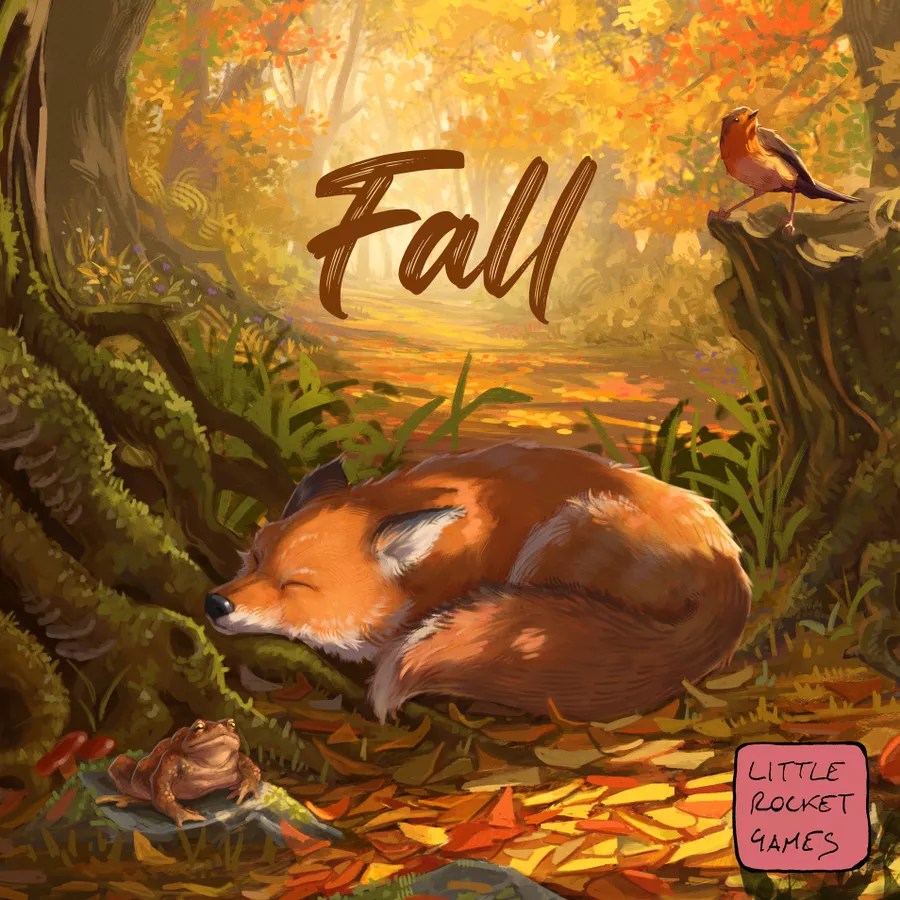
Autumn has arrived, and the fall flowers color the forest. The robin announces the imminent cold and the hoopoe, almost ready for the great nocturnal migration, feeds itself with the last available food. The fox grows its winter coat and toads swarm the most humid areas of the grove, thriving with mushrooms and deciduous leaves.
In Fall you create, together with your opponent, an autumn ecosystem. You both place leaves tiles in the same environment to grow the forest and host its flora, fauna, and funga. However, each player scores points for different objectives, and only at the end of the game the opponent’s scoring conditions will be revealed, thanks to the Fox, Bird, and Flower scoring cards, which are different for each player in each game. During the game, try to understand your opponent’s strategy, to counteract it and make it turn in your favor. The game uses a single tableau for both players, with variable scoring opportunities for each player.

Place the season board on the table, the players agreeing on which side to play. The week marker is placed on space 1, this helps you track which round it is – it also tells you what sort of Token cannot be placed in this round. The Players each get one random scoring card of each type (Birds, Foxes, Flowers) as well as 8 mushroom tokens in their color. The leaf tiles are mixed facedown in a draw pile, and the Fauna/Funga tokens are placed in the bag. Four Leaf tiles are exposed face up and a token is drawn from the bag and placed underneath each – forming 4 sets of a tile/token. The start tile is placed in the center of the table.

The game is played over 12 rounds. In each round, the starting player will alternate, and play will go in an A-BB-A pattern. The first player will take a turn where he chooses a set, placed the tile chosen immediately, and choosing to either place or keep the token. The second player now takes a larger turn where two sets are chosen; those two tiles are placed and then the tokens chosen are again kept or placed. Finally, the first player takes another turn choosing a single set of tile/token. At the end of the round, a new display of 4 tiles is drawn with a new token being drawn underneath each. The start player then alternates for the next round.
When placing a tile, you must play adjacent to or on top of a tile already in the ecosystem. When you place a tile, it must be adjacent on a side to a tile side with the matching color OR when playing on top of a tile, the bottom tile must have at least one segment which has a same olor as the tile being placed on top. As you place tiles, you might also make flowers at the corners – these are important for scoring.

Note that you can only make a stack of at least 3 tiles in height, and you can never place a tile nor a token on top of the Starting tile. If there is a Fox/Bird token on a tile when you place a new one on top, discard the token. You cannot place a new tile on top of a Mushroom or Toad token.
There are 5 different types of tokens. You can place Fox, Bird and Mushroom tokens if the tile played has a matching symbol on it. If you place a Mushroom, place one of your player markers on that tile as well to mark ownership. A mushroom can never be removed, and it will score points for its owner at the end of the game. Toads must be placed the turn that you take them, and they go on any empty non-Starting tile. Toads cannot be removed and tiles cannot be placed on top of them. Any tile can only have one token at most on it.

After 12 rounds, each player reveals their scoring cards and scores are calculated:
- Points from Flower Goal Card
- Points from Fox Goal Card
- Points from Bird Goal Card
- Points for mushrooms: 1VP if on 1st level, 3VP if on 2nd level, 6VP if on 3rd level

The player with the most points wins; ties broken in favor of the player who scored most from mushrooms.
My thoughts on the game
Fall is certainly a beautiful game – the artwork and components are really well done, and I feel like it is trying to capitalize on a number of similarly themed / visually appealing games of recent release. This one is a two-player only game, another characteristic that seems to be trending in 2024.
Each player gets one of each type of goal card at the beginning, and these should help you determine your initial strategy. Always keep in mind the turn track as the changing restriction each round can certainly alter your plans. Your plans though will be continually interrupted by your opponent; usually when they play a tile on top of something that you’ve already placed.
The key (at least what I think is the key) is to try to figure out what your opponent is going for. If you play something that is at least somewhat beneficial for them (i.e. completing a flower they want or perhaps putting a particular animal in a good place), they’ll be less likely to want to play something on top of that tile. Sure, it takes a bit of skill and luck to find a tile and a legal location to play it that helps you a lot and your opponent not as much – but that seems to be the way to get a leg up on the competition.

The other great strategy that we’ve found is to draw the random goal cards better. Some of the cards seem much more difficult to achieve a good score with; and it’s a complete crapshoot as to which cards you get. Given the fact that most tiles are eligible to be covered; some goals feel impossible (i.e. get a group of 7+ foxes), especially if the other player has any sort of goal card that wants something different with those foxes.
That being said, you can only place one tile each turn, and each player has three goals, so it’s not like everything crumbles on a single play. There aren’t that many turns in the game, so it would be wasteful to spend one of your twelve turns just trying negate something that your opponent is doing if it doesn’t also somehow forward your own goals.
The flow of turns is nice with the A-BB-A rhythm. It’s sometimes really nice to go first and have best pick from the market, but getting the double turn also garners the second player a nice little advantage. The end result is a pretty tight back and forth swing in the action. As both players are working on a single tableau, all plays have an effect on both as well.
As an introductory game, this probably has a place. It certainly looks appealing, and I think the game wants you to think of Cascadia or Parks – games with proven nature themed goodness. For me, the goal cards and the tile play is a bit too swingy, and I would have liked some of those harsh edges to be smoothed out. Nevertheless, it’s a short 15 to 20 minute game, looks beautiful on the table with the art and components, and it is possible that you might fall in love with it if you’re into this sort of thing.
Ratings from the Opinionated Gamers
- I love it!
- I like it.
- Neutral. Dale
- Not for me…


