

Thorgal: the Board Game
Designers: Joanna Kijanka, Jan Maurycy Święcicki, Rafał Szyma
Artists: Maciej Simiński, Frédéric Vignaux
Publisher: Portal Games
Players: 1-4
Age: 14+
Time: 90-120 minutes
Played with review copy provided by the publisher
Do you want to go on a co-op adventure where each player has true agency? If so, read on.
Do you like optimization puzzles? If so, read on.
Do you like Thorgal, the Franco-Belgian graphic novel series that started in 1977 in Tintin Magazine (Think a Conan-type character in a heroic Viking fantasy setting)? If so, read on.
Thorgal: The Board Game is a cooperative adventure optimization game from Portal Games. It is not a ramble-around-and-find-stuff game because you lose if a character dies or time runs out.

Photo by Alain (note the back of the character card tells you what you start with an which cards you get during setup)
There are four different characters players can choose. Their major differences are starting abilities, upgrades, and shape of area where they take wounds.
The game has seven very different standalone missions. You can play them as a campaign, but there is minimal carryover between missions, so we just played them individually. Each mission has not only a different map, event cards, and paragraph system in the book, but it also uses different action cards.
Mechanisms
Thorgal has a few exciting features that set it apart from a ‘standard’ excellent co-op adventure game with differentiated characters and a map like Eldritch Horror.
- Card Action Row
The action cards create a row of actions. This is important because actions become more powerful when actions to the left of that action have been taken. This adds a strategic twist in that the sequencing of the actions is important, but it is not a slog of discussion because often things ‘just make sense’ if everyone communicates what they are thinking.

Photo by Alain
The cards are important because they are numbered and change through a single mission. This means their order changes and the special bonus when you take that action. You might get a better move card but it is to the left now so there will be fewer tokens on the left of it when you go there to take that action, possibly making it a weaker base action with a better bonus. Since these action card swaps are ‘may’ not ‘must’, the group has to decide which to use. Again, this is not a burdensome choice but can lead to an interesting discussion which often ends in accepting the upgrade.
- Chip Placement Actions
The basic mechanism of the game is to take an unused token from the row and move it to a new action card (see below) to take that action. The actions are somewhat standard,
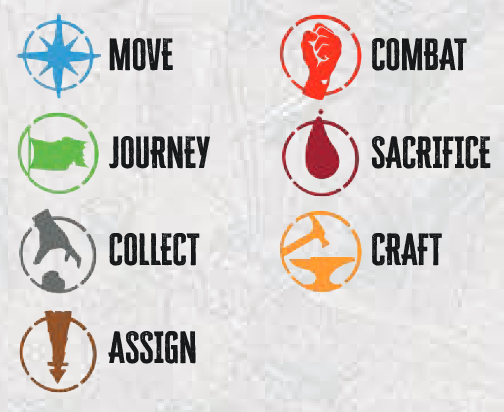
Moving means moving your figure on the map. You cannot cross black lines.
Journey is placing polyomino tiles on the journey cards, picking up items, and making progress from left to right, which limits your ability to get everything on the card. Collect is to use the smallest polyomino, a 1×1 piece to go back and take something you passed on your journey (aka visible on the journey cards).

Photo by Alain (the journey path is the upper row and the random events are the lower row)
Assign is using the resources you picked up during Journey and Collect to meet a certain goal on the map. The game does not have trading between characters, but if you need to assign five pieces of wood to a location, you can assign 3 of your own and 2 from a character in the same region of the map if they donate them.

Photo by Alain (note how the die results translate into cardboard pieces that then get placed on the card. We can kill this monster by placing that purple 1×2 piece across the bottom of the L to cover that third heart.)
Combat uses enemies of four different strengths and the combat process is discussed below under the polyomino system.
Sacrifice means taking wounds to achieve a goal at a location. You know what you are going to get, but wounds are taken using the polyomino dice as discussed below. You cannot sacrifice or contribute if there is an enemy in that location, so you may need to sequence the combat to come before the sacrifice.

Photo by Alain (this is the row of one-time-use cards you gain with the Craft action)
Crafting means taking a card from a card row of five face-up cards. These are generally one-use items. Each character has a starting item that they come with and all others must be taken using the crafting action. The row does not get clogged because after the player takes their items, they may discard an additional one before all the gaps are filled.
Thorgal scales by giving the group four actions per round regardless of the number of players, but it does suggest solo players use two characters. With fewer characters, you will take more wounds, so there is some scaling.
- Individual missions use distinctive decks, round trackers, and success/fail conditions.
After the four actions are taken by the players, the environment responds without it being tedious. Along with moving the round tracker and changing the weather, the four chips are flipped from their used to the unused side so that everyone can track which ones can still be used after a few actions have been taken. Then a card from one of two event decks is drawn and the first player token rotates.

While Thorgal has seven missions, unlike Robinson Crusoe (also from Portal), there is a paragraph book that comes with the game and certain missions that you don’t know about before you start, but you do know what it is in subsequent plays. This means you can improve and try to succeed, try new characters, and wait for the inevitable expansions. At the same time, the events change every mission so the water map has far more water events without them being the same every game.
- Polyominoes and Polyomino Dice
Where classic adventure games track health and perhaps sanity, Thorgal uses a polyomino system where the asymmetric characters have double-layer mats and a recessed area that represents your health. As you add wounds, you need to fit them into this area. When you heal, you might heal a certain size polyomino. If you have no size three wounds and you get a card that lets you heal them, tough luck. Sometimes a heal leaves a great space remaining, but sometimes not so much.
The polyominoes are also used to journey and fight enemies. Unlike when you take wounds, the journey and fight cards are grids with three colored spaces, beige, yellow, and red. When placing a piece on a yellow or red space, you take a particular type of damage to your character, which could be a wound, loss of an item, or some other setback. The journey cards have icons that get you items from a card row or basic resources. For journeying, you can improve your skills, which gives you greater flexibility to select shapes. For combat, you roll combat dice that have polyomino shapes on the sides. There are four levels of dice, Green, Yellow, Orange, and Red. The red ones are the best and the green ones are the worst. The larger the pieces, the better the chance you can cover all the hearts on the card(s) and kill the creature. Since damage does not carry over, you might want to improve your fighting skill (getting better dice) before engaging.
This system makes a coherent whole and drives the adventure while adding a bit of risk and reward that generates excitement.
Art, Components, & Theme
Thorgal is a beautiful game. This is a review of the retail edition, so no fancy bits and bobs are considered. Given that the subject of the game was originally graphic, they used imagery that was either in the books or in the spirit of the books. As such all the cards have a ligne claire art with strong lines and minimal hatching, like Tintin comics or the amazing art in the game The Lost Expedition.
The Thorgal art is fresh and colorful. The maps are appealing because they are bound in a book and the aspects of the game are tastefully integrated without making it all too busy.
The rulebook and game rules are set out clearly in a beautiful set of charts and a two-page icon glossary. The rules are clear and a clear improvement on past Portal rulebooks.
The Book of Tales, the paragraph book, is beautifully illustrated and well-written. It seems well bound but is not used anywhere near the tome in Tales of the Arabian Nights or other heavily narrative adventure games. I did not flip through it much to avoid spoilers for the missions I have not tried.
The polyominoes are colorful and fairly thick. They are a bit small but work well and keep the game size manageable for a normal table.
The event cards and character inserts are wonderful and evocative of the subject matter. Note that the starting items for the character are on the back of the character board which separates from the back section that has the dial and cardboard that holds the character. We initially missed that there is content on the back of the character inlays. That said, once you know, it seems obvious.

Photo by Alain
Note that the characters differ from each other in terms of how well they fight and journey using the red dial in the upper right, which tells you which dice you can roll, and the track on the left where you can improve your journeying (choosing any shape below your cube). Wounds are taken in the lower right and seem not to get very full, so don’t worry too much about taking small wounds to achieve what you want to.
Comparisons
I enjoy it when reviewers add a discussion of how the reviewed game relates to other games in the space. While Thorgal is easy to compare with Robinson Crusoe, that does not mean that everyone who likes Robinson Crusoe will like Thorgal or vice versa.
Robinson Crusoe is relentlessly tough. You often cannot handle events and know they will come back and bite you even worse down the line. Events will trash your carefully built shelter and spoil your food. It is more a survival game than an adventure game. This is not a bad thing, but it can feel like Thorgal meets The 7th Continent. Thorgal on the other hand is more beautiful and more hopeful. That is not to say that things are a cakewalk, but the game does not beat you down as much while still being challenging. I appreciate this tone.
Thorgal’s use of polyominoes makes it seem a bit more gamey. Going on an expedition and flipping cards can add excitement while puzzling over polyomino placement and deciding which damage to take to get two pieces of wood breaks the illusion that Robinson Crusoe retains. That said, The 7th Continent’s counting stars mechanism has the same issue as Thorgal’s polyominoes.
Another resonance is recent Ryan Laukat games such as Sleeping Gods and Creature Caravan. The chit placement system in those games feels similar to the systems in Thorgal, but forcing specific shapes on the player does lead to more challenge than placing six 1×1 tokens.
As mentioned, the narrative Book of Tales draws from classic games from Tales of the Arabian Nights to Lands of Galzyr but mercifully has a physical book so no app is needed.
Critical Observations
I played Thorgal with several different groups and not all players liked it as much as I did. Here are a few of their comments.
- Don’t get this if you want an adventure game -this is a puzzle game with a tight timeline and moving around wastes time. It is not like Time Stories where you need to play it several times to succeed, but the game does not encourage haphazard exploration. The map tells you roughly what you can find at different locations and focus on those you think you need.
- Not enough meaningful actions per game with four players – The scenarios include ~36 chip placements in total. That means that in a four-player game, each player has nine actions. If the events get in the way, you can have a few wasted actions, which feels bad when there are so few.
- We did not take enough wounds with four players to feel the pressure of dying from wounds.
- The fighting track felt more important than the journey track – in a game where we tried to specialize, the fighters got more buffs than the journeyers.We were not sure how scenario-dependent this is.
- Getting resources is not easy – unlike Euros that shower you with resources, Thorgal is somewhat stingy with them, so events that force the discarding of resources can feel unfair or at least game-changing.In other words, if you want a game to be nice to you, this might not be for you as in round 9 of one game, we flipped an event card that prevented us from fighting, losing us the game. It was a co-op flip-the-table moment.
Final Thoughts
I had a wonderful time with Thorgal. Each mission fits within two hours and is replayable two or three times in short succession. With time, it will be replayable even without expansions due to changes in items, events, characters, and other factors.
The system is solid and seeing new action cards is quite exciting. I look forward to more adventures with Thorgal and might look into the additional characters too.
Ratings from the Opinionated Gamers
I love it! Jonathan, Steph H
I like it.
Neutral.
Not for me…


