
Please Don’t Burn My Village!
- Designer: Simon Weinberg
- Publisher: Fireside games
- Players: 2-5
- Age: 10+
- Time: 20 minutes
- Amazon affiliate link: https://amzn.to/3F8cZ0p
- Played with review copy provided by publisher

A fearsome dragon is threatening to burn all the villages in the kingdom! Luckily dragons are greedy, so if you can bribe him with treasures from the battlefield like a barbarian’s axe or a phoenix feather, you might persuade him to spare your village. Unfortunately, other villagers in the kingdom have the same idea…
In Please Don’t Burn My Village!, which is set in the world of Castle Panic, you want to bribe with the right treasure at the right time to keep the dragon’s attention — while buying treasures at the black market and cursing the other villagers’ treasures. When no treasure remains, the dragon will burn all of the villages except one. Will yours be the one that survives?
To set up the game, place the board in the center of the table. The top half shows the dragon and Dragon’s Favor slots for the six goods, with values ranging from 1 to 4 above each slot. To start the game, the six goods markers are randomly placed into the slots under the dragon. The bottom of the board shows the black market with six slots, prices ranging from 0 to 3.

The deck of cards is shuffled (14 cards each of the six goods and a number of wild cards) and each player is dealt a hand of 7 cards. One card is then dealt to each slot in the Black Market.
On a turn, players use their hand of treasure cards to 1) bribe the dragon, 2) buy more treasure cards from the black market, or 3) draw a treasure card.
When they bribe the dragon, they place cards of a single type (and wild cards) in sets in front of them (or add to a set already played in front of them), move the token up in value in the dragon’s favor – moving one space for each card added to the Bribe this turn, and finally deal more cards into the black market. To do this, flip cards from the deck one at a time, starting in the 3 stall on the left and then moving to the right. Continue to so this until you place a card matching the Treasure type you used in your bribe or a wild card. If you make it all the way to the 0 stall at the right of the board, the next card will go back into the 3 space and you continue down the line again.

If they instead choose to buy at the black market, they choose a stall whose cards they want. Then, the player pays from their hand the number of cards indicated on a black market stall, take the cards from that stall into their hand. Stack the cards that you paid, and the top card in the stack is the Cursed Treasure. Move that treasure down in the dragon’s favor a number of spaces that matches the number of cards spent. The number of spaces a player moves a token up (when bribing the dragon) or down (when buying at the black market) equals the number cards played.
If players don’t want to affect the values in the dragon’s favor or are out of cards, they can simply draw a card. This has no effect on the tokens in the Dragon’s Favor row.

The game features a push-your-luck ending: every time someone bribes the dragon, cards are turned over and placed in the black market spaces until a matching card or wild is revealed. When no card is found and the deck runs out, the game ends immediately.
Players may then add any cards in their hand to bribes that match cards previously played. (A player cannot add wild cards and new treasure types at this time.) Then they sum the total value of their bribes, with each card being worth its value in the dragon’s favor. Unplayed treasure cards are worth -1 to -4 points, based on the final Dragon’s Favor standings. Unplayed Wild cards are worth -2 points each.. The player with the highest score wins, sparing their village from disaster. Ties broken in favor of the player with the most cards played of the most valuable good.
My thoughts on the game
Please Don’t Burn My Village is a quick set collection game with a nice twist in the manipulation of the card values. Virtually every turn, players will change the values of the goods, and you will constantly be trying to manage your plays to keep your desired suits at the top end of the Dragon’s Favor scale.
The safe play might be to just play some of every suit; but at best you’ll do just average with that plan – as all your cards will just well average out to be average. A higher risk strategy of playing just a few suits could pay off at the end of the game, but you’ll have to carefully manage the tokens in the Dragon’s Favor to keep your potential score in the upper range.
Of course, the big complication here is that you are never quite sure when the game will end – the number of cards which come out of the deck after a bribe is made can be very variable. As the end of the game is immediate, once the deck gets down into the bottom quarter or so, each turn could easily be your final turn – and this can definitely change how you approach those turns… Do you try to make a bribe to get more point scoring cards down? Or maybe you buy cards from the black market, taking a risk to add a few more cards to your hand (that hopefully match other cards in your hand) while allowing you to get rid of other cards that you don’t want to play.
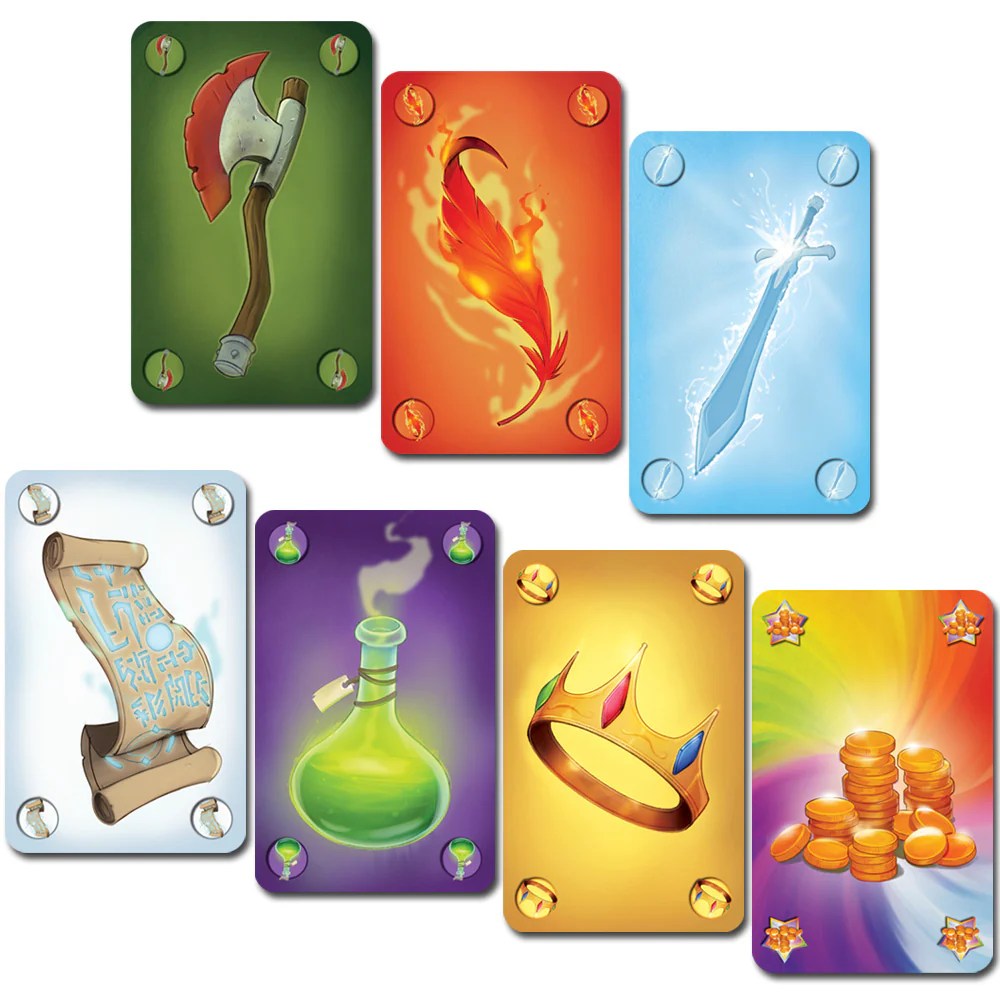
Individual turns move along rather quickly, as the three options are super easy. The whole game easily fits into the 15 to 20 minute range, which makes this a great opener/closer/filler. The artwork on the cards is simple but clean (just 7 different illustrations), and if you were a fan of Castle Panic; the fact that this game is tied into that universe is another plus. I haven’t actually played Castle Panic myself, but it is certainly not necessary to have done so to enjoy Please Don’t Burn My Village! It’s a great little filler and the added challenge of market manipulation set upon the set collection game is a surefire way to make this a very interesting game.
(Note: The designer Simon Weinberg is a member of the Opinionated Gamers, but he did not have any role in the writing nor editing of this review)
Thoughts from other Opinionated Gamers
Alison Brennan: Set collecting where each time you play or collect cards, the value of the colours change so you’re never sure what each colour will be worth at end of game. As such, whenever you get a chance to collect more than a single card on a turn jump on it (cards are added to the display each time a set is played), collect what others are collecting, and keep some cards back in your best suits to try and move them to a higher value just prior to game end. The admin (value adjustments, feeding the display) takes longer than the game-play, which Is too simple and random for our tastes – it looks to be aimed at a younger audience.
Ratings from the Opinionated Gamers
- I love it!
- I like it. Dale Y, Steph H, John P
- Neutral.
- Not for me… Alison
Amazon affiliate link: https://amzn.to/3F8cZ0p


