
Towerbrix
- Designer: Simon Thomas
- Publisher: Kosmos
- Players: 1-6
- Age: 10+
- Time: 20-30 minutes
- Amazon affiliate link: https://amzn.to/3HQYPl2
- Played with review copy provided by publisher
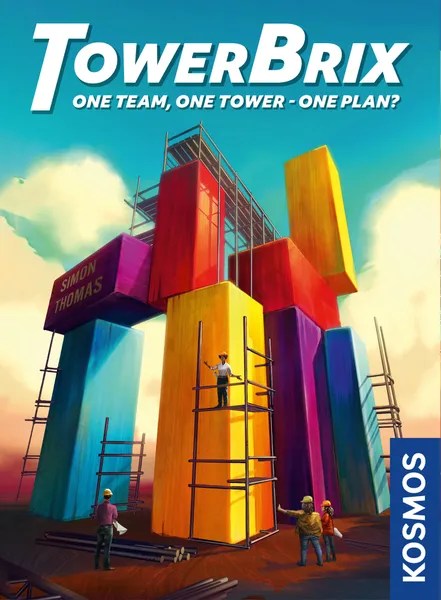
In the co-operative dexterity game TowerBrix, you build a tower out of bricks, with the cards in your hand telling you who has to fulfill which conditions — but each person knows only their own tasks and cannot tell the others about them. During the building process, the aim is to find out which conditions must be fulfilled in order to successfully complete the round. TowerBrix features different levels of difficulty and additional missions.
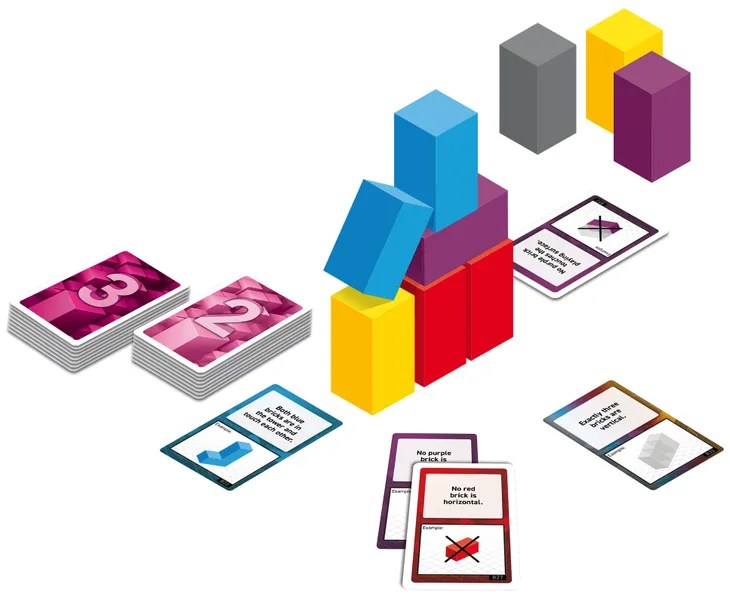
To start the game, first decide as a group which mode you will play – essentially, which deck of cards you will use. The green cards are easier, and they use the four pairs of basic bricks. The red cards are a little more complex, and they add in a ninth grey brick. Regardless of color, the cards are marked with 2s or 3s on the back. A difficulty level is chosen and players then distribute cards amongst themselves until the sum of the cards equals the difficulty level. Each of the cards has a single rule on it which must be followed.
Once everyone has been given their cards, the players cooperatively try to build a tower of bricks – in a way that all of the rules on the player cards are respected. The catch – the players may not verbally communicate during the play. There is no order to the building phase, anyone can build or break down the tower in order to get the blocks in an arrangement that works for them.

In order for the tower of blocks to be valid, all the blocks must touch at least one other block and all must be connected together. With the green cards, all 8 blocks must be used. With the red cards, at least one block of each color (thus minimum 5 blocks) must be used, and the rules are only checked against the blocks that are used.

When everyone is satisfied (the rules recommend giving a thumbs up), the cards are all flipped over and the cards are checked to make sure that the tower respects all the rules. If so, the group wins. If not, deal out a new set of cards and do it again. In the basic game, there is no time limit, so the group keeps building the tower until everyone gives the thumbs up.
After doing this three times, the group sums up the difficulty values of their three towers and then compares their sum to a chart in the rules to pat themselves on the back for a job well done.
There are also a number of challenges that can be added to the base game for additional complexity. The challenges might tell you to only have a single block touching the table. A different challenge mandates that the tower must have mirror symmetry when built. The most important one for me is setting a time limit for the construction of the tower (the rules suggest 2.5 minutes).
My thoughts on the game
As the players start building the tower of blocks, everyone else can try to deduce what that player’s rule card says. As the tower later gets modified, you can continue to get more information on the rules based on the reactions from the players. More often than not, it’s a trial and error process. I’ll put a block onto the tower, and then see if anyone gives me the thumbs down. Then, the next player takes over and does things to the tower, again looking at players to see if their changes meet approval.

The base game in Tower Brix is not a game IMO, it’s just an activity that is shared by the people at the table. There really isn’t any way to lose – players simply build and rebuild the tower until all the rule cards are fulfilled. There is no tension or time limit to the process; the players just keep going until the tower works. I suppose there is some benefit to using this mode to learn the flow of the game – but… it fails for me in the sense that there’s not a way to lose. It’s fine for something to do between games or while you’re waiting for someone to show up – but it’s still not a game. That’s not to say that the puzzles aren’t a nice little brain exercise, but without any tension in the process, it’s just an activity.

When you add in the timed challenge, now there is an actual win/loss condition, and something to make your hands a bit sweaty. With a time limit, players are a bit more likely to not wait their turn and to try to build the tower as quickly as possible. Most of the other challenges increase the level of difficulty, but they still don’t change the trial and error nature of the activity. I’m pretty much only playing this with the timer option. Of course, YMMV, and depending on who you are playing with, the untimed version may be perfect for you – a game that is more about the doing than the succeeding or the scoring.
FWIW, my son took this game to a local game night, filled with college kids, mostly data science interns – and THEY LOVED IT. Couldn’t stop playing it, and a few of them asked to take the game home with them to give it a forever home.

Ratings from the Opinionated Gamers
- I love it! (local data science interns)
- I like it.
- Neutral. Dale Y (game with a timed challenge), John P
- Not for me… Dale Y (base game)
Amazon affiliate link: https://amzn.to/3HQYPl2


