
Quacks
- Designer: Wolfgang Warsch
- Publisher: CMYK
- Players: 2-4
- Ages: 10+
- Time: 45-60 minutes
- Times played: 8, with original review copy purchased from Amazon.de; 4 plays with new 2025 version provided by CMYK
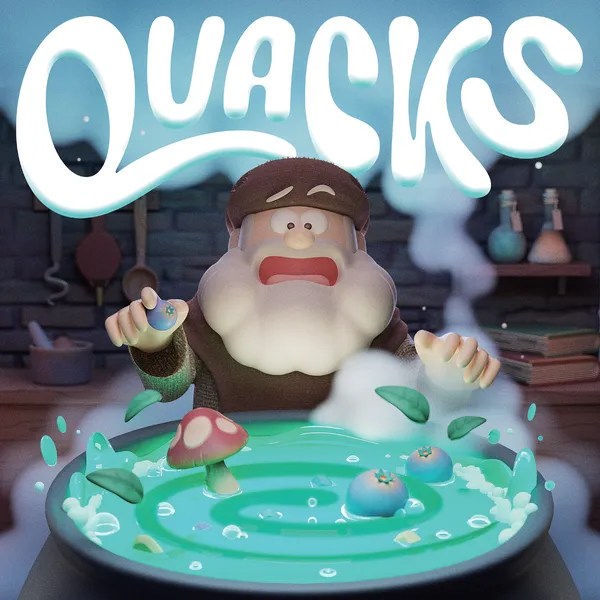
In Quacks, which was first released as The Quacks of Quedlinburg, players are charlatans — or quack doctors — each making their own secret brew by adding ingredients one at a time. Take care with what you add, though, for a pinch too much of this or that will spoil the whole mixture!
Each player has their own bag of ingredient chips. During each round, they simultaneously draw chips from their bags and add them to their pots. The higher the face value of the drawn chip, the further it is placed in the pot’s swirling pattern, increasing how much the potion will be worth. Push your luck as far as you can, but if you add too many cherry bombs, your pot will explode!
At the end of each round, players gain victory points and coins to spend on new ingredients, depending on how well they managed to fill up their pots. But players whose pots have exploded must choose points or coins — not both! The player with the most victory points at the end of nine rounds wins the game.
Back in 2018, while at the Gathering of Friends, some of the most played and most hyped games were designs by Wolfgang Warsch. As I’m sure you’ve probably heard, The Mind was taking the place by storm. Multiple copies of the game were always in play. Another Warsch game, Illusion, was getting a lot of play as a filler. And, Ganz Schoen Clever is the new roll-and-write king.
Having played three great designs from the same guy, I was looking to place an order from Germany to get Ganz Schoen Clever and Illusion. As I’m scrolling through the pages, I also notice that there is a fourth 2018 release from Herr Warsch. So… I don’t know a dang thing about it, but I just order it on spec because of the quality of the other games I’ve played thus far during the week – Quacks of Quedlingburg. This game was in instant hit here, and one which has been in constant play since its arrival – though now there is a new version available to play, released in 2025 by CMYK Games, now called simply “Quacks”.
The players are quack doctors who are brewing up healing potions. Each player has a cauldron – that is their player mat – and a bag of ingredients (chits) that are found in a cloth bag. For reasons unclear to me, the quackery requires you to pull your ingredients at random out of the bag as I supposed this somehow makes for a better potion! Each player has a drop marker which initially starts in the center of the cauldron. As ingredients are added to the cauldron, they are placed in an outward fashion from this drop marker.

At the start of the game, all players start with the same set of basic chits in their bag. There are a number of different colored chits, and some of them come with special abilities. The chits can be numbered anywhere from 1 to 4. Arrange the chips in the supply by number – you will have three piles: value 1 chips, value 2 chips and value 4 chips.

The game is played over nine rounds, there is a round tracker on the main board which tracks this. Each round follows the same pattern. At the start of certain rounds, there is a special action which occurs at the start of that round (round 2, the yellow book becomes available; round 3, the purple book becomes available, and round 6, each player gets an additional White-1 chip).
Then, the top event card is drawn and read aloud by the start player. There are two basic types; one is an immediate effect that happens at the start of the round, often granting players new chits to their bag or possibly rubies – the other type change one of the scoring rules at the end of the round.
The next phase takes up the bulk of the round – the preparation of the potions. To do this, players draw a chit out of their bag and then place it in their cauldron. The chip is placed a number of spaces forward from the previously placed chip as the number printed on the drawn chip. (The first drawn chip is place that number of spaces forward from the drop or the rat marker…) While placing chips, the most important color to watch are the white boomberries. As you are brewing your potion, you always have to watch your boomberry content – because if your total sum of boomberry chits ever is above 7, your pot will explode, and you cannot work on your potion any more! The other colors all have varying abilities, and four of these colors (blue, red, green, yellow) have varying abilities that are chosen in setup. One magic book for each color is selected, and whatever ability is printed on the book is in effect for the whole game.

You can end this phase voluntarily at any time, and if you explode (that is, your white chip sum is greater than 7), you are forced to stop – though you still place that final white chip which caused your cauldron to explode. Additionally, while you are drawing chips, if you draw a undesirable white chip AND your bottle is still full, you can empty the bottle by flipping it over and return that drawn white chip to your bag. When all players have completed this phase, the game moves onto scoring. Players who have exploded their cauldron should announce this fact at this time.
Before I get to scoring, I should talk about the timing of the potion building phase. The rules say that if timing matters, players should draw chips simultaneously (and if they choose to drop out of the phase, they should reveal an empty fist when they come out of the bag). While this works, it does cause the game to be unnecessarily slow. Our group has adopted a method where we are on our honor not to look at anyone else’s board while drawing – thus no advantage would be gained by taking longer than other players to see what has happened.
Scoring has a number of different phases. First, all players need to determine what their scoring space is – it is the empty space which is directly in front of the furthest placed chip. There are three features here: a victory point value in a tan box, a larger money number at the top of the space, and possibly a ruby icon.

The first scoring issue is the bonus die. Anyone who exploded in the potion making phase is ineligible to win the bonus die. All non-exploded players compare who is furthest along the track, and all the player(s) who is furthest gets to roll the bonus die and taking whatever shows on the die – gain VPs, a ruby, an Orange-1 token, or a bump forward of their drop marker.
Next, the black, green and purple chips are evaluated. Players compare the number of black chips they have in their cauldron to the left and right hand opponents. If you have more Black tokens than one opponent, you get a bump of your drop marker. If you have more Black tokens than both of your opponents, you get a bump of your drop marker AND a ruby. The green and purple chips are also scored at this time, and the actual thing being evaluated changes based on the particular magic book in play for those colors.
Then, check to see if you get a ruby. If there is a ruby shown in your scoring space for this round, take a ruby from the supply.

The next two phases (score VPs or buy chips) are somewhat linked – If you exploded in the potion making phase, you must choose to participate in only ONE of these two phases. All non-exploded players get to do both…
To score VPs, each player moves their scoring marker equal to the number in the scoring box on their scoring space. Then, in player order, players can use their buying power to purchase up to two chips for their bag. The chips must be of two different colors, and no change is given for unused buying power. The cost for the different types of chips is shown at the bottom of the left page of each magic book. Note that the chips are supply limited, and you can only buy chips that are available in the supply.
Finally, players can choose to spend 2 rubies to refill their bottle (if they had emptied it earlier to return a newly drawn white chip to their bag). Players can advance their drop by one space for each 2 rubies spent. All chips are now returned to the player’s bags, and the event card deck is passed to the next player in turn order who now becomes the starting player for the next round.
To end the round, you calculate the rat tails (that is, the catch up mechanism in the game). Find the leader on the scoring track. All other players count how many rat tails are depicted on the track between their marker and the leader, and they place their rat marker this number of spaces in front of their drop. Thus, players who are not in the lead get a slight advantage in this round, proportionate to the amount that they trail the leader. (If you’re familiar with the initial version of the game, this used to be at the start of each round, but it has been moved to the end of the previous – really it makes no difference in how the game plays out).
All of the other rounds in the game are similar except for the final round. In that last round, players are able to trade in 5 money for a VP (since adding more chips to your bag isn’t useful anymore) and can convert each pair of rubies leftover for 1 VP. The player with the most points at the end of the final round is the winner. Ties are broken by the player who has placed has placed a chip further ahead in that final round.
Once you are experienced with the game, you can also use the backside of the cauldron which adds a more advanced element to the strategy. In addition to the cauldron, you now also have a row of test tubes at the bottom of your board – with a drop marker placed on the leftmost test tube. Now, in the game, when you are able to move your drop forward, you must choose whether to spend it on the one in your cauldron or to move to the next test tube to the right. If you choose the test tubes, you will immediately gain the bonus depicted on that newly covered test tube (VPs, rubies or chips added to your bag).
If you have the All-In edition of Quacks, there are also a number of expansions that are included in your box. The Witches expansion adds a new ingredient (Locoweed) as well as a way to overflow your cauldron past space 33. There are also 3 Witches in the game, each with their own special ability, which players can use three times each.

The Alchemists expansion gives you Patients to treat – which you now have to make Essences for. These two expansions can be played separately or they can be combined together.

My thoughts on the game
Well, I guess I’ll cut right to the chase. I love this game, and in the first three weeks of owning it, I’ve played it 8 times. It has continued to make the table on a regular basis with a slight uptick this year given the new version. I’ve loved playing all sorts of deck builders and related games such as bag builders. Quacks scratches that deckbuilding itch as you really get a chance to try to develop a strategy based on the composition of chips in your bag.
As you go through to potion building phase, there is a great sense of suspense as you press your luck to draw out chips while trying to remain under the explosion threshold. It takes a good deal of luck to get an optimal draw of chips, and a good memory of what you have added to your bag is also needed. You’re not allowed to look into your bag while you are drawing chips, so memory is definitely an important skill to use here.
There can be some excruciatingly tough decisions as you try to calculate the odds of having a good or a bad pull when you get near the bottom of your bag. For me, it’s usually easiest to keep track of the white chips. You know that you start the game with 7 total white chips (four value 1, two value 2, and one value 3). At round 6, you get an additional value 1 white chip. You can always see which ones are in your cauldron, so you should be able to figure out which ones have yet to emerge. While you can’t look in the bag, you can always count how many chips are left in there using your sense of touch. Our group has plenty of fun watching people make agonizing decisions about whether to draw or not.
Early in the game, it is less agonizing to bust – because the penalties aren’t as severe. Usually players will opt out of the VP scoring so that they can continue to add more chips to their bag to improve their changes in future rounds. When you’re only giving up 2 to 4 VPs, it’s not completely crippling to your score, but in the later rounds, when you could be losing out on 10 to 15 points – it’s a much more painful penalty.

The different colored chips will also lead to varied strategies as each color has its own special ability associated with it. I have found that I like to try to focus on one or two colors in a game, trying to maximize one particular effect – while other gamers in my group have found success with a much more colorful and varied strategy. A lot depends on the luck of the draw… There is a lot of variety in this game as each game will play out differently based on which magic books are chosen for use in that game.
What further makes the strategy decision more complicated is the fact that your ability to buy certain chips also depends on how lucky you were during the drawing phase of that round. If you don’t get to a high enough number for your potion, you will have to settle for a less than optimal set of chips to add to your bag.

Using my group’s preferred simultaneous draw method, the potion portion of each round only takes a few minutes, but they are minutes filled with excitement, dread, anticipation and all the things that make gaming awesome – and by keeping this time short, the entire game can generally be finished in under an hour, and you get a lot of ups and downs in that time.
For the most part, the games are fairly competitive, and the rat tail mechanism helps keep players close together for awhile. That being said, we have had one instance where a player saw a strategy that no one else did, and we had a big runaway leader. Of course, with any game with variable powers, this is a risk, and I would make sure that all players have had a chance to read, understand, and digest the different color powers before starting a game.

The game has helpfully organized the books into six coherent sets – so you can always choose to one of the recommended combinations to allow for more balanced play. Once you are used to the game, you can pick any combination you like – so long as you have one of each color. Like Dominion, which the author notes was a inspiration for this game, a big part of the challenge in the game is processing how the different magic book actions will interact with each other – but you still need to rely upon luck to have the right chips come out at the right times.
The new components are great. The spell books are easy to read and understand, and the colorful chits always look great on the table. I also like the conversational style of the rulebook – which is a little bit nore casual than a traditional game ruleset, but I think this format makes it easier for a newbie to understand how to play. There is a pleasing solidness to the chips, they feel good in your hand, and they generate a pleasing clickiness to your ears when they rattle around in your bag.

Overall, this game is filled with excitement – giving the game many choices along the way as well as the satisfaction (or perhaps agony) of watching their strategy develop through the contents of their bag. It is complex for me to give a satisfying game experience, yet not so difficult that I can’t fully explain the game in more than ten minutes nor finish a game in more than an hour. I love the building aspect of the game, and this is right in the sweet spot for me in terms of game length, complexity and luck. This one is a definite keeper for me, and one that I’m glad I took a chance on buying on spec just based on the name of the designer back in 2018! I’m very glad that there is a new version with updated art in 2025. I’ve already given the game as a gift to a new gamer!
Thoughts from other Opinionated Gamers
Chris Wray (2 Plays): I love this game, and as Dale point out, Wolfgang Warsh is certainly on a roll. This is my new favorite in the bag-building genre. The engine-building aspect makes the game deep enough to satisfy gamers, yet it is still approachable because of the press-your-luck mechanic. It’s an innovative title.
I think the rats are a solid catch up mechanic, and a strong one at that. Sure, the event cards can also have a catch up feel, but not all of them do. Those few extra spaces not only give points, but they also give additional buying power, and the cumulative effect of that adds up.
My only quibble with the game is the length. It isn’t a long game — and it doesn’t overstay its welcome — but with the rules as written, I don’t think this can be played in 45 minutes with three or more players. Dale’s house rule is probably the best way to play this: just draw simultaneously. I haven’t tried it yet, but I fail to see how doing it in order adds anything.
Ratings from the Opinionated Gamers
- I love it! Dale Y, Craig V, Chris Wray, Mark Jackson
- I like it.
- Neutral.
- Not for me…Doug G.


Main problem is, it gets too solitary
The art is so much worse in this version than the original. The graphic design might be a bit better but man, that art….
Thanks for this review! I loved the game when I first played it years ago but thought the art didn’t fit. I think the new art captures the feeling I had when I first played it much better, and I am super happy with my all-in version. A note on the thematic reason of why you draw ingredients without looking is that the players are not trained doctors or herbalists, they’re quacks. They only know what an ingredient does by throwing it into their cauldron and hoping for the best.