
Ink
- Designer: Kasper Lapp
- Publisher: Final Score Games
- Players: 1-4
- Age: 8+
- Time: 30-45 min
- Amazon affiliate link: https://amzn.to/4fHLoAO
- Played with review copy provided by publisher
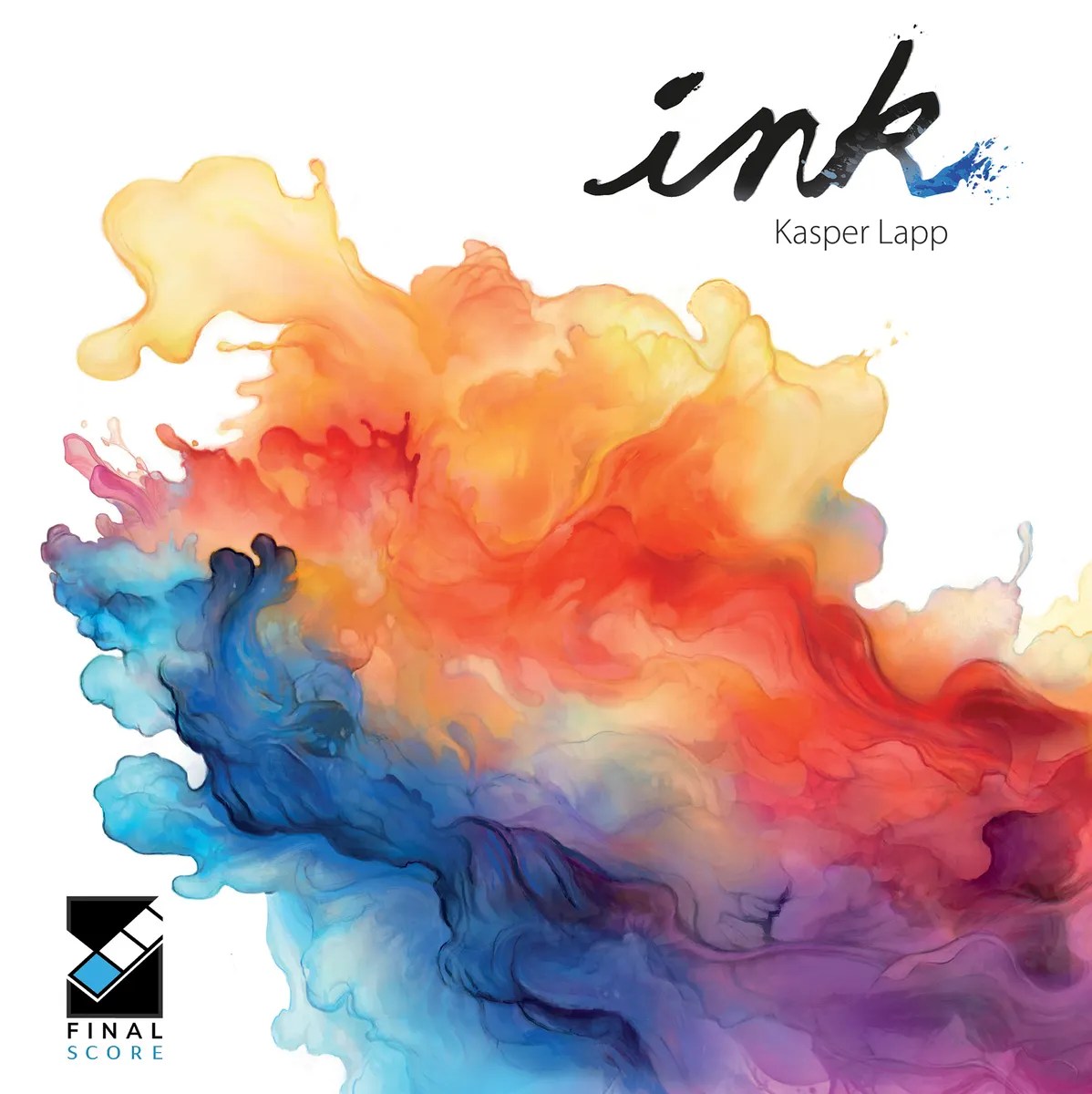
Ink is an unforgiving medium. However, when mastered with care, its spontaneity and brilliance can create visual effects of astonishing richness. INK invites you to deploy your talent by creating sumptuous paintings worthy of the greatest collections.
Combining tile placement, resource and hand management, and pattern recognition, Ink challenges players to complete high-value contracts by carefully placing ink tiles to form harmonious patterns. The trick lies in balancing spontaneity with planning, every move you make affects not only your current canvas, but the options you’ll have in future turns.
To set up the game, the circular quill board is placed on the table and random ink tiles are placed next to each of the 6 quills on the wheel. Players get a random starting tile (which starts their painting) and palette board. They take the ink bottles in their color, filling the palette board as well as placing one on the quill board. The Bonus action display is set up, with two actions of each color being randomly selected for the game.

The game is played in rounds with the overall goal being to play all your ink bottles. On each player turn, the active player can either take a full turn or pass.
A full turn consists of four phases, all of which must be done
1] Pick a Tile – move your bottle clockwise around the wheel and choose the tile at whatever position you stop at. If you move past the starting space (marked with an X), you draw an X token from the bag and then you must use this cover space(s) on your painting matching the color of the X. If you cover an ink bottle, it is returned to your supply.

2] Add the Tile to your painting – place the new tile so that one of its little squares shares an orthogonal border with a previously placed tile. The new tile can be flipped and/or rotated as desired.
3] Complete Objectives and play Ink bottles – Objectives are numbered spaces seen on the Ink tiles. If you have a contiguous area at least as large as the number, and you increased the size of that area this turn, you can place an upside-down bottle onto that Objective. Ink bottles from your palette must go on objectives matching one of the colors on the palette card; the other ink bottles can be placed on any color objective. Once you have marked the objective space, you can then place your Ink bottles to fill in any white spots in that area. Check to see if you have triggered a bonus action (see the Bonus Action board, and they are associated with specific Objective numbers) It is possible to complete multiple objectives on a turn.
4] Replenish the Quill wheel – refill any empty spaces on the Quill board from the bag
Alternatively, a player can choose to pass – taking no actions other than moving two of the ink bottles from the palette card to the wild area next to it.

Play continues until someone has played their last ink bottle – finishing the current round until everyone has the same number of turns. If further ink bottles are needed, players can use the special black bottles to continue their placement. The winner is the player who played the most ink bottles. If there is a tie, the tied players play additional rounds until the tie is broken at the end of a round.
My thoughts on the game
Ink is the most recent design from Kasper Lapp – a designer who has devised games of all sorts of different styles. In this game, Lapp uses tile placement, pattern recognition and a bit of resource management to give players an interesting challenge.
The drafting decision starts out each turn. Ideally you’d like to choose the optimal tile for your player area – to allow you to complete your objectives. However, you can’t move too far around the wheel as each time you make a full revolution, you’ll have to draw an X token from the bag which then nerfs some of the spots in your area. (For what it’s worth, in more than half of my games, the group think of my group has had most players prioritize a closer tile – and we have not had as many issues with the X’s blocking our areas.

Once you have your tile, then you have to find the right place for it. If you complete an objective, you then get to move some of your ink bottles onto the board – and the placement of those bottles is important as they might restrict you in claiming later objectives.
Each player has a slightly different baseline color motivation, based on the two colors on their palette board. There is an interesting bit of bottle management as you have to be able to play your ink bottles from both the palette card as well as the “wild” area. You could always spend a turn to move two bottles into your wild area, but this is a very non-efficient use of a turn, so it might be better to just get the tiles that allow you to use the bottles from the right areas…
Timing can be important here; you can sometimes trigger a cascade of actions with the Bonus actions – but you need to be set up right in order to get things to work out in your favor.
The game is quite easy to teach; I’ve found just making an example board and showing how objective completion, bottle placement, and bonus actions work – that’s pretty much most of the game. After a few examples, players are pretty much ready to play. However, though the rules are simple, the decisions that can arise in the game can be really tough. It’s the sort of puzzle game that I like. Though I can’t put my finger on it, it does remind me a lot of Habitats, which I have reviewed earlier this summer, and both are amongst my favorite games in this class. Will my game collection need both? Honestly, I’m not sure, but they will each likely need a few plays to see if one separates from the other.
Thoughts from other Opinionated Gamers
Alison Brennan: Take a tile from the draft, add it to your tableau such that it extends a colour to make it big enough to meet a size objective, and then score it by filling that colour with meeples so it can’t score again. The bigger the area, the bigger the bonus action you get, and bonus actions are paramount to gaining advantage. Repeat ad nauseum. It’s so abstract. And uninteresting. And repetitive. And as fun as watching ink dry.
Ratings from the Opinionated Gamers
- I love it!
- I like it. Dale
- Neutral.
- Not for me… Alison
Amazon affiliate link: https://amzn.to/4fHLoAO


