
Etherstone
- Designer: Virginio Gigli, Simone Luciani
- Publisher: Thundergryph
- Players: 2-4
- Age: 14+
- Time: 20 min per player
- Amazon affiliate link: https://amzn.to/4aXGXBM
- Played with review copy provided by publisher
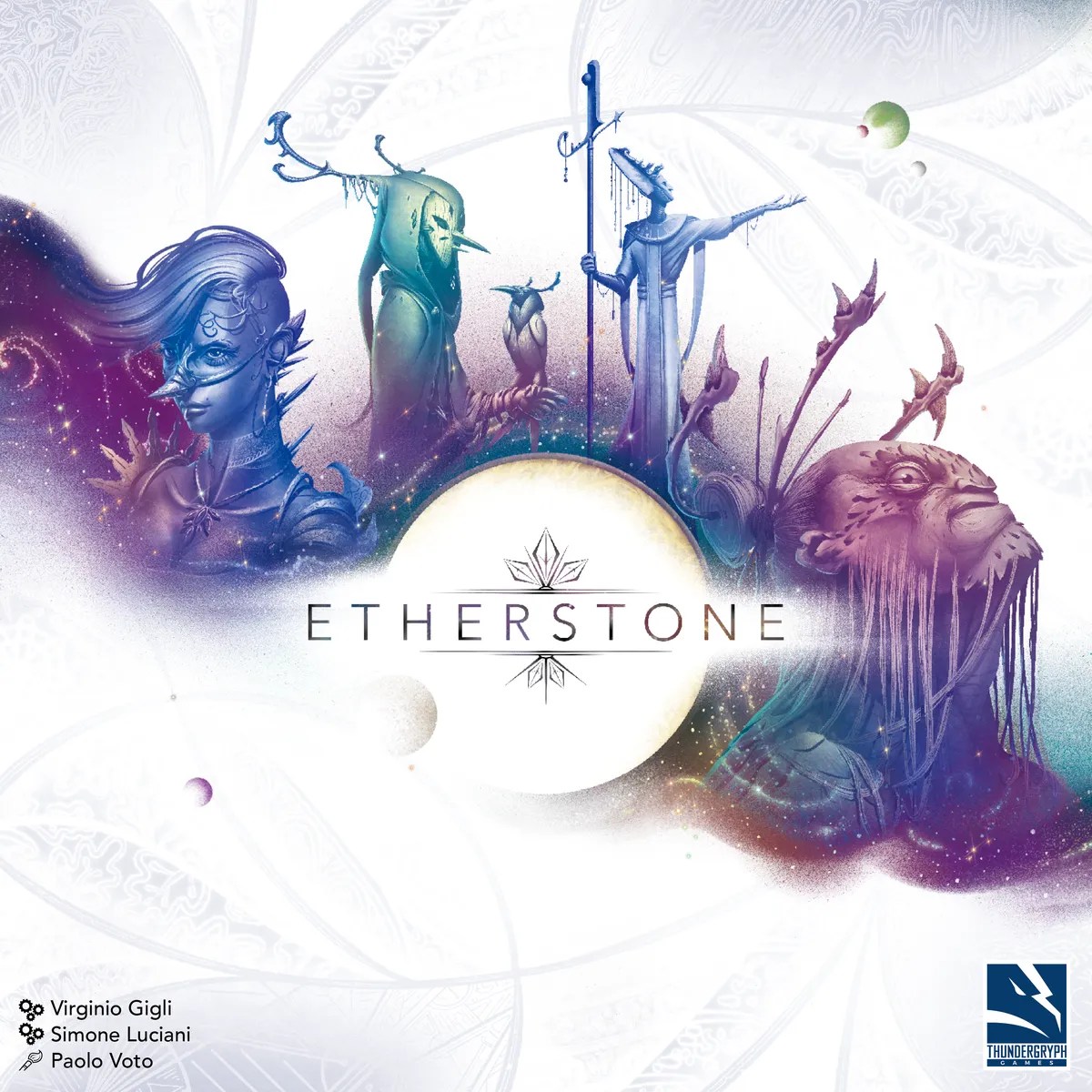
Nobura is a forgotten planet shrouded in mystery. The story told that a cosmic being sacrificed its divine essence to breathe life into its desolate lands. Etherstones shaped the planet’s biomes and interconnected all living beings with nature. Yet, the lurking threat of the Vacuous, a parasitic force born from the depths of Nobura, poses a challenge to life on the surface, weaving a tale of divine sacrifice. Nobura has always been part of a paradoxical loop of life and death, where the forces of creation and destruction dance in an eternal cosmic struggle. In Etherstone, players embody faction leaders uniting forces to avert the impending extinction, striving to gain the most victory points through various means, such as summoning cards, overcoming threats, and utilizing their abilities as effectively as possible.
The first stage of the game will be drafting your hand of 7 cards and your leader card. Alternatively, for the first few matches, players can take a pre-made hand of cards with the matching Leader. Leaders have a set number of life points, a strength value, and a persistent asymmetric ability. Players will get a wheel on which to mark their life points. A deck of Threat cards is constructed based on player count and a display of three Threat cards is made. The 5 dice are rolled, and the four non-purple dice are placed in their display tokens.

During your turn, you first collect and re-roll all the dice if the display is empty. You can also choose to lose an amount of life equal to the number of dice currently in the display to reroll them all. Then, you can take only one action among the following:
- Dice Draft – choose a die from the display, gain 2 Etherstones of that color. (If you take purple, lose 1 life and take 2 stones of any single color, and the purple die takes on that chosen color for this turn). Perform any abilities on your Leader or cards in play that trigger from the color dice you drafted.
- Summon – Play a card from your hand to the table, paying the casting cost in the upper left. Perform any Pre-cast ability, then play the card and then trigger any instant abilities.
- Attack – choose a Threat card in the display, then choose any number of your in-play cards, rotating them to show they are exhausted. A Leader can also join the attack. You can trigger any attack abilities on your cards. The group must have a summed strength equal to that of the Threat in order to win. If your Leader attacked, you lose Life as shown on the Threat card. Take the rewards shown on the Threat card, and then keep the defeated Threat card in your Spoils stack.
- Rest – untap all of your exhausted cards
- Void Pact – you must take this action if your Leader is corrupted (has no life left). Take a Void Pact token, worth negative 7 VPs, and then reset your health dial to your starting amount.

Players will win by gaining victory points while doing several different actions and the game will end if any of the end-game conditions are met:
- The active player has no cards left in their hand
- There are no cards left in the Threat deck (there may still be Threat cards in the display when this happens)
- The victory point pool has no more tokens in it. (25 tokens for a 4p game)

Continue playing until the end of the round, so all players have had the same number of turns. Players now calculate their score:
- Point tokens collected during play
- 2 VP for triggering the game end
- Points on all your in-play cards
- Points from end game abilities on your in-play cards
- Points from all your Spoils cards (defeated Threats)
- 1 VP per 2 life points left
- -7VP for each Void Pact token
- -3VP if you are corrupted (0 life) at the end of the game
The player with the most points wins. Ties broken in favor of having the fewest cards left in hand.

My thoughts on the game
Etherstone had been one of those games that had been on the stack of games to be played at game night, but hadn’t made it onto the table for two or three weeks running. At a recent con, I was talking about the game with some other OG writers, and both were quite positive about the game, so I made sure to move it to the top of the “to be played’ stack thereafter.
Once I made it through the rules (lots of lore terms and whatnot), the game itself is quite simple – and it felt very similar to Res Arcana. You draft (or as a beginner, are given) a very small hand of 7 cards – and these are the only cards you’ll get all game. You then have to make the most out of this small selection to score points.

When you play the full game, I’d say that the drafting contributes as much to your overall success as the playing of the cards during the game itself. While you only have 7 cards, you will take many more turns than just 7 – and if you are able to draft synergistic cards into your hand, you’ll have the opportunity to make the most of each turn.
The dice offer some interesting strategies. At the basic level, you sometimes simply choose a die to gain the two resources of the matching color. Some of the cards can be quite expensive, and you’ll need to come up with a bunch of resources just to play them. Once you have some cards in play though, you might have abilities that can be triggered by drafting certain numbers or certain colors, and that leads to some really interesting possibilities.
As you learn what cards other players have in play, you might end up even just hate drafting a die in order to prevent an opponent from triggering their own action (or sometimes to protect yourself from the attack that would come from said action).

Depending on the card set, there can be plenty of interaction as players can end up with lots of effects that cause other players to take damage. In a recent game, one player had a card that dealt a damage to any player who Attacked, another had a card that on a 2 or 3 die draw caused other players to exhaust a card or lose two life, another did damage with every green die draw. In any event, it was a common announcement at the table “hey, you guys all lose a life”, etc.
It’s definitely on the players to remember to trigger their effects and then announce them to their opponents; and I had to rely on those announcements because frankly there are just too many cards on the table for my brain to keep track of them all. (also, for the players who were sitting further away from me, there wasn’t an easy way to see on their cards what the possible interactions would be).
The end result is a game where players end up participating on most turns, not just their own. For some, that’s a great attribute. For me, it was a bit much. In the games that I have played, all of that felt out of control and just a constant drain on my life – I had few ways to prevent the small pings from happening, and no in-game way to defend against them. Nothing wrong with that sort of system, but it’s not what I personally prefer.
There are three ways for the game to end, and you’ll have to start watching whether any of those criteria can be met. If you think you’re winning, you might actually want to push to accelerate the game end as well!

So I’m all for a game having a backstory and/or mythology – but I will say that the amount of extra text and terms and whatnot in Etherstone is distracting. I may be in the minority when I say that, but there seemed to be a lot of terminology in the rules and even class descriptions on the cards that simply have no role in gameplay. And at least for me, this made it hard to learn the game and made it more difficult to play the same. To be fair, other Opinionated Gamers have told me they had no issues at all – so this could very well be a “me” problem.
Overall, I’m glad that I finally got to play Etherstone, and I can definitely see the parts of the game that my colleagues love about it. For me, I think it’s not a good fit because I want to be left alone a bit more. It’s still a fun challenge to try to maximize my small hand of cards (and to draft the best hand I can), so I wouldn’t say no to a game of Etherstone if asked, but I think I’d personally prefer other choices in this small niche of hand management games.
Ratings from the Opinionated Gamers
- I love it! Lucas H
- I like it. Jonathan F
- Neutral. Dale Y, John P
- Not for me…
Amazon affiliate link: https://amzn.to/4aXGXBM


Sounds like a game that might be best when played with 2. That’s what the Geek strongly recommends and based on your review, would very likely be my preference.