
Questline
- Designers: Marc-Andre Lavoie and Martin Lavoie
- Publisher: Thunderworks
- Players: 1-6
- Age: 14+
- Time: 15 minutes
- Preorder link – https://thunderworksgames.com/products/questline-card-game
- Played with review copy provided by publisher

In Questline, players compete to earn the most reputation stars by chaining together seven cards in their hand, attempting to tell the most compelling story for their hero. Players draw, swap and discard cards to create an ascending sequence of levels, optimizing the reputation stars gained from each card. Once satisfied with the cards forming their questline, players remove their discarded cards from play and claim an epilogue card. All players then display their cards, recount their hero’s journey, and score reputation stars.
To start the game, each player is dealt two blue class cards and six red adventure cards. The Epilogue cards are chosen for the player count and stacked on the table with the highest reputation star card on top. Players now choose one of their 8 initial cards to discard – this is placed face down in front of them to start their discard area.
Players work to form questlines, and they will eventually be laid out on the table and scored from left to right. The first card must be a class card. Then, going to the right, cards should generally be in ascending order (though are not obligated to be so) – as cards fully score if all the level numbers less than that card are seen to the left. Of course, special actions/cards can change those rules.
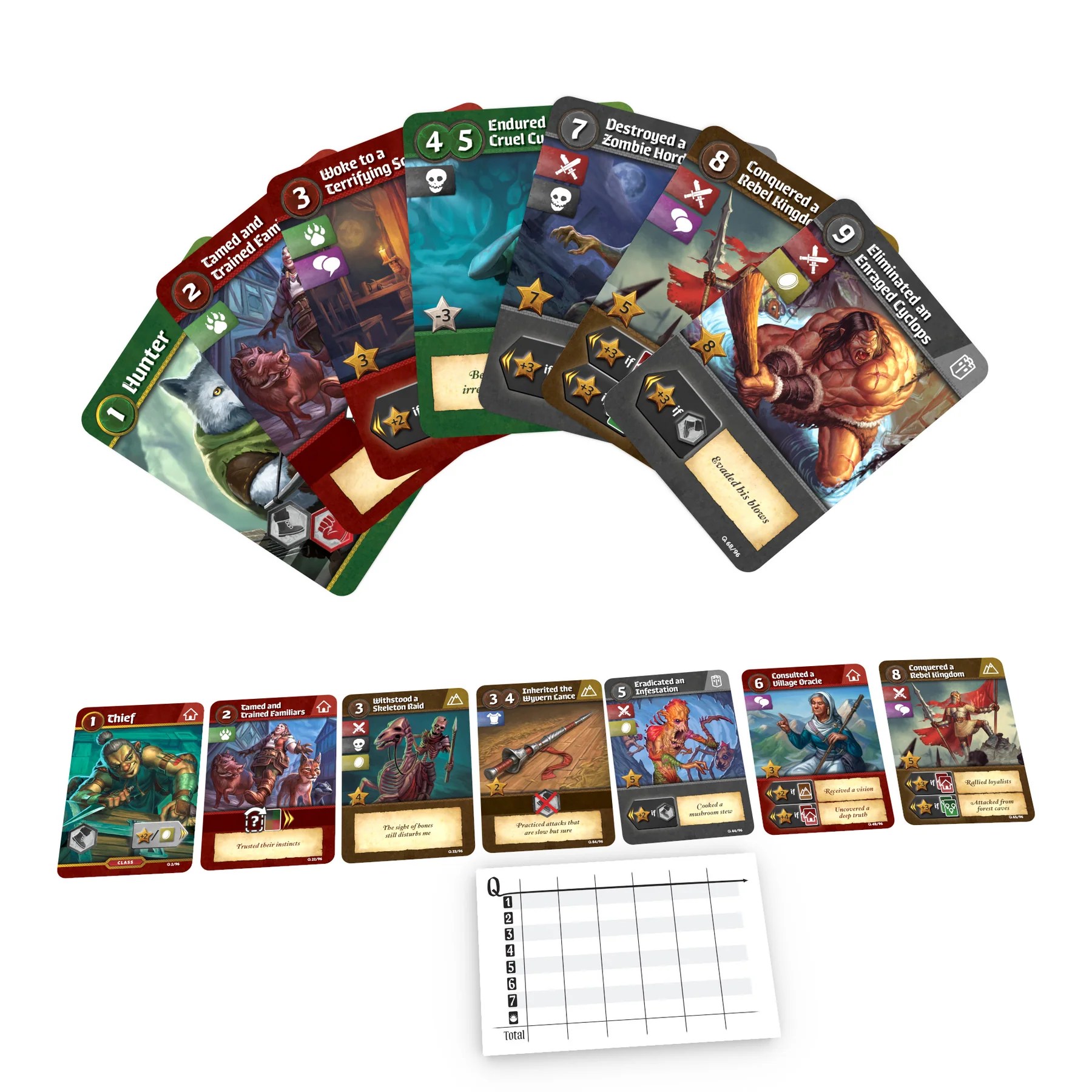
The cards have a lot of information on them – the most important probably being the numeric level in the upper left. Every card belongs to a particular terrain type (upper right and color of the top bar). In addition, tags and skills can be found on the cards. Quests are found on some cards and they score stars for each specified icon found to the RIGHT of the Quest. Masteries give a one time score for a specified icon found to the LEFT of the Mastery. Setbacks might be found on the cards which provide a roadblock on a Mastery score. Some cards also offer shortcuts
Interestingly, there is no turn structure to the game – once it starts, players play in realtime, simultaneously working to make the best Questline possible. Each player goes through the following steps in order (but again at their own pace):
1] Draw a card – unless restricted, draw a single card from the top of the adventure deck, from the top of the class deck, from your own discard area or from the discard area of the player to your left or right. If your discard area has 7 cards in it, you can only draw a card from your own discard area.
2] Discard a card – choose a card from your hand and place it face up in your discard area. Arrange them so that all other players can see/read the cards.
Players continue these two alternating actions until they are done. At that point, they collect all the cards in their discard area and flip them facedown – they can no longer be drawn by other players in the game. They add the highest value Epilogue card still available and then wait for everyone else to finish.

When it’s time to score, players reveal their Questlines, one card at a time from the lowest level to the highest. Remember that in order for a card to score, all the lower numbers must be seen to the left of that card. If you are missing a level (and do not have a shortcut to skip it), you must place your highest level card facedown in the gap, and that facedown card will not score anything.

For each card, score the base value (if any), and then any Quests or Masteries. As you are going through the cards, you can also tell the story of your questline – reading out the titles of the cards and embellishing as you desire.
The player with the most stars is the winner, ties broken by higher epilogue card number.
My thoughts on the game
Questline is a game that plays out quite quickly – most of our games here take maybe ten minutes or so. When asked to describe it to someone else, my initial response is that it’s a quick handbuilder, like Fantasy Realms, but yet, quite different.
The goal here is to generate the best 7 card hand – ideally with cards in numerical order, though not entirely necessary as there are plenty of ways to skip levels as well as a number of cards which provide multiple numbers on them. There are plenty of ways to combine your cards, with different tags and skills and terrain types.
As you are figuring out your hand, you’ll surely find cards that work in a particular slot, but man, you’ll never know for sure if it is the _ best _ card for that space. You could, of course, continue to draw cards and search for that elusive best card, but this could cost you points. First, the quicker you finish, the larger the score of your Epilogue card. Second, as you continue to draw and discard cards, you make more cards available for your neighbors allowing them to possibly score more points than you.
There is a nice ebb and flow between trying to look at cards as quickly as possible balanced with the desire to slow things down a bit in order to give your opponents time to play cards into their discard area. The advantage of picking up discards is that you can see the card before you take it. If you draw from the top of the deck, it’s always a bit of a mystery – and you should not forget that you can only have 7 cards in your discard area, so going too fast and filling this up can really stall out your hand development.
The artwork on the cards is nice, and brings out the ties to the Ulos universe. The symbols are decent and make sense once you’ve played the games a few times – but many people around here have had to refer to the rules and player aids a lot on their first game or two until everything clicks. The overall dark theme to the cards makes it a bit harder to pull those details off the cards for me.
As with many of these games, getting a lucky deal might be an advantage, but in a ten minute game, probably nothing to fixate on. Anyways, as I said earlier, I think it’s really hard to know that you have the “best” cards possible – so you’ll still have to commit at some point and take your epilogue card. More often than not, when I try to rush to the Epilogue card, I have not been successful in winning the game. The game gives you an interesting puzzle in a short time frame, and given its short stay, it is the sort of game that gets played a couple times in a row around here.
The game is available for preorder now, and the release date should be GenCon this summer.
https://thunderworksgames.com/products/questline-card-game
Thoughts from other Opinionated Gamers
Dan B. (1 play): It’s interesting but the fact it’s so reminiscent of Fantasy Realms doesn’t do it any favors – I’d rather just play that. However, I’d play this again, but preferably house-ruling a regular turn structure as I don’t see the point in the real-time play and I don’t care for it.
Ratings from the Opinionated Gamers
- I love it!
- I like it. Dale Y, John P
- Neutral. Dan B.
- Not for me…


How does solo work for a real-time game? (I ask as a fan of the World of Ulos – or at least major parts of it.)