
So, we don’t do a lot of Kickstarter Previews, but I was approached by Button Shy to look at their newest offerings which will go live in August 2026.
https://www.kickstarter.com/projects/239309591/button-shy-micro-games-summer-2026-collection
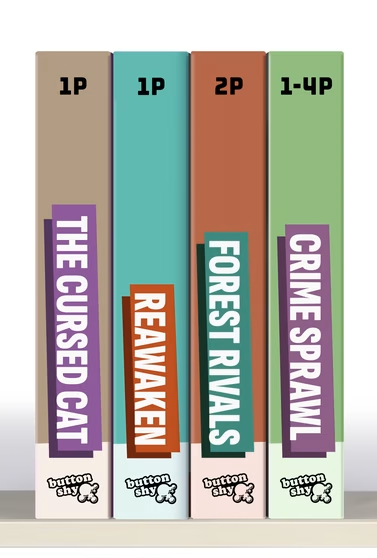
I’ll admit that I’m on a bit of a Button Shy high right now, having spent much of this year playing through a huge collection that I bought second-hand back in January. The company is well known for its tiny format – eighteen card games that come in a nice little pocket sized wallet. As of 2026, the company announced that they will now start packaging their games in boxes (to help fit in to retail norms), but that doesn’t change the amazing amount of innovation and ingenuity needed to cram such good games into this small format.
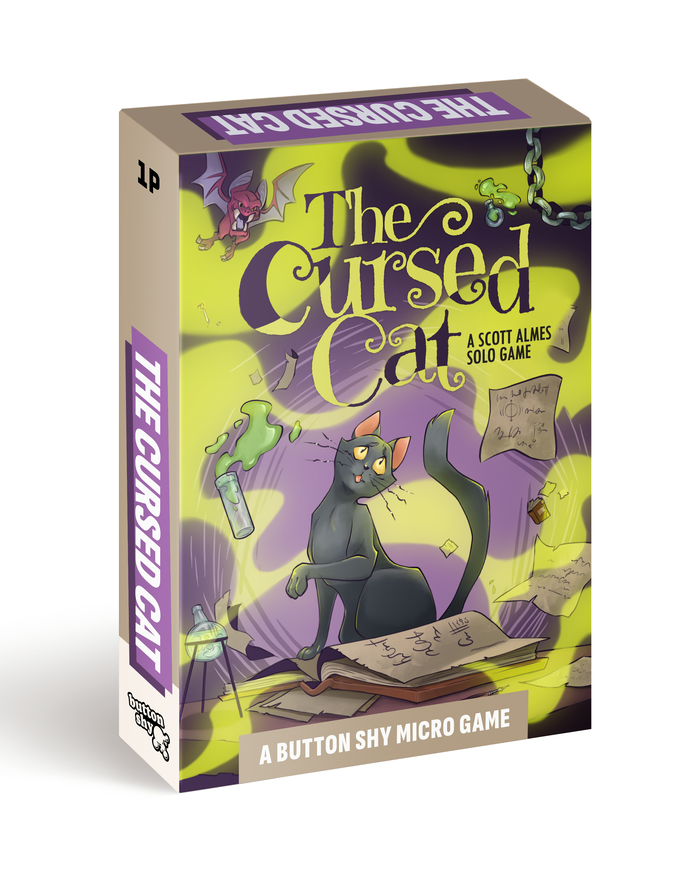
The Cursed Cat
- Designer: Scott Almes
- Publisher: Button Shy
- Players: 1
- Played with preview copy provided by publisher
From the publisher: “Our ELEVENTH (!) entry in the Simply Solo line from Scott Almes, The Cursed Cat puts you in the shoes of a very beleaguered witch or wizard whose feline familiar is causing problems around the lab. Try to keep everything in order while that cursed cat makes a mess! “

The eighteen cards are broken up into 3 room cards and 15 double sided cards with spells on one side and monsters on the other. The 3 room cards are dealt out in a line (Lab -> Spellbook -> Portal) and then monster cards are dealt out in a column above each room – the number of cards in each room determined by your chosen level of difficulty. Each Row of monsters in the array is then arranged in descending order so that the highest number in each row is on the left. The remaining cards are made into a deck of Spells, and the top 3 cards from this deck are laid out to form the Spell Row.
The goal of the game is to move all of the monsters into the Portal column before you run out of spells. At the start of every turn, you get to relocate up to 2 monsters – this is moving the monster at the top of any column and moving it to the top of any other column, but you must abide by the Size rule which says that you can only place monsters on top of higher numbered monsters. Note that your columns will not be strictly smallest to largest from top to bottom. The size rule only applies to the card you are moving and the card you are moving onto.

Then you cast a spell from the Spell Card row or the top of the deck. Trigger all the effects of the spell in order, and if you move monsters, they always move to the top of their new column. If there are any gaps after the spell happens, move everything down to eliminate the gaps. If you are unable to resolve the card, the spell fails, and as punishment, you will only be able to do a single relocation at the start of the next turn.
Discard the spell you cast. If it is from the Spell Row, it is NOT replenished. Continue playing until you either win or lose. You win if you are able to move all the monsters to the Portal row. You lose if you run out of spells before winning.

After a few solo plays, there is a neat little puzzle here. I have found that the easy level is in fact fairly easy, but I’ve found a really nice challenge (for me) at the Medium level – currently winning about 50 percent of those games. This game has been sitting at my desk at work and I’ve squeezed in a few games during short downtime periods. If I played straight through, the game is maybe ten minutes or so – but it’s also great to sit out and be played one turn at a time. As with many of Almes’ other solo games, a solid solitary game that you can take with you anywhere you go.

Forest Rivals
- Designer: Prof. Ryan Cooke, Steven L. Smith
- Publisher: Button Shy
- Players: 2
- Played with review copy provided by publisher
Bears. Bees. Battling? Players try to outwit and outflank their opponent to get the most honey. What makes it work are the elegant placement and scoring rules that require both players to think carefully about their own strategy… and their opponent’s.

The eighteen card deck is split up into two 8 card player decks (Bears and Bees), a first player card and a Largest Group card. Each of the player cards has a varied arrangement of icons with the same distribution of 3 player icons, 2 opponent icons and one beehive.
Before the game begins:
- Each player chooses a side: Bears or Bees.
- Using the image on the back of the deck as a guide, each player separates and shuffles the cards for their chosen side to form a personal face-down deck.
- Choose a starting player. The first player takes the First Player card, turns it to their chosen side (Bears or Bees), and places it in front of them.
The first player begins the game with 1 victory point, as shown on this card
On a turn, you draw the top card from your deck and play it legally. It must be orthogonally adjacent to a previously played card AND at least one symbol must match its neighbor on the previously placed card. You can stack your card on top of a previous card, covering up to 3 symbols, but beehives can only be covered by other beehives. You can rotate your card any way that you like before playing it.

Continue until all the cards have been played and then score the game. First, each player identifies their largest contiguous group. The player with the larger group takes the Largest Group card, worth 1 point if their group is 1-4 points larger than the opponent or 3 points if 5+ larger than their opponent. Nothing is awarded for a tie.
Now, score each beehive which is fully surrounded (i.e. has 8 animals around it). The player with more animals around each scores 1 point. Nothing is awarded for a tie. The start player scores a point for having the Start Player card. The player with the most points wins. Ties broken in favor of the player with the most beehives controlled.
A very nice two player abstract game here that plays quickly. There is definitely an advantage to going second here as you get the ability to respond to the first player’s action at every turn. Personally, I’m not sure if the 1 point for the start player card is enough – but we’ve personally solved this by making our sessions 2 games each, so that each player can go first once. The rules are so simple, though you’ll need to make sure in your first few games that players are playing legally – it’s easy to overlook the rule that one of your card’s icons must match a neighboring icon. One of my playing partners has also suggested keeping some markers around to help you score beehives as they are surrounded – this keeps the game moving along slightly faster as you won’t have to continually do the math mentally each turn.

Button Shy’s Micro Games: Summer 2026 Collection Kickstarter campaign is slated to go live August 11.
https://www.kickstarter.com/projects/239309591/button-shy-micro-games-summer-2026-collection
Until your next appointment,
The Gaming Doctor


