|

August 2026
Games I played for the first time this month, from worst to best, along with my ratings and comments.

Tap 4 – 5/10
Tap 4 has come into the spotlight since it was recently published by The Op Games, fresh off their success with Flip 7. Originally self-published in 2019, the game’s actual pedigree goes back a good bit farther. After all, this is basically a variant of a standard deck game, Palace, that goes back to the 1970s at least.
The goal is to get rid of all your cards. Players get face value in points for any cards remaining when someone goes out, and you play until someone loses by hitting 150 points. But these cards aren’t just in your hand. You also have four facedown cards, topped with four faceup cards. You’ll need to get rid of them as well.
On your turn, you can play any number of cards from your hand and/or the faceup cards in front of you, so long as they are all the same rank. They also have to be an equal or lower rank to the cards already played. If you are unable to play, you must add to your hand all the cards played so far.
The cards played will all be discarded if there are ever four or more of the same rank. This also allows the person who played the fourth one to take an extra turn. Clearing the cards in the middle can also happen by playing a special “Tap In” card, which does not take your turn. Finally, there are Tap Out cards which can be used to skip someone’s turn.
Playing the facedown cards in front of you carries some degree of risk unless the pile is empty, since you might make an illegal play, forcing you to pick up the pile. This uncertainty creates a minor catch-up mechanism, slowing down the players who are closest to going out.
Tap 4 feels like a traditional card game, maybe even an “old lady” game. It’s quick enough and familiar enough to provide a nice diversion at a family reunion or similar event. But it’s not likely to become a favorite for most people, regardless of their level of tabletop gaming experience.

Quagmire – 6/10
Quagmire is an abstract strategy game with a theme of frogs and lily pads. Your goal is to score the most points, either by getting your frogs to follow a set path through the 4×4 grid of lily pads or by discarding a frog when specific lily pads are occupied.
The lily pads start unoccupied (save for some bugs that can be eaten to draw additional frogs). Your hand consists of a few frog tiles, each of which has a path that it must complete through the lily pads. Your turn consists of either moving a frog or adding a new frog to the board. You’ll want to be careful that your frog’s path does not place it in the way of an opponent’s next move, or they may force your frog off the lily pad it occupies and score a point for it. If your frog completes the entire route (four moves) it will score points equal to the number of players (as this is a good deal more difficult when there is additional “traffic”).
Instead of playing a frog tile, you can discard it for points. Each tile has four highlighted spaces, unrelated to the route, and you’ll score a point for each space occupied at the time you discard it. You can certainly try to move your frogs into position to take advantage of this, but (especially at higher player counts) it seems you’ll want to be opportunistic rather than strategic about this option. In any case, whether through playing or discarding frogs, you’ll eventually need more. And the only way to get them is to land on the bugs on the lily pads, which means you have yet another consideration to take into account.
This is a game that rewards (but does not demand) careful planning and positional analysis. Much like in The Amazeing Labyrinth, you could spend a long time analyzing the perfect path that helps you while hindering others, or you could simply move with your heart and see what happens. Kids can play it easily, adults can play it cutthroat, and both groups will think it’s cute.

Hypothetically – 6/10
Hypothetically is a newly released party game in which players try to match the judge’s numeric answer to a hypothetical question as closely as possible. Think of it as sort of a hybrid of Wits & Wagers and Whoonu.
The player whose turn it is will draw a card, on which are printed two hypothetical questions. They’ll pick the one they like the best. For example, “how many french fries can you hold in your hands?”. At this point, the other players are encouraged to ask clarifying questions. Are you envisioning steak fries or shoestring? Are they in a container of some kind? Can someone help you stack them in your hands? How many attempts do you get? And so on and so forth until the players are confident they are imaging the same hypothetical scenario that the player answering the question is. This whole process is often quite amusing. You’ll notice that you don’t need to ask questions like “how big are the hands?” because these hypotheticals are about the player in question.
Everyone writes down their answers on the included whiteboards (or grabs some pencils and paper if your player count exceeds the included components for six). The closest to the “correct” answer gets a point token. If a player matches the answer exactly, they get three points, as does the player whose turn it is. This is the only way to score points during your turn, which has the effect of encouraging round numbers and not being too ridiculous. After each player has taken two turns, count up the points and see who won.
It’s a simple concept, not groundbreaking, and yet effective. There is far more “game” here than in something like Apples to Apples, where the judge’s answer can be more capricious. You are rewarded for estimating skills as well as for knowing the personality of the player in question. And if you don’t know them well, this game might give you some insights into who they are. You wouldn’t want your game collection to be made solely of such games, yet Hypothetically has a solid role to play as a filler/party experience.

3 Witches – 7/10
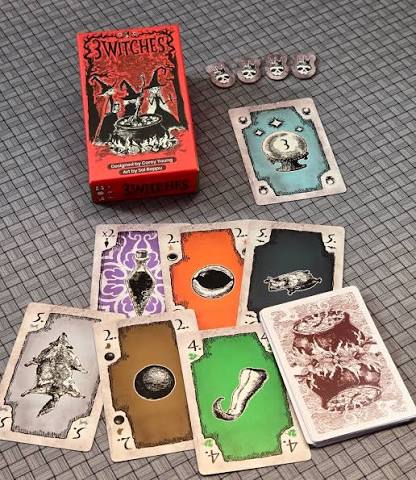
It might be a hard sell to get you to purchase a game that only plays with exactly three players. But 3 Witches manages it pretty well. This is a trick-taking game in which the player who bids highest must play against the other two players.
The components consist of only 18 cards, all of which are dealt out each round. Yet there are five suits as well as one unsuited special card, meaning each suit only has 3 or 4 cards in it. Players are required to follow suit when possible, but the winner of the trick is simply the highest card, regardless of suit.
The start player gets a chance to bid that they will take 3 or 4 tricks. If they bid 3, the next player can bid 4 and so on, but once someone has bid 4, they become the solo player. The inability to bid on taking all five tricks is a good design decision; it seems to come up often and prevents a player that simply got a dealt a good hand from winning the round on auto-pilot.
The solo player will lead every single trick. They will do this by playing one faceup and one facedown card. The faceup card sets the suit that must be followed if possible. Each defending player then plays one card. High card wins the trick, however if a side’s cards match in suit or rank, they are added together instead. This provides opportunities for teamwork for the defenders and bluffing for the solo player.
If the solo player makes their bid, they score two points. If the defenders prevent this, they each score a point. First to five points wins. As you might expect, this can create some peculiar kingmaking dynamics, sometimes even seeing one of the defending players trying to help the solo player win. It’s not a dealbreaker, but it might be perceived with distaste by some players who aren’t expecting it. This scoring system does also mean that ties are possible, maybe even likely.
For its niche, 3 Witches works well. The discovery of how to play well will take several sessions at least, a surprising depth for a game so fast-playing and component-light. But it’s still easy to name a dozen or so trick-takers that I’d recommend before it.

Mountain Goats – 7/10
Mountain Goats has been around since 2010, but was recently republished by Allplay, which seems to have sparked new interest in it. (In fact, they also published it in a tiny box version with no mechanical differences and also created a legacy version.) This is a lightweight dice game a bit reminiscent of Can’t Stop, but with an even shorter playing time.
Your goal is to collect the most point cards, which you will do by reaching the top of a mountain path with one of your goat meeples. These paths are numbered 5 through 10, and moving up one requires dice rolls that add to exactly that value. Higher values have shorter paths to the top.
On your turn, you roll four six-sided dice and then break them into whatever combinations you see fit. Low rolls are obviously worse, but if you roll multiple 1s, each one after the first becomes a wild. There are no re-rolls or push-your-luck with the dice themselves, but there is a certain element of push-your-luck in how you interact with the other players. This is because when you reach the top of a path, you remain there until someone else kicks you out. And as long as you remain there, each roll of that path’s value lets you score the points again, rather than having to start all the way from the bottom each time.
You can also get significant bonus points for collecting a card from each mountain path, though this becomes less appealing the higher the player count. Still, this does provide another layer of texture to the decisions present.
Mountain Goats is a filler game that just works. It’s hard to imagine anyone despising or revering it. You’ll have some games where the dice just don’t roll your way and some games where you make it to the top of a valuable path and can just sit there scoring points over and over again. And that’s fine and dandy for a game of this length.

The Game Makers – 7/10
In 2009, a game was released called The BoardGameGeek Game, which was a set collecting game where players took on the role of game publishers. It was themed with other real board games at the time from six different publishers. The game got pretty mediocre reviews, though it’s still barely hanging on in BGG’s top 10,000 games of all time. There was an appealing idea here, it just needed a better execution. And The Game Makers has delivered on that promise, with more interesting gameplay and a stable of over 100 publishers to pull from for the theming.
You will start the game with a few cards, each representing a board game along with the components needed to manufacture it. Depending on the game depicted, you’ll need some combination of plastic pieces, wooden pieces, dice, cards, and tiles. Each of these comes in three levels, with higher-level ones being able to sub for lower ones, but not vice-versa. Interestingly enough, each component you collect has an alternate use, but you need to decide this at the time you receive it. The wooden meeples can be used to take extra actions instead of as wooden components. The plastic pieces can instead be used to unlock special abilities. The tiles can instead give you ongoing discounts. The dice can instead increase your endgame bonuses. And, cleverest of all, the cards can either allow you to start manufacturing the game they depict, or else as card components needed for a different game.
The process by which you gain these resources is reminiscent of Fromage. Each turn, you’ll place your three forklift tokens onto a rotating wheel depicting the various types of resources. You can get low-quality resources and then take your forklift back right away, medium-quality resources losing your forklift for the next turn, or high-quality resources by losing the next two turns. Given that you will need high-quality resources at some point, it’s really a question of when, not if, you’re going to have a very boring turn where you only place one or even zero forklifts. Sequencing and long-term planning are crucial here and nothing is obvious, which is to the game’s credit.
There are a lot of really good ideas here, some that are even clever enough to elicit a gasp or giggle. But it still doesn’t come together in a way that aligns with my personal preferences. It’s easy to fall behind and never recover, interaction is barely present, and the inability to get what you need in an efficient manner can feel ponderously slow if not outright frustrating. I’d also be remiss not to mention the $200 price tag, which while somewhat justified by the component quality and quantity seems to miss the mark a bit for the complexity of a game like this, which is really just a mid-weight euro (see also: Foundations of Rome). For me, The Game Makers is good but not great. I want to play my friend’s copy from time to time, but not rush out to purchase it myself.

Gunsen: The Battle for Toshi Ranbo – 7/10
Set in the world of Legend of the Five Rings, Gunsen is a 60-90 minute dudes-on-a-map game that integrates euro game sensibilities in ways that have drawn comparisons to Scythe and Kemet. The game is a race to 7 achievements, with the options for doing so mainly involving winning combats or building up various resources.
On your turn, you will choose an “order card” from the five random ones in the display. Each will give you a few resources, or allow you to pay for even more resources. Then that card is slotted into your personal clan board, also activating all other cards of that color. Thus you are incentivized to take cards of all the same type. But of course it’s going to be very difficult to complete goals while ignoring 3/4ths of the possible actions afforded by your board.
So you will absolutely need to take cards of each of the four colors throughout the game. And you will have to be tactically adaptable based on what cards are available, as well as considering what cards your opponents may want and what goals they are pursuing. Both you and your opponents can effectively pursue goals of building up particular resources at the same time, but when it comes to combat, the interactivity becomes highly relevant.
Combat occurs when you move your troops into a territory on the map that is occupied by your opponent. This can only occur once per turn. The size of your armies is compared, along with any bonuses from cards, and then dice are rolled. The dice depicte wounds that kill enemy units, shields that block wounds, and swords that contribute to overall strength. The highest strength wins the battle, but won’t be able to claim the rewards unless at least one of their units survives. This is a good system that manages to be both exciting and efficient (though turns with combat will still take longer than those without).
Winning battles is another way you can score achievements. Battles are likely to take place a few rounds into the game as players will have built up by then, but there are strong incentives to do it sooner than later. The center space of the board is a fortress called Toshi Rambo, and taking over it for the first time will score an achievement. You also get a temporary achievement for holding onto it. With those two achievements combined, plus another one for winning a battle, it’s very possible to take over Toshi Ranbo and immediately win the game. In fact, this seems like the most likely way for the game to end.
Gunsen’s decision to provide variable player powers as well as a vast array of means to score achievements creates a high amount of rules overhead for how fast-paced the game can be. I’ve only played once, yet it felt difficult to see the progress towards the endgame as any kind of arc. I couldn’t identify if we were in the opening, mid-game, or oh it’s over? No doubt becoming more familiar with what’s possible would lessen this somewhat. And the different clans have just enough going on that it’s intriguing to consider playing as a different one. But I think Gunsen is a fun experience rather than a transformative one.

Railroad Tiles – 8/10
Railroad Tiles follows in the footsteps Railroad Ink, its roll-and-write predecessor. But rather than rolling dice to generate the streets and railroads that will be written onto your board, this game has you build your network out of pre-printed tiles.
There are several ways to score points. First of all, you would like to build the largest complete rectangle of tiles, incentivizing you to fill in gaps. Secondly, you want to close off as many open-ended roads and tracks as possible. Thirdly, you want to use tiles that have towns printed on them to make many separate cities composed of at least three town tiles each. Finally, you want to populate your networks of rails and tracks with car, train, and pedestrian tokens, with the point values increasing the more tokens populate a single route.
It might sounds like a lot to think about, but each one of these goals is very simple to understand, even more so when you see it in action. However, as you can probably imagine, these goals are often (though not necessarily) in tension with one another.
Adding another layer of interest is the way these tiles are acquired. Before each round, several sets of tiles will be laid out to be drafted by the players. It’s nearly always desirable to take the pile with the largest quantity of tiles, but doing so will mean that you choose last in the following round. Looking for opportunities to take a small pile of tiles that fits the needs of your board is key.
Between the tough choices in the draft and the complexities of managing the scoring opportunities in placement, Railroad Tiles is a highly-tactical exercise in managing trade-offs. It occupies the space between a filler and gateway game, which for my money makes it easy to reach for in a lot of circumstances. It might not be an all-time classic, but it’s the kind of game that makes it into your travel bag with regularity.

Greylune – 8/10
In 2005, William Attia had his first game published. That game was Caylus and it took euro game lovers by storm, eventually reaching the #1 rank on BoardGameGeek. In subsequent years, beyond a few Caylus spinoffs, his output was remarkably slim: a couple word games (neither of which was published in English), a roll-and-write in 2023, and a game called Spyrium in 2013. Greylune is a reimplementation of Spyrium, but if you were unenthused with this predecessor, don’t let that dissuade you. There are some fascinating and fun ideas here.
While ostensibly themed around gathering companions and magical items to go on fantasy adventures, Greylune is quite abstract. The theming is pretty to look at, but barely even serves as a mnemonic for the game’s mechanical underpinnings. Yet those underpinnings provide a broad, tactical decision space that demands on-the-fly adaptability and an understanding of the subtle implications of one’s choices.
In each round, there are nine square cards arranged in a 3×3 grid. You will take turns placing workers into the gaps between the cards, so that each worker borders two cards. At some point, you will move to the second phase of the round, which involves removing each of those workers to activate one of the cards it borders. Some of the cards you activate will stay in the grid for other players to use, some have a limited number of uses, and others will actually be removed from the grid and taken into your possession.
Because players may have different amounts of workers (or may wish to snatch up an in-demand card), players can move to the second phase of the round (removing workers) at different times. You’ll want to go as soon as possible, but you also don’t want to have unplaced workers that go to waste. Further confounding these decisions is the fact that you have to pay an additional coin for each other worker next to the card. So high-demand cards become more expensive, and yet as workers get removed will actually become cheaper. There is almost a push-your-luck feeling to how much you are willing to spend and how early to take a card before someone else beats you to the punch.
There are lots of other options for your workers as well. Some cards you acquire provide alternate uses for them, each round has a random “festival action” they can be used for, and your player board has a space for one as well. If and when to use each of these is both crucial to your success and also very difficult to plan for. It’s these tactical challenges that give Greylune its unique feel.
For those who like their euro games with a bit more theme, you’ll be irked by the abstraction. For those who like their euro games with more long-term strategic planning, you’ll be frustrated by the high amounts of tactical adaptability required. And all new players will be annoyed by the iconography, which is nearly never intuitive, rather only serving as a reminder once you’ve already read the explanation of a card in the rulebook. Nevertheless, Greylune gets credit for being a game that doesn’t quite feel like anything else out there. The gaming world is a better place because it exists.

Drillers – 9/10
Drillers is a newly-released deckbuilding game about drilling into the earth to find precious minerals. You’ll start with a deck of cards representing your mining robot, and gradually repair and improve it throughout the game allowing you to mine deeper and find more valuable gems.
The cards in your deck provide you with two main resources: movement and drilling power. Movement will allow you to move deeper into the mine (and back to the surface) while drilling provides several ways for you to score points and get money by excavating the room you move to.
The catch is that each of these cards costs fuel to play. You can discard cards for fuel instead, but that’s pretty inefficient. It may, however, become completely necessary to prevent yourself being stranded down below. When you make it to the surface, your fuel refills to maximum automatically, and this is also when you get to sell your gems to purchase new cards for your deck.
There are echoes of games like Lost Ruins of Arnak here, but Drillers is definitely its own thing. It’s beautifully produced, strategic and tactical, and contains meaningful interaction without being too hostile. You’ll find yourself becoming attached to particular cards you’ve purchased, racing the other players to the deeper levels, and deciding how much damage you’re willing to take to push your mining bot even harder. All of these elements are just plain fun.
The drawback here is that the game will drag when played with the full complement of four. Most people seem to think that 2 players is best and I personally found it to work well with 3. But the turns can be so cerebral that waiting through three opponents’ turns will create a lot of downtime. Downtime in which you can’t effectively do much planning as your options will likely have changed quite a bit. Nevertheless, when your turn does come around, it’s always a joy, so even the wait at four might be worth it.

A highly recommended game that I have most certainly played prior to this month, probably many times.

Last Night on Earth: The Zombie Game – 10/10
This is a fast-paced tactical minis game with an incredible amount of thematic immersion. The stories you tell when the game is over always take the form of something straight out of a zombie movie (e.g., “Father Joseph sought refuge in the church while the zombie horde closed in all around him. Suddenly, Jade the High School outcast burst in, smacking a zombie in the head with her skateboard and clearing a path for them to make a break for it!”). It’s an amazingly cinematic experience.
Despite the level of story, there is a seriously tactical game here. One player or team will take the role of the heroes, and the other player or team will take the zombies. All the missions are scenario-based, and the creators have done a great job of really varying the strategies players will have to use based on very simple rules tweaks. Sometimes the zombies are extremely aggressive and the players just need to run. Sometimes the players are killing machines, trying to rack up a high body count. Sometimes the heroes are searching the buildings for important items or information, other times they are holed up making a last stand until sunrise. The rules themselves are easy to grasp, but the emergent gameplay that arises from them is vast.
Most of the games in my Top 10 have the ability to capture my imagination long after the game is over, and this one is no exception. The kinds of games that I daydream about and yes, obsess over. The kind of game where I’ve lovingly painted all the minis and bought the overproduced 10th anniversary edition despite already owning the base game. This game is perfect.
|





How do you think Railroad Tiles compares to Railroad Dice?
Curious if you had the same problem that I did with drillers. The difference between the green and yellow cubes is really close. You’re going to have problems if you don’t have really good lighting and possibly even a white background to set them on.
I like Railroad Ink, but I’m kind of favoring Tiles right now. I think the open draft works very well and adds a lot.
We did have some slight isssues with the color, but nothing that wasn’t corrected very quickly. It was kind of like “oops I guess that’s actually yellow” rather than “oh no I planned my whole turn around this!” You can’t rely on a certain color being there before your turn starts, so at absolute worst you just undo your turn a couple steps.
Re: Color
We never mistook one color for another, but I felt like we took special care each time to make sure it was the correct one. It wasn’t just grab the nearest one…