
3 Witches
- Designer: Corey Young
- Publisher: Allplay
- Players: 3
- Age: 10+
- Time: 20 minutes
- Played with review copy provided by publisher
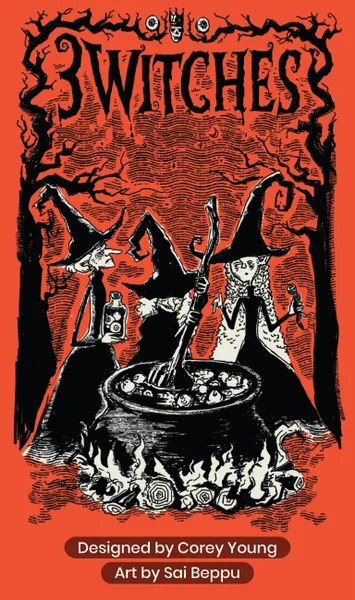
3 Witches is a must-follow, trick-taking game with no trump suit. At the start of each round, players bid on how many tricks they can win (out of five). The highest bidder becomes the Lead Witch, and their opponents play together on a team as Lesser Witches. The Lead Witch plays two cards (one face down), while the two Lesser Witches combine one card each. Two ingredients of the same rank or suit get added together, leading to tricky situations! If the Lead Witch wins exactly the number of tricks that they bid, they receive two fate tokens at the end of the round; if not, each Lesser Witch receives one fate token. The first player to collect five fate tokens wins.

To start, give each player a player aid which shows the card suits and their distributions. Shuffle the deck of 18 cards and deal each player 6 cards. The player who is dealt the Elixir card must make that known. The player to the left of the Elixir starts the bidding – legal bids are 3 or 4 tricks or a pass.
If a player bids 3, everyone else has one more turn to either bid or pass. If someone bids 4, they win the bid automatically. The winner of the bid is the Lead Witch. The other two players team together as the Lesser Witches.
In the case where all three players pass on the bid, each player simultaneously passes 2 cards to the left, and the Elixir must be amongst the passed cards. Now, the player who is to the left of the Elixir starts bidding again.

If there are three rounds of passing – and you’ll know this because the Elixir will end up back in the hand of the player it was dealt to – there is one final round of bidding, and if no one bids, the player with the Elixir must bid.
The game now moves into a trick taking phase. In each trick, each team will play 2 cards and whichever team plays the highest combined sum will win the trick.
To start, the Lead Witch plays 2 cards, one face up and one face down. The Face Up card determines the lead suit for the trick. The first Lesser Witch must now follow the suit if possible. If they cannot follow, they may play any card or they can pass. The second Lesser Witch must now also follow suit if possible. If they cannot follow, they can play any card. Finally, if the First Lesser Witch has not yet played a card, they must now do so.

If the Lead Witch plays a 2 card face up, the Lesser Witches must play their cards facedown – though they must still follow suit if possible.
If the Elixir is played (by any player), there is no rank on that card; in the scoring, the other card in the pair scores double.

To resolve the trick, the Lead Witch now reveals their facedown card, and the pairs are summed:
- If both cards have the same rank, they are summed together
- If both cards have the same suit, they are summed together
- Otherwise, the score is simply the higher of the two cards
The team with the higher score wins the trick. The Lead Witch wins all ties. The team which won the trick then decides which of the two played Lead Witch cards to return to the Lead Witch’s hand. If this decision is made by the Lead Witch, the choice of card is done secretly. One exception, if the Elixir was played, the Lead witch must keep the Elixir. The Lead witch always leads the next trick.
At the end of the 5 tricks, see if the Lead Witch has made their bid exactly. If so, they get 2 Fate tokens. Otherwise, each of the Lesser Witches gets 1 Fate Token. The game is won by the player(s) who first reach 5 Fate Tokens.
My thoughts on the game
There aren’t many trick taking games that play specifically three, so I was very interested in giving this one a try. I’ve now played it a few times, over the course of the whole year, and it remains a game that is interesting – in part because I can’t figure out how to consistently succeed at it.
The game has a unique bidding system where the player who thinks they can take the majority of the tricks ends up on their own while the other two players team up against them. The Lead Witch has the benefit (well usually it’s a benefit…) of leading every trick, and that definitely helps them chart their way through the five tricks. Of course, the big catch here is that the Lead Witch must make their bid exactly, so planning is of utmost importance.
When I play this game with newbies (myself included), I find that new players often try to bid whenever they can. Sure, the Lead Witch gains 2 VP when they successfully make their bid, but it’s not as easy as it looks. More often than not, at least around here, the Lead Witch fails and the Lesser Witches each score 1VP.
I think that new players undervalue the amount of information and strategic ground that comes from the card pass – if all players pass on the bid. If the bidding makes it to a second or third round, you now have much more information on which to make an informed bid. You know 2 cards in the hand of your left hand opponent, and you also know some cards that your RHO didn’t want. With this increased information – players can definitely make a more informed decision on what to do. But, until players realize this, the bid often never makes it out of the first round, and I think that’s why the Lead Witch fails so often.
The gameplay itself is a bit more interesting that most trick taking games because of the unique resolution. The suits are quite short, so there’s often room for the Lesser Witches to make tactical plays to help them either win or lose a trick.
Why Win or Lose? The Lesser Witches are bound by a limited communication rule, but they are allowed to at least talk about whether they want to try to win or lose a particular trick. This can be important because as the Lead Witch needs to hit their bid exactly, the Lesser Witches can try to set in either direction – by either winning too many or too few tricks. Once the decision is made, this can also alter the decision on which card gets kept by the Lead Witch.
3 Witches is a very situational game. First, you must have exactly 3 players in your game night. Second, they have to be willing to play trick-taking games. Third, they have to be fairly good at trick-takers because the game requires a fair bit of subtlety and finesse in play, and with the right players, this game can shine. If players cannot make those subtle plays, it can be a bit fragile. If you’re a fan of trick-takers, this is worth a try to fit that niche of 3p only games.
Thoughts from other Opinionated Gamers
Nate Beeler: It’s been a while since I played this, but I remember going in thinking it was an interesting set of mechanisms. The game definitely rewards repeated plays, because it is truly difficult for newbies to make an exact bid as the lead witch. Like, it felt impossible. My recollection is we played it again right away, not because we love it, but because we were sure we must have missed something (and because it was short and we felt it held promise). Indeed, in the next game we all found more interesting ways to bid for and play as the lead witch, and I think the game started to become what it was meant to be. Still, I’d rather just play Cosmic Eidex if I’m going to play a three player trick taking game.
Joe Huber (1 play): I have no doubt that I didn’t see everything this game has to offer. But given the existence of Schnäppchen Jagd and Flaschenteufel, I’m not lacking for three player trick-taking games, and I don’t play with the same group of three regularly enough to be likely to reach the point that Dale has – and not encouraged enough by my one play as to explicitly pursue that point.
Dan B. (3 plays): No doubt if I played more I would get to the point where the Lead Witch doesn’t always get set by being forced to take more tricks than they bid – but I don’t feel the need to do so. As Joe notes, there are some fine trick-taking games that are excellent with three players, and if the correct way to play this game is to pretty much always pass on a round or two of bidding in order to get more information, I honestly don’t think I’d find it that interesting.
Ratings from the Opinionated Gamers
I love it!
I like it. Dale, Derek
Neutral. John P, Nate Beeler
Not for me… Joe H, Dan B (although I’d play if asked, it’s not that long)


A rule in which the high bidder plays against the other two is not unique to this game.