
Well, Pandasaurus has had a number of new summer releases, and two of them share names with classic games. Daryl Andrews is back to his old tricks, and he has reworked both of these games into new versions.
Gulo Gulo
- Designers: Wolfgang Kramer, Hans Raggan, Daryl Andrews, Jurgen P. Grunau
- Publisher: Pandasaurus
- Players: 2-6
- Age: 5+
- Time: 20-30 mins
- Amazon affiliate link: https://amzn.to/4yiVGiL
- Played with review copy provided by publisher
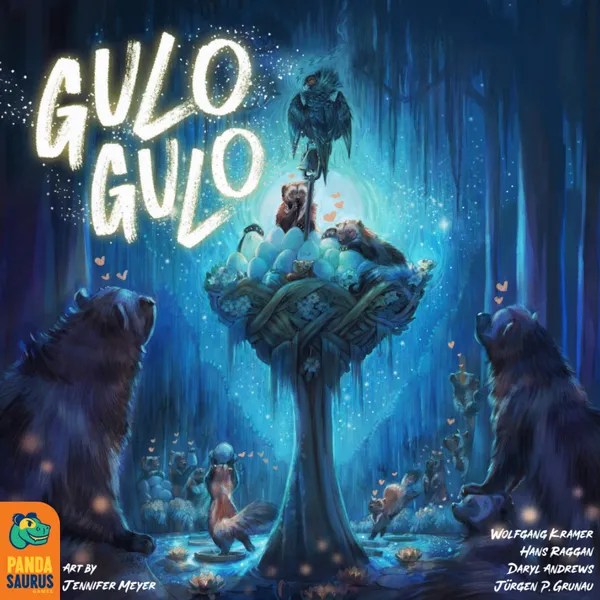
Each player is a Gulo, or wolverine, trying to rescue a baby Gulo who got caught by the swamp vulture whose eggs it was trying to steal. Unfortunately for the baby Gulo, all the adult Gulos are distracted by all the delicious swamp vulture eggs, and it has to wait very, very patiently as the adults constantly trip the very, very sensitive “egg alarm” rigged by the vulture to scare off the pesky Gulos.
There is a nice wooden bowl filled with multicolored swamp vulture eggs of various sizes, into which a long thin dowel with another egg at one end is inserted, like a flagpole. As you can imagine, lots of M&M Peanut-shaped wooden bits banging around together in a polished wooden bowl makes it rather difficult to keep a thin dowel with weight at the top balanced…
The essential mechanic of the game is to try to pull an egg of a particular color and move to a tile of that color on the linear path toward the bowl, and the little stack of tiles hiding the baby Gulo tile. If you set off the alarm, or knock any eggs out of the bowl, your Gulo is sent back to the previous tile of the attempted color. If there’s no such tile, then back to the start he goes!
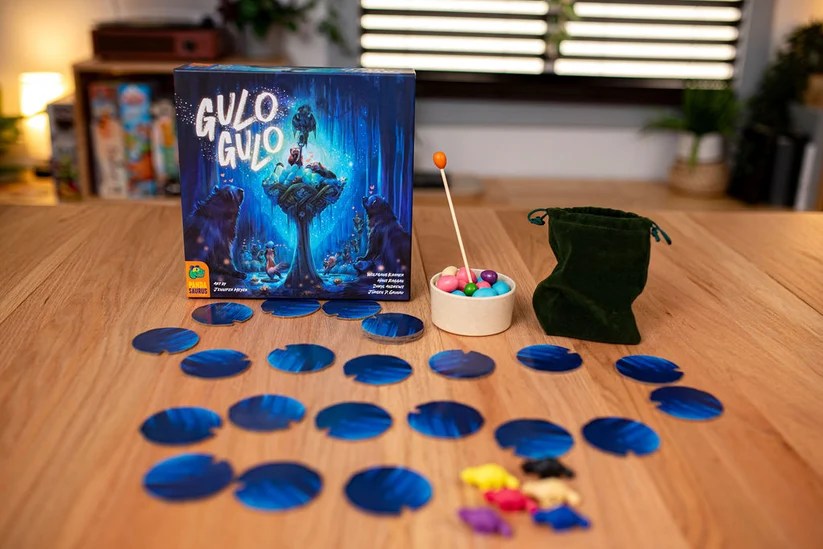
Setup the nest by mixing all the eggs within and then placing the alarm pole in it – making sure the heavy end is up top. Shuffle the yard tiles, then pull 4 of them aside and add the Gulo Junior tile to make the Nest deck. This is shuffled and placed next to the nest. Then make a trail of the yard tiles away from the Nest.
A turn involves three steps:
1] Choose any tile in front of you, up to and including the first facedown tile in the path. If it is face down, flip it over.
2] Steal an egg from the nest that matches the color of the tile that you have chosen. You must let everyone know which egg you are trying to take. You only use one hand and you must remove the egg without setting off the egg alarm. If you steal an egg, place it in the bag.
3] Move your Gulo to the next tile in the path that matches the color of the egg you stole. If you fail at stealing , you must run backwards as penalty to the tile that matches the color that you tried to take. If the Egg Alarm is triggered, the nest is refilled with all the eggs from the bag, and then the Egg Alarm stick is reset.
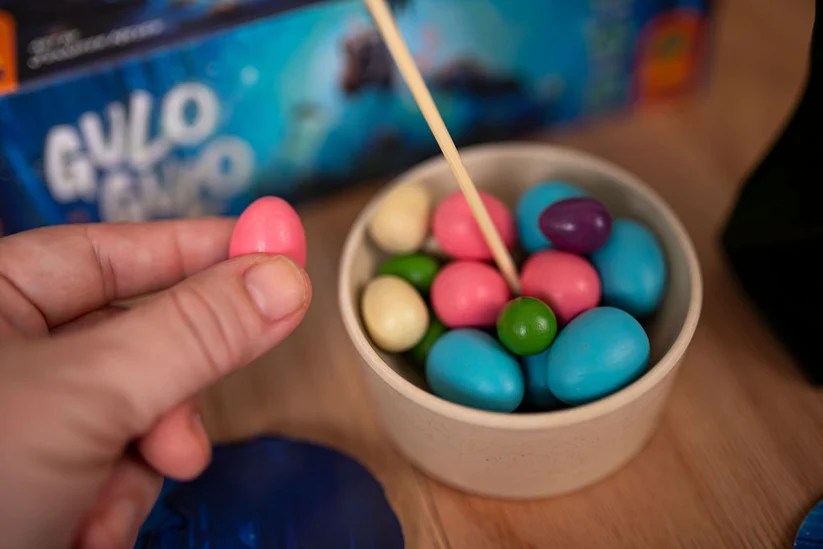
If you are able to take the last egg of a color out of the nest without triggering the alarm, you get to take an extra turn immediately – though you do get to also reset the nest before taking the extra turn.
Once someone is at the end of the path, they now flip over the top tile of the Nest stack and then try to steal an egg of that color. If they are successful, they add the tile to the end of the path and go again. If they fail, they move backwards using the regular rules. If it is the Gulo Junior tile, they must try to steal a purple egg – and if they succeed, they win the game.
So, I hadn’t played this game in maybe 15 years, mostly because I had always felt this was more of a kid’s game, and my kids haven’t been the age to want to play this sort of game for about… 15 years. Umm, this new version honestly feels the same. It’s still a kids dexterity game. I no longer own the original, so I’m don’t have anything to compare to – but it really feels the same.
Some research online shows that the main changes here are in the rules – streamlining the rules about moving backwards as well as the final stack of tiles. Is that really enough for a design credit to be added for Mr. Andrews? Who knows. From my standpoint, the best thing about the new version is that it does make the game available to a whole new generation of gamers. It’s certainly still lots of fun to try to wiggle those eggs out of the nest, and it is nice that this game allows younger players with smaller fingers to really compete with their fat fingered parents.
If you have never played the original, or if you was to reminisce about kids games from the past, give this one a look.
Mark Jackson interjects: While I haven’t had a chance to play the newest version, I’m a huge fan of the original game & could not be more excited to see it back in print.
Dexterity games are tough with kids – they like the chunky bits & the whole “stack stuff & watch it fall over” – but younger kids just do not have the proper fine motor skills to compete with adults successfully. But they can play the oddly (but correctly) named Gulo Gulo… a dexterity game in which the smaller the hand, the better the player. That’s right: the younger kids have an advantage here. (BTW, “gulo” is the genus name for wolverine – told you it was correctly named.)
The game works with smaller kids (and mixed age groups) for a trio of reasons:
- There’s not a lot of difficult decisions… it’s pretty easy to figure out your best move, even for younger kids.
- The penalty for failure is not too severe… in fact, the layout of the tiles can make it very easy to catch up.
- The tiny fingers of small kids have a much easier time getting out the eggs than adult-sized fingers. (I lost count of the number of times my younger son would PLUNGE his hand into the bowl to grab an egg without causing a disturbance.)
I’ve seen kids as young as 3 play this game… though I’d probably recommend 4+ due to the “please don’t bump the table” factor.
Amazon affiliate link: https://amzn.to/4yiVGiL
Hacienda (version 3.0, 2026)
- Designers: Daryl Andrews, Wolfgang Kramer
- Publisher: Pandasaurus
- Players: 2-5
- Age: 10+
- Time: 45-60 minutes
- Amazon affiliate link: https://amzn.to/4zXCvgb
- Played with review copy provided by publisher

In Hacienda, you’re not just managing land—you’re restoring an ecosystem. Set in the wilds of Argentina, players take on the role of eco-conscious entrepreneurs re-wilding the Patagonian steppe. Through careful stewardship, you’ll introduce native animals like pumas, capybaras, and guanacos while competing to create the most thriving eco-tourism business.
The game blends card-driven strategy with spatial planning. Each turn, players use terrain and animal cards to place land and animal tokens on a modular board. Expanding habitats, building chains of land, and connecting to water sources or visitor centers are key to scoring points. Strategic placement unlocks powerful actions, while viewing platforms and water tiles offer long-term advantages.

This edition of Hacienda introduces several major changes from the second edition: a fully modular board that scales with player count, a brand-new card-based action system that replaces the original currency mechanism, and a completely reimagined theme focused on conservation and eco-tourism. It also features upgraded wooden components for animals and land markers, adding a premium tactile feel. For even greater variety, the game includes variable board powers via special Visitor Centers that add new layers of strategic depth and replayability.
Confusingly, for me, this is the third version of this game, all with the same title. The original version came out in 2005, and it did seem to have good success in the market and with the critics. In 2019, the game got a second life, published by White Goblin Games. For the most part, the rules were the same, though I remember there being a new variant scoring added.
This new version in 2026 again shares the same name, but it is a much different game. The publisher touts “major changes” but really I think they mean to say that it’s a totally different game! In this sense, I find it confusing that the game still has the same name as it is most definitely not similar to the game on which it was based.

In the original game, you used land cards and separate animal cards to claim things. Here, there is a single deck of cards where you combine icons on your cards played to make claims. No longer do you buy cards, you simply spend an action to get one. Also, in this new version, you always get 2 cards when you place next to a visitor center (nee Markets) – in the old version, while you earned coins, it was related to the size of the animal group that touched the market.
The strategy seems a bit more simplified with the rules changes. In the 2026 version, it felt like the majority of my decisions were simply based on the matches that I made from the cards that I drew.
The new version does add a modular board system which should give plenty of variety when setting up the game. I’m not a fan of the animal meeples in this version as they don’t stand up well enough but they are too large to fit onto the hexes. Dealing with the toppling meeples was a constant annoyance in my most recent game.
The changes here seem OK, but this definitely isn’t the Hacienda that I remember. Heck, you can’t even build a freaking Hacienda in this version! Maybe it would have been better to call this Visitor Center or Viewing Platform?
Amazon affiliate link: https://amzn.to/4zXCvgb
Until your next appointment,
The Gaming Doctor


I liked the original and was really looking forward to it but this version does not make me interested in playing the game