
Container
- Designers: Kevin Nesbitt, Franz-Benno Belonge, Thomas Ewert
- Publisher: Allplay
- Players: 3-5
- Age: 14+
- Time: 45-90 minutes
- Amazon affiliate link: https://amzn.to/4gaQQNd
- Played with review copy provided by publisher
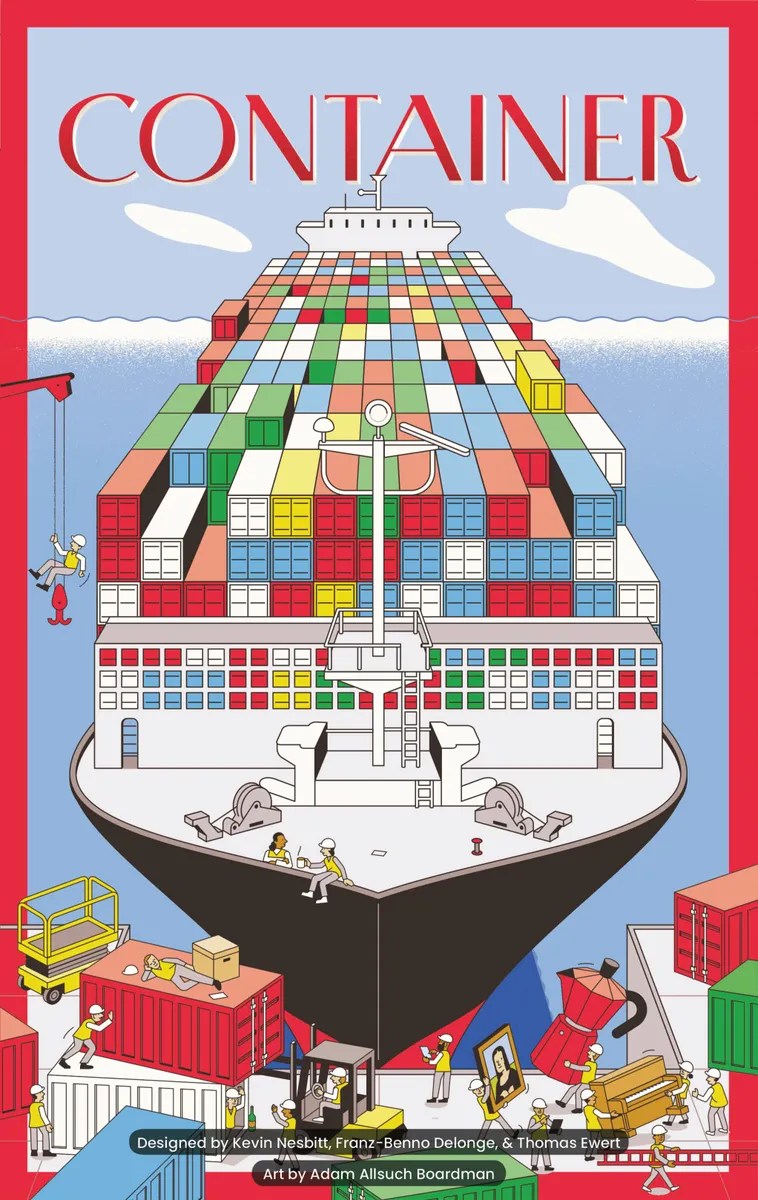
Every decision you make in Container shapes the market. During play, you build factories, produce containers, set prices, negotiate with your rivals, sail across the sea to trade, and (obviously) buy low, and sell high. At least that’s the goal — but can you make it happen?
The rules for Container are simple; the real challenge is understanding and timing the market. Players build machines, warehouses, and containers, then sail your containers to the island and auction them off. Be careful with your money — in the closed economy, money’s tight and your opponents are cutthroat!
At the beginning of the game, container value cards are secretly dealt to all players. Because these values aren’t shown, you’ll have to suss out what your opponents are going for throughout the game! But at final scoring, these come into play. The player with the most money wins.
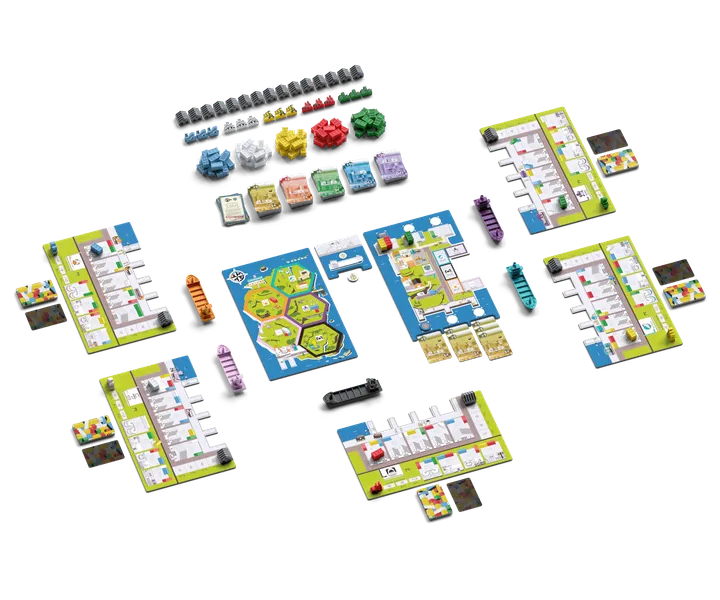
To set up the game, place the container Island and the Bank board in the center of the table, putting 2 random containers on the I space near the bank and a different colored one on the “II” space. The three cash auction bins are also seeded with money below the bank.
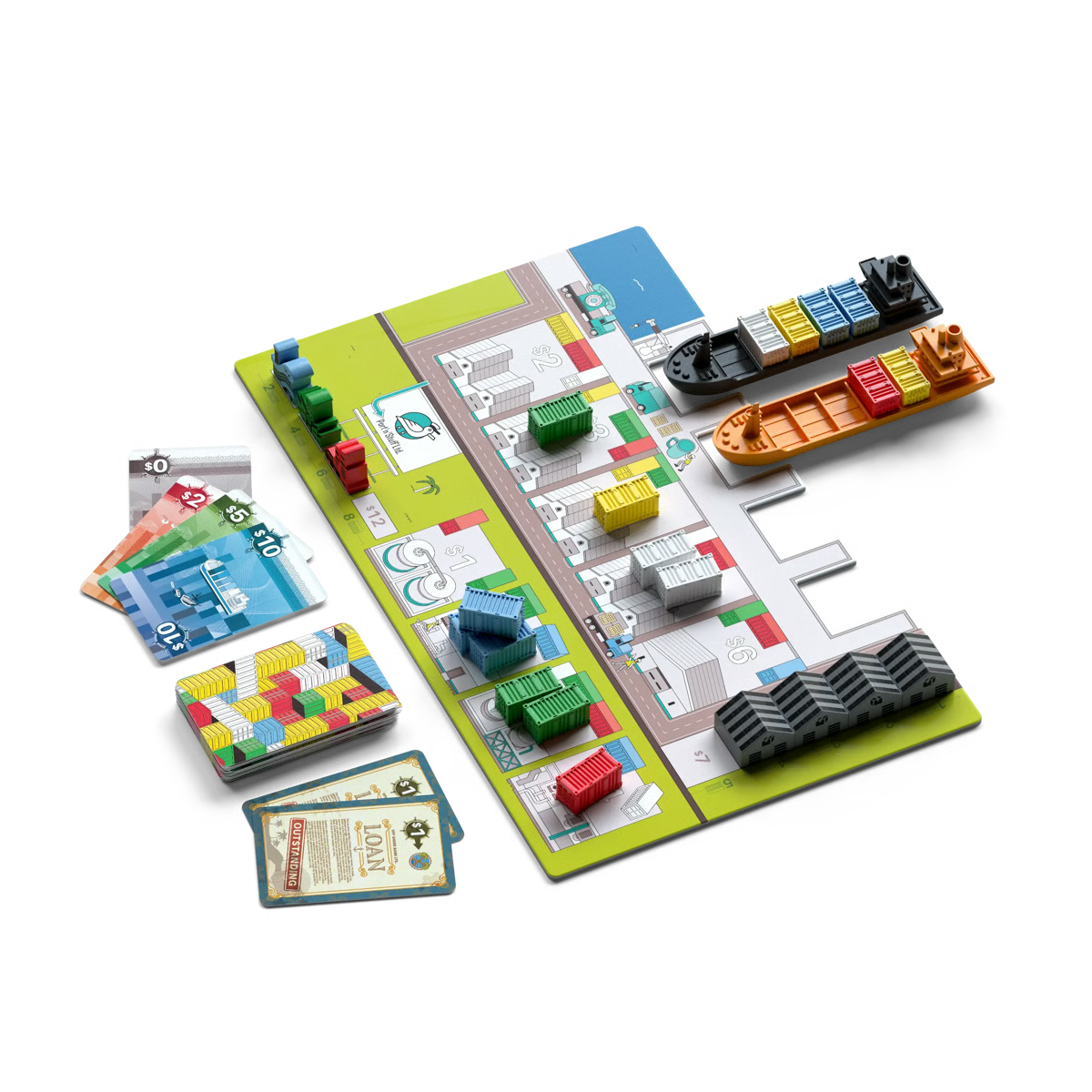
Each player gets their own player board and ship of matching color as well as one free starting warehouse. Each warehouse on your board will make a container of matching color whenever you produce. The total number of containers you can store is next to the warehouse spaces. Each player gets a random different colored factory and a container of matching color to be placed on the $2 lot on the bottom half of their board. When you buy containers from other players, those go into these areas and the price there shows how much it will cost for other players to deliver those containers. Interestingly, you can never buy your own containers nor ship your own containers. Players start with $20 and a secret end game scoring card.
Players take turns, each having three phases
1] Pay Interest on your Loans – you are allowed to take up to two loans, and you owe the Bank $1 for each one at the start of every round that you have them. If you cannot pay the interest on your loan, the Bank repossesses one of your containers and places them in the Bank’s container auction lots.
2] Win Broker Auction – if you have a high bid on one of the auctions at the Bank when your turn starts, you win that action. Distribute your bid amongst the auction lots of that type (skipping any lots with an active auction – i.e. when you win with cash, split the money as evenly as possible amongst the three money lots at the bottom of the bank. If you win cash, place it in your supply. If you win containers, place it in your holding area on the bank board.

3] Take 2 actions from this long list as well as any free actions you like
- Build a Factory – pay the cost shown on the next available factory space and choose a factory in a color you don’t already have
- Build a Warehouse – pay the cost shown on the next available warehouse space and place a warehouse there
- Produce – pay $1 to the player to your right for union fees, then each factory you have produces one container of matching color (so long as you don’t exceed your factory storage limit). These can be placed in any factory storage lot you desire; you can also reprice any previously stored containers at this time
- Factory Purchase – choose any opponent and buy any number of containers (so long as you do not exceed your harbor storage limit) from their factory storage lots, paying the cost for each based on their location. Move those containers to your harbor and put them in harbor storage lots, thus setting their price. You may also reprice any previously stored containers in your harbor.
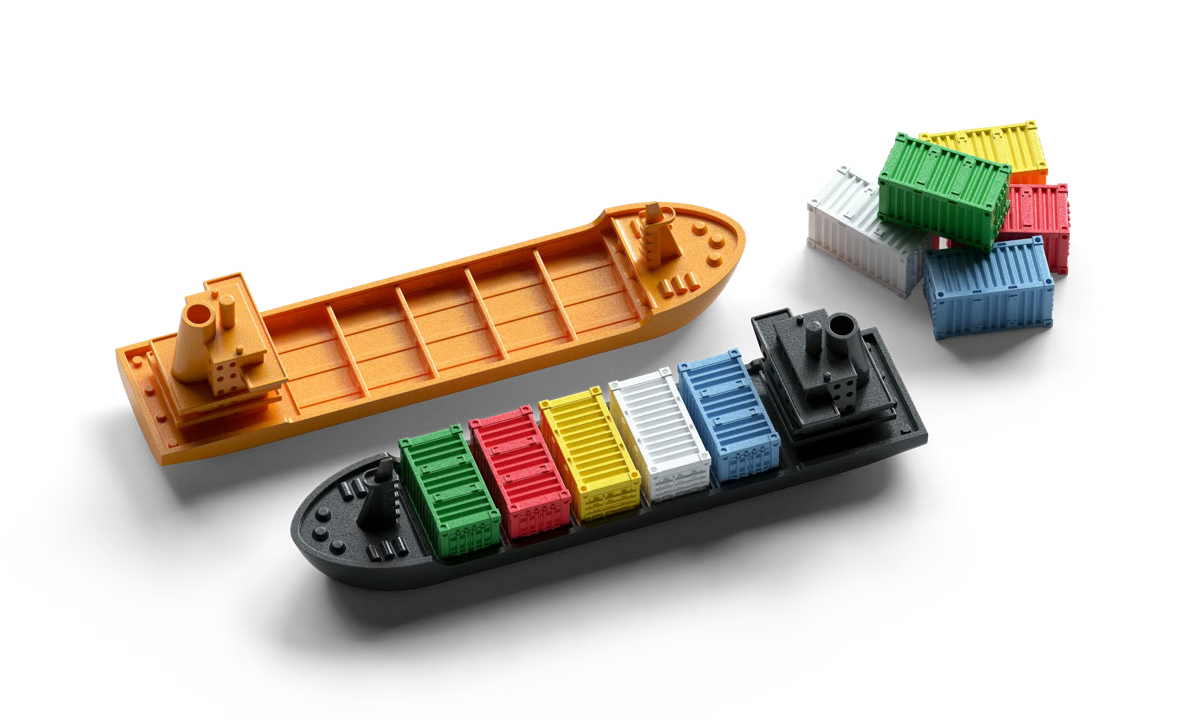
- Sail – Either move your ship from a harbor/island into the ocean OR move it from the ocean to a harbor/island. At every location (harbor/island/bank), there is a free action you can take when you move there
- Harbor Purchase – your ship must be in an opponent’s harbor to take this action, buy any number of containers in that harbor for the price (based on location). Your ship can hold a max of 5 containers.
- Reprice – choose one of the two areas on your board and reprice any or all of the containers in that area
- Call Bank – you can either start a new auction or bid in an active auction. There are two types – above the bank, you bid cash for containers and below the bank, you bid containers for cash. With 5 players, there can be one auction of each type, and with fewer players, only one auction total at the bank.
Free actions:
- When you move to an opponent’s harbor, you can take a Harbor Purchase Action
- When you move to the bank, you can load any number of containers from your holding area onto your ship
- When you move to Container Island, you immediately hold a Delivery Auction – all players make a facedown bid of money, possibly using $0 bluff cards. The highest bidder wins, and takes all the containers on your ship and places them in their scoring area. You collect the bid money as well as a matching bid from the supply. Alternatively, you can buy out the auction by refusing the highest bid and instead paying that high bid amount to the Bank money auction lots, and you take the containers to your own area.
- When you Build, you can also take a Reprice action in that area
- You can take a Bank loan at any time in the game. You immediately get $10 but must pay $1 at the start of each of your turns. You can have at most 2 loans
- You can repay your loan at any time for $10.
The game ends when the supply is exhausted of two colors of containers. The current player finishes their turn and the game ends immediately. All auctions are immediately won by the player with the bid marker.
My thoughts on the game
So, I’ll admit that I was a bit leery when Allplay offered me a chance to try their new version of Container. Why? Well, I remember the original game, and it had a lot of critics (myself included) that found the game too fragile. The economy of the game can definitely be cut-throat and competitive, but there was also too high a chance that it spiraled into stagnation causing a really long and dull game. Oh, also, the colors chosen for the bits were… not good.
I was happy to hear that Allplay had reworked the game a bit, using some of the changes started in the 10th Anniversary edition of the game, to help the economy from grinding to a halt. Those changes seem to have worked as our games thus far have been tight affairs but never once risked complete economic collapse.

It’s still not the most intuitive game to grok; though for the fans of this game, that’s probably the main selling point. You are both making containers as well as delivering containers, but you can’t deliver your own. So – you have to figure out how to entice others to come get your stuff while looking for bargains to pick up with your own ships. Then, once they arrive to Container Island, you’ll have to be savvy with the auctions to actually get things into your scoring area. This is the one exception to serving yourself as you can buy your own lot that you delivered – but the cost is high as that is money out of your account going back to the bank rather than 2x the bid price to refill your coffers.
The key (at least for me) about Container is that the entire game is about reading the table. There are not a lot of direct signals given by the game; you have to watch everyone else – what colors are they making, where is their ship going, how much room do they have on their ship, etc? If you can figure out what they want to do, you can then try to work together with them to get a marginal gain over everyone else. Rinse, lather, repeat.
The game isn’t as simple as max production and max shipping all the time – you’ll not have enough money to do both. Rather, you have to figure out where you fit into the closed economy of the game and leverage it as best you can. Maybe it’s having enough warehousing to turn a buck on each one. Maybe it’s making enough containers that people want to pick up from you. Maybe it’s doing a little of each.
Is it fragile? On the whole, I don’t think so. Looking at the way a single player could play it (poorly) – then yes. The game will likely play differently with each new group of players because so much of the action is determined by the actions of those in the game. It’s admittedly not my favorite sort of economic game, but it is definitely a challenging one to play – and thus, it hits the table every now and again. It is admittedly quite abstract, and it can go a bit long, but it’s definitely unique.
Ratings from the Opinionated Gamers
- I love it!
- I like it. Dale Y
- Neutral. Steph
- Not for me…
Amazon affiliate link: https://amzn.to/4gaQQNd


