Dale Yu: Review of Pioneer Rails

Pioneer Rails

  • Designers: Matthew Dunstan and Jeffrey D. Allers
  • Publisher: Dranda Games
  • Players: 1-80
  • Ages: 10+
  • Time: 45 minutes
  • Played with preview copy provided by publisher

Says the publisher:  “In Pioneer Rails, you represent a railroad owner who has seen an opportunity to expand your empire across the new lands of the frontier. You’ll be competing with other railroad owners to plan your railway in the best way possible to connect establishments to the railroad and satisfy the demands of the locals. Pioneer Rails is a Flip & Write game where you’ll use poker cards to extend your railway tracks and build a poker hand at the same time.  Each turn you’ll choose one of the revealed poker cards. The suit of the card helps you extend your railway, connecting you to new towns and surrounding features. When you connect to a town, you’ll gain the ability to do a one time bonus. When you surround a feature with your tracks, you’ll activate it for end game scoring. The value of the card is added to your poker hand, which you’ll score additional points for at the end of the round. Each game you’ll also be competing over 3 goals, meaning every game you’ll be pulled in different directions. The mechanism of surrounding features to activate them gives Pioneer Rails a satisfying ‘puzzley’ feel to the game. The variable objectives and the poker cards give enough replayability so no two games are ever the same.”

Continue reading

Posted in Preview, Reviews | Leave a comment

Dale Yu: Review of Gamegenic Card Boxes

Dale Yu: Review of Gamegenic Card Boxes

Gamegenic Card Boxes are one of the many gaming accessories that are now available on the market.  Gamegenic is focusing on the high-end of the spectrum, providing high quality deck boxes, sleeves, player mats, and card binders for the more discriminating gamer.

I have had the chance to use a few of their products recently, and I’m pretty pleased with how they have turned out. 

The Sidekick 100+ XL box comes in a variety of colors, and mine is a nice felted green color and a soft microfiber lining on the inside. The box is especially designed to hold sleeved cards, and as such, there is no crushing of the corners of my sleeves which can sometimes happen with other deck boxes.

As I have outgrown the CCG phase of my life, I don’t really have too many competition decks that require pampered travel accommodations, but I am still a budding game designer, and my Sidekick 100+ XL box is the perfect home for my trick-taking prototype game.  There are about 60 cards right now as well as a 4 page ruleset, and it all fits snugly in the box, with room for my notes and scoresheets.

The top is magnetic, and it comes completely off the top, or it can hinge back to allow access.  If you take it all the way off, you can place it underneath in order not to lose it, or you can actually use the lid to prop up the box to allow for easier access.  The other bonus of the removable top is that if I had multiple boxes, I could mix and match the tops and bottoms to form whatever combination I liked; and this would surely help with the rapid identification of the particular box I was looking for.  As the entire box is covered with the felt-like Nexofyber material, there’s nowhere to write a game/deck name on it, so the color is the only method of identification you have other than opening up the box and seeing what’s inside.

The magnets are quite strong, and they have yet to be dislodged, even when I tried tossing the box onto a chair or holding it upside down.  The prototype cards on the inside also did not suffer any damage, so overall, this is looking like a perfect storage solution for me.  It comes in seven different colors, and while the price is a little high for storage (MRSP $21), I’m not sure there is any other box that really competes with this for quality and security purposes. 

There are other versions which may be a bit better for your purposes.  The Squire holds cards in an upright orientation and the Watchtower adds a nice little drawer to hold dice, chits or other necessary bits with your deck. 

I also have a Dungeon 1100+ Convertible box which is so big, I’ve yet to find the right purpose for it.  It worked wonderfully as a way to bring a huge Dominion set up to the lakehouse – the base set, a few expansions, and then all the player mats, coins and whatnot (stored in my Sidekick 100+ XL).  

The channels in the box allow for both regular deck boxes as well as the swanky XL ones that they make.  The cover is also magnetic, and there are some small divots on the sides that really helps keep the top from falling off.  Again, I tried holding this box upside down (when filled with all the Dominion stuff), and the lid stayed firmly in place – pretty amazing really.

I think that I will likely end up using this as my primary trick-taking repository.  I’m thinking pretty hard about taking a bunch of my trick taking games out of their usual boxes and storing them here in the Dungeon 1100+ Convertible with some dividers separating the different decks.  The rules should fit in the sides of the channel near the cards they go with.

Both of these products are definitely at the high end of quality, and they are admittedly both “splurges” as far as game storage goes, but having a few samples to try has definitely shown me that there is good value here, and I’m certainly going to make good use of mine.  If you are looking for a nice way to store and show off your cards, the Gamegenic products would be an excellent choice.  

They also make a bunch of game specific accessories, and I would be remiss not to mention that they are now being sold at the BGG Webstore – https://boardgamegeekstore.com/collections/gamegenic.

You can go there to check it out and help support one of the best websites in our hobby.

Until your next appointment

The Gaming Doctor

Posted in Reviews | Leave a comment

Dale Yu: Review of High Score

High Score

  • Designer: Reiner Knizia
  • Publisher: KOSMOS
  • Players: 2-5
  • Age: 8+
  • Time: 30 minutes
  • Played with review copy provided by Thames&Kosmos

Says the publisher: “Roll some dice, make the right moves, get lucky, and earn the most points by the end of the game! High Score is a competitive dice game that marries the luck of the dice with strategic gameplay and ever-changing rules. 

Each round players are presented with a new challenge card that dictates different dice-rolling rules for that round. Players take turns rolling dice, deciding if they want to re-roll dice, and trying to get the most points possible as determined by the current challenge card: Do only the odd dice count? What value is the vortex die in this round? Which dice count towards your final score? The player with the most points by the end of seven rounds wins! 

Continue reading

Posted in Reviews | Leave a comment

The Scribbling Strikes Back: A Review of D&D Dungeon Scrawlers: Heroes of Waterdeep

“It’s like déjà vu all over again.”

Yogi Berra

Actually, it’s not déjà vu… it’s just the same game system with some nifty new wrinkles. If you’d like to, you can read my review of the original game (Heroes of Undermountain) here on the Opinionated Gamers website – there’s a lot more detail on how the game system works (plus Dale chimes in with his thoughts on the design.)

For those of you unwilling to click the link & hit the wayback machine, let me do a quick refresher on the basics of Dungeon Scrawlers:

  • It’s a real-time game of drawing your way across a dungeon map, interacting with monsters, treasures, spells, etc. with various feats of scribbling.
  • Players “interact” (aka black out, draw a line through, trace a pathway, etc.) various elements of the dungeon to score points.
  • Some elements involve racing to finish them first (killing a boss monster, finding and completing orbs, etc.).
  • Each player has a “special power” which allows them to interact with a single dungeon element in an easier way.
  • Some dungeons are timed (players have X number of minutes to score as many points as possible) while others are finished when one player takes out the boss monster.
Continue reading
Posted in Reviews | Tagged , , | 2 Comments

Maricel Edwards: Lock & Spell solo review

I’ve realized that I prefer sound bite reviews over narrative ones, which is ironic since I’m a writer. Then again, if one wants to spend less time reading and more time playing, this makes perfect sense. I’m also a sucker for lists and I hope you are too.

Lock & Spell

  • Designer: Sam Kennedy
  • Publisher: Jupiter Valley Studios
  • Players: 1
  • Age: 12+
  • Time: 30 minutes

*I received this game gratis in exchange for an honest review.


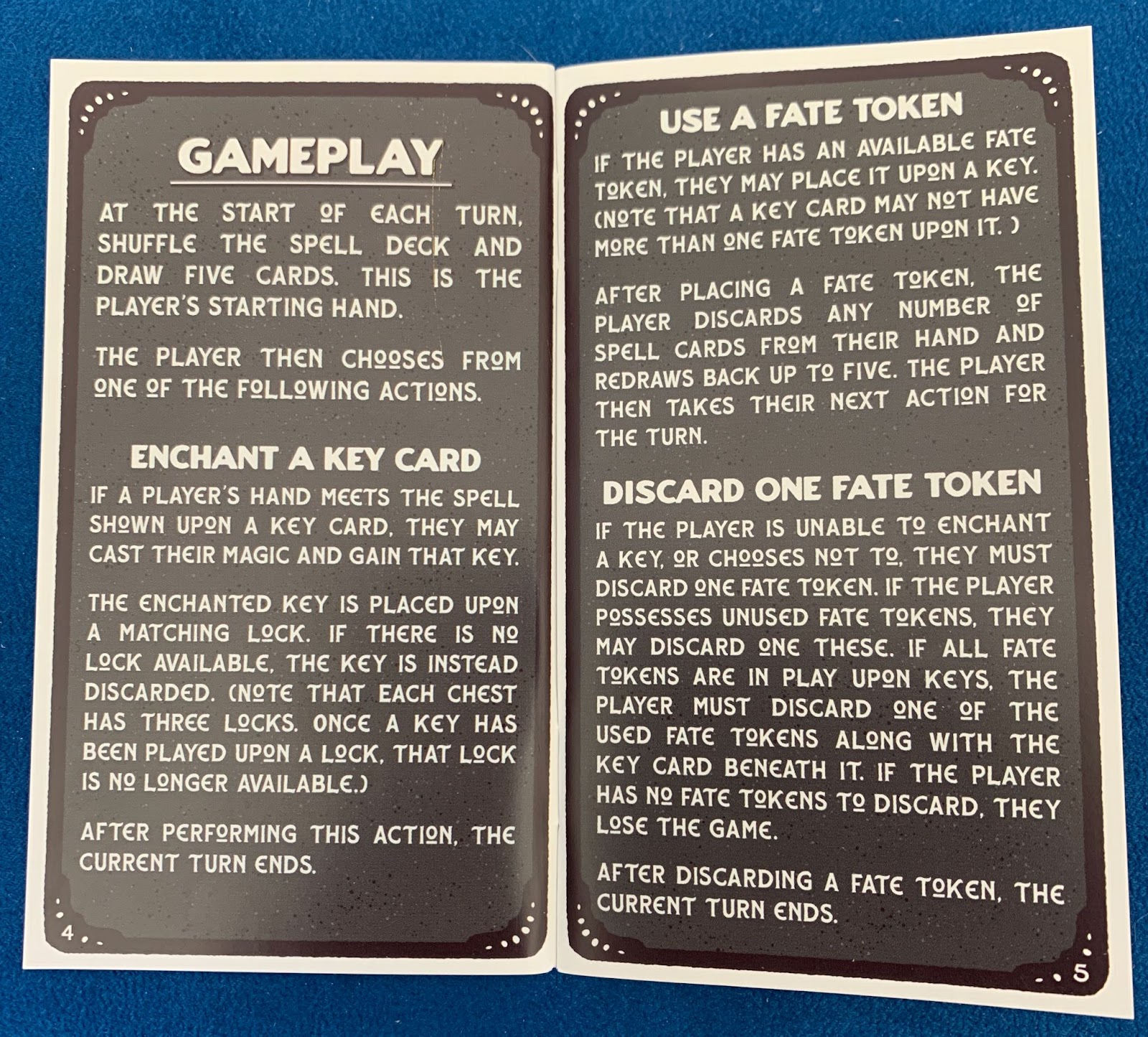
Firstly, I’m not one for gameplay explanations, so I shall just include pictures of the six pages of rules here because you know what they say is worth a thousand words, right?

Visceral reactions after a first play:

  • Low complexity as evinced by my being able to hold an in-depth conversation with my daughter whilst playing BUT…
  • This would probably be much easier and much faster with people familiar with poker hands. I constantly had to either chant in my head “flush is suits; straights are numbers” or reference the rulebook – which was brilliant, by the way because
  • The rulebook is compact in size and scope but super clear and concise. Setup instructions were literally contained in a single page of the 4.5” x 2.5” book and gameplay instructions took up six. The rest of the book consists of “fortunes” but more on that later.
  • Love the components! The spell deck – which you’ll be shuffling A LOT – is linen and wonderfully riffle shufflable. The other cards (treasure and keys) are linen as well, but those don’t really require much handling. The chest cards are your standard tarot sized semi-gloss (i don’t think there’s a core because, held up to the light, one can see the backs which really isn’t a problem since the color palette – black – is very forgivable in instances like these) which is fine since they don’t need to be shuffled beyond setup.
  • Box is compact – no air.
  • Font is pleasing – I’m a font snob so I know from fonts and this one is legible but not boring.
  • The color correspondence of spells to keys are genius, and makes it very easy to reference if one was inclined to use the rulebook (like I was). 
  • The art is vaguely steampunk-ish which I’m grateful for since most games that include “spells” tend to the fantasy genre. By opting for this Victorian aesthetic, the creator succeeds in elevating this game from a generic derivative to something memorable and special, even if 
  • I was wary about the spell cards being a normal deck of cards, but again, the font is large and clean, and when you’re “making spells” it needs clarity over art, methinks, so the creator made another wise decision here.
  • The addition of a fortune along with a scoring metric adds that extra sumpin sumpin to an already charming game, and I was actually more invested in finding my fortune than in tallying up my scores in the end.
  • The creator, Sam Kennedy, is super responsive, very kind, and open to critique.
  • My only gripe is that the score sheets do not fit in the box, so storage of it is problematic. I’ll probably end up not using it, which is a shame because, like the rest of the components, the score sheets are aesthetically pleasing.
Oh, score pad! Why you so much wider?

And for the narrative fans out there:

As you probably realized, a solid knowledge of poker hands would make entry into this game infinitely easier, but even without this, the rulebook does a phenomenal job in explaining them clearly and concisely. The footprint of the game is small – this would be a total travel game for me – and really, it could even be played cooperatively without breaking the game simply by having someone to consult when it comes to determining hands/spells. 

The box says 30 minutes of play, and I agree – barring my befuddlement with the hands/spells, of course – so it’s perfect for a before-bedtime session. BGG lists the weight as a 3 (medium heavy) but even to a light gamer like me, I’d bump this down to a 2.5. It’s not complex, but I suppose if you’re a serious poker player, play the odds, or count cards, then it could get analysis paralysis-inducing. According to creator Sam Kennedy, “I’d say repeated playthroughs help you become more familiar with some tactical choices to make with your spell cards, along with which keys to go for and when. You also find yourself coming across pretty exciting moments when you get just the right card you needed. (Or exactly the wrong card!).” I, however, played haphazardly, throwing caution to the wind and going balls out by utilizing fate tokens and discarding cards back to back, and I ended up with a score of 31 (rulebook says a perfect score is 50), but as I said, this didn’t matter so much since I did manage to open three chests and got a killer fortune for my efforts.

This game feels like John Burton’s The Brambles for me. That is to say, as a solo gamer, I don’t want to burn my brain with complicated rules or fiddly components and both these games are tailor made to my needs. Lock & Spell is a true gem, and I strongly recommend this game to solo gamers who are jonesing for a breezy but thinky mini game to add to their repertoire.

Posted in Reviews | Leave a comment

Talia Rosen: Pushing Your Luck on Your Own

I’ve been enjoying solitaire games more lately. It started during the pandemic with the four-game solo campaign version of Lost Ruins of Arnak: The Search for Professor Kutil. I was impressed with how the designers altered the underlying structure of the game to make for a compelling solo experience.  Then I enjoyed the solitaire versions of Dune: Imperium and Ark Nova, not as much as Arnak, but as a decent way to get more familiar with the rules and experience a shadow of the “real” game experience.  And most recently, I’ve enjoyed the challenge of trying to enact the 19th Amendment in the solo version of Votes for Women.  So I jumped at the opportunity to receive a review copy of Michael Erceg’s new solitaire game Cave-In.

I don’t write many reviews, and when I do they tend to be a little bit odd, like this comparative review for Clash of Cultures, or this rambling “review” of Living Forest.  So forgive my comparative and rambling discursion on push-your-luck games and solitaire gaming.

When I hear push-your-luck, I immediately think of Sid Sackson’s 1980 classic Can’t Stop and the Alan Moon and Bruno Faidutti spiritual successor Diamant (now known by some as Incan Gold).  There are of course plenty of other games with push-your-luck elements (Knizia’s Ra comes to mind and even the aforementioned Living Forest in a manner of speaking), but these two games strike me as the purest distillation of the mechanism with the entirety of the game revolving around players deciding whether to play it safe or risk it all.  Upon reflection though, the real joy of Can’t Stop and Diamant for me is largely in the player interaction.  The kibitzing and cajoling seem like a core feature with players encouraging each other to keep going and attempting to shame each other into going for broke.  The peer pressure of rolling those dice just one more time is what makes Can’t Stop so memorable.  And the chanting of “Ra! Ra! Ra!” when your opponent elects to pull another tile from the bag in Knizia’s classic auction game is real joy.

Continue reading
Posted in Reviews | Leave a comment