In this cooperative logistics game, players work together to deliver the 8 goods to the port city. The board is double sided with one side giving you a map of Western Europe (recommended for your first game) and the other showing the Continental US. Both maps are full of cities, connected with a bunch of tracks, coming together at 3-way and 4-way junctions. At the start of the game, black switch discs are positioned at the intersections so that only one path is open through each intersection. In your very first game, you are asked to copy a setup illustration from the rulebook, but later games give you rules to follow to make your own setup. Around the periphery of the continent, you will find orange hexagonal starting locations for trains.
Exacto is the next game in the No Plastic line from NSV – these games specifically do not include plastic to be better for the environment. Exacto is a simple observation game – in fact, really all that you do in this game is observe.
Prototype review copy sent to me by designer/publisher
Bobop is subtitled as a game for city lovers. It is an interesting idea, sort of a pocket sized way to explore a new place, or honestly, maybe even a city you’re already familiar with. It is a game meant primarily for couples – and it gives you a deck of challenge cards to help guide your exploration of your surroundings.
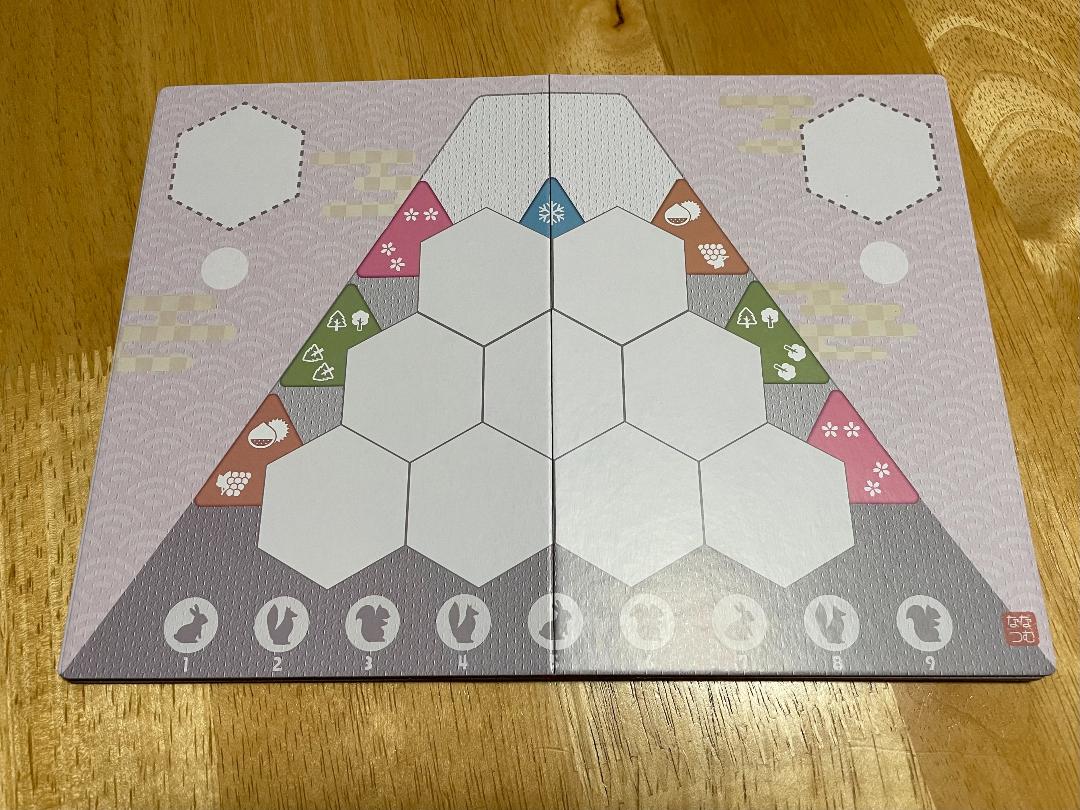
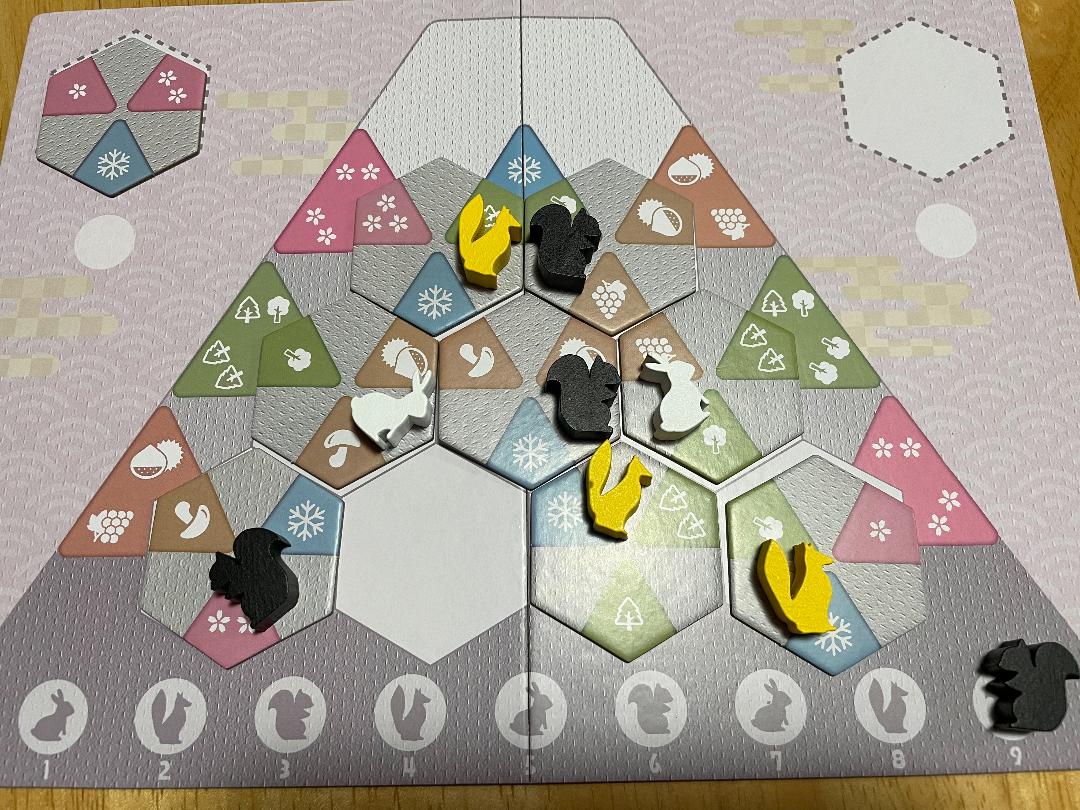
Fujiyama is a delightful tile placement game, themed around building the most beautiful mountain through the 4 seasons and attracting wildlife over 9 turns.
Fujiyama is a tile placement game. Each player has their own player board and the boards have asymmetrical starting seasons and animal order.
The players each take 11 tiles and have 3 animals of each type. Each tile has 3 season pictures and 3 mountain spaces. Season spaces are connected to make complete triangles of one season type to score. Mountain spaces hold animals.
To start the game each player draws three tiles. One to keep as a “trump” tile which they can use once during the game. In a multiplayer game the player will give the player on the right and left one of the remaining tiles. These tiles are placed on the other player’s board. Then the player will choose which of the received tiles to use on their turn. This was a bit tricky getting used to giving all the tiles away and not being able to keep one to play! When placing tiles players try to complete season triangles of the same season (color). triangles will score at the end of the game. Each season scores a bit differently for the icons. For example the spring season or pink scores for the number of blossoms present.
So players may think, why don’t I just give my neighboring tile the worst possible in regards to scoring? Well, here is where it gets a bit tricky again. If another player chooses to play the tile that you gave them, they must give you the animal on their board for that round. There are 3 animals: rabbits, squirrels and foxes. When you place a tile you may also place any animals that you have received that round onto one the gray flatland spaces of that tile (one animal per space). Flatland triangles score for differing animals at the end of the game. This makes a delicate balance of passing opponents a good tile, but not too good with the hopes of receiving an animal.
The game ends after 9 rounds. Then each season triangle is scored if the seasons do not match in the triangle it scores zero. Each flatland with animals is scored. The player with the most points wins.
Fujiyama is a fun tactical game where you must make the most of the tiles given. I like the challenge of giving your opponent a tile good enough that they will pick, thus offering you an animal but also not allowing them to score too much with it. It would make a great meaty filler.
Ajisai
Publisher: Nanatsumu
Players: 2-3
Time: ~15 minutes
Ajisai is a game based on the beauty of Hydrangea flowers. Hydrangeas originated in East Asia but are ubiquitous to gardens these days. Commonly known for their striking blue or pink colors depending on the pH of the soil they actually provide a wonderful transformation of colors throughout the season from spring through summer to the rainy season. As the flowers change color a feeling of movement is instilled and the designer tried to capture that in this game. These are flowers from the same hydrangea in my garden.
At first glance Ajisai may remind you of Othello but it’s much more with interesting changes.
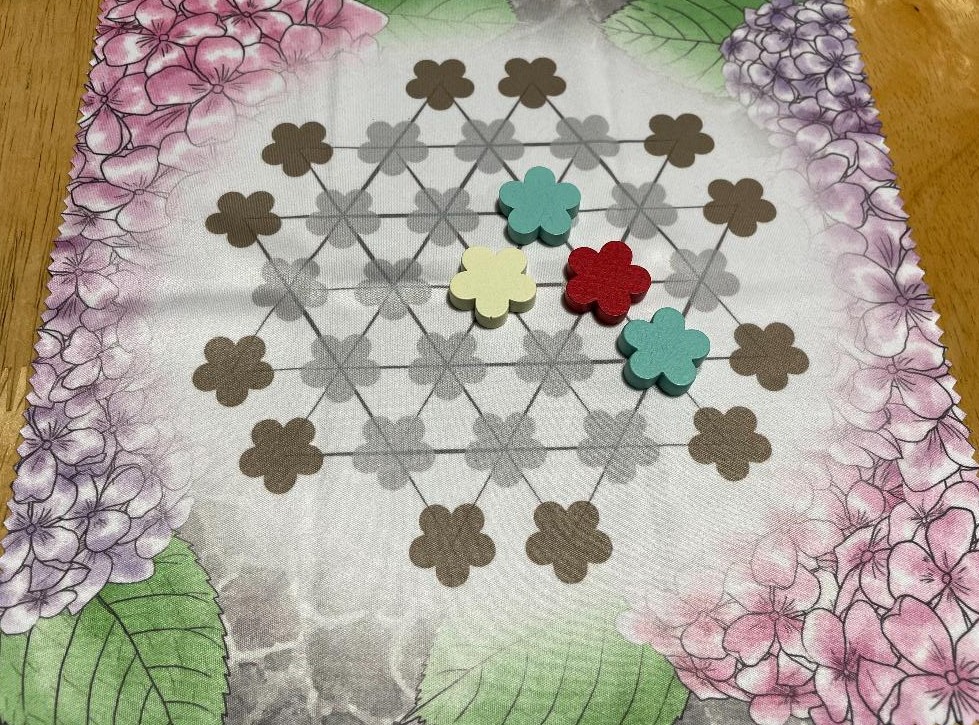
The game is for 2-3 players. The board is cloth with a beautiful border. The flowers are nice wooden tokens. Each player has 2 or 3 colors depending on the number of players. There is also a neutral color flower, white. On a turn the player must perform “blooming” or play one of their flowers onto the board.
After blooming, players check for color transition. Any flowers, including white flowers, sandwiched between 2 flowers of the same color along a line will become that color, in this case the red flower would become blue.
Then check the color rotation chart.
If the newly placed flower is adjacent to flowers of the color as indicated on the chart, that have not already changed, that will also apply. In this case if the purple flower is placed, the blue flowers will become purple. This effect does not apply to white flowers.
The game ends when either there are no white flowers in the supply (they are placed on the board if a color change is indicated and no further flowers of that color are available in the supply) or when the board is filled. The player with the most flowers of one color wins. There are also two variants included with the rules in this game.
As a gardener I really love the theme of this game and appreciate the way the designer incorporated it into game play. It’s quick but challenging play and will travel well with the small size of the box.
“…the fact that my son & I played it five times in the first 2 1/2 days ought to tell you something…”
Just over two years ago, I wrote a lengthy blog post about my history with (but mostly without) the original Dark Tower game… and how the siren call of the Restoration Games reimagining managed to pluck precious board game purchasing dollars from my wallet.
Well, it arrived last Friday around noon – and by late afternoon, my son & I were immersed in a battle to force Ashstrider out of the tower so we could defeat him. (And we did – in words of Monty Python, “There was much rejoicing.”) We took a dinner break… and then we took on Isa the Exile – successfully, I might add.
Saturday morning we added the Alliances expansion… and both the Lingering Rot (morning) and Gravemaw (afternoon) roundly defeated us. Sunday afternoon found us fighting Utuk-Ku the Ice Herald… and finally being successful while playing with the expansion.
To flesh out the header at the top of the page – when your 16 year old son who prefers shorter games (Unmatched, Exceed, Jump Drive, etc.) is willing to play a 90-120 minute game FIVE TIMES in just over 48 hours, you know it’s something special. It’s just as true when I’m personally willing to play the same 90-120 minute game five times in a weekend.
Living Forest is not a game that I expected to be writing about. It’s a deck-building game, and I hate those, right? I thought I did. I was sure I did. Of course I devoured Dominion when it came out in 2008 with over 100 plays in the months that followed. But I tired of it, and then its immediate progeny were exceedingly dull and derivative. Ascension, pass. Thunderstone, hard pass. Orleans, no thanks. A Few Acres of Snow, ha! Mage Knight, my time is finite. Penny Arcade: The Game, derivation piled on derivation. Nightfall, make it stop! After a few years, I decided to just write-off all deck-building games as a lost cause.
When the couple dozen Opinionated Gamer contributors are planning what to write about, we send around a few emails to discuss the latest games and, of course, our opinions. Most games don’t generate more than a handful of emails. There are just too many games and too little time. Living Forest is not most games. For some strange reason, discussion of Aske Christiansen’s debut game generated piles of emails, mountains of emails, heaps and heaps of emails.
Occasionally, I turn those email threads into an OG Roundtable, like the one about traditional card games or the one about Legends of Andor. Not this time. It all started with a message declaring that the game “surprisingly did not suck.” An auspicious start if ever there was one. Paris and Helen had set sail for Troy, and the die had been cast (to mix my Mediterranean metaphors).