Times played: 4, with review copy provided by Studio H
Oriflamme is a game that I surely would have guessed was French if I had sat down to play it and didn’t know anything else about it. And, I am not using “French” as a pejorative adjective; this is a card game with plenty of take-that, with wild swings in action often based on the action of a single card. Bruno Faidutti has made a career out of similar sorts of games, and this game clearly relies upon its Gallic predecessors. I could make your read of this review short – if you like games such as Mascarade or Citadels, I’m pretty sure that you’ll like this one.
It has been fairly well received since its debut at SPIEL 2019, most recently winning the 2020 As d’Or (the French award for Game of the Year) To help put this award in context, other nominations for this year included party board game Fiesta de los Muertos and dino-park sim Draftosaurus. The complex game award for the year went to Res Arcana…
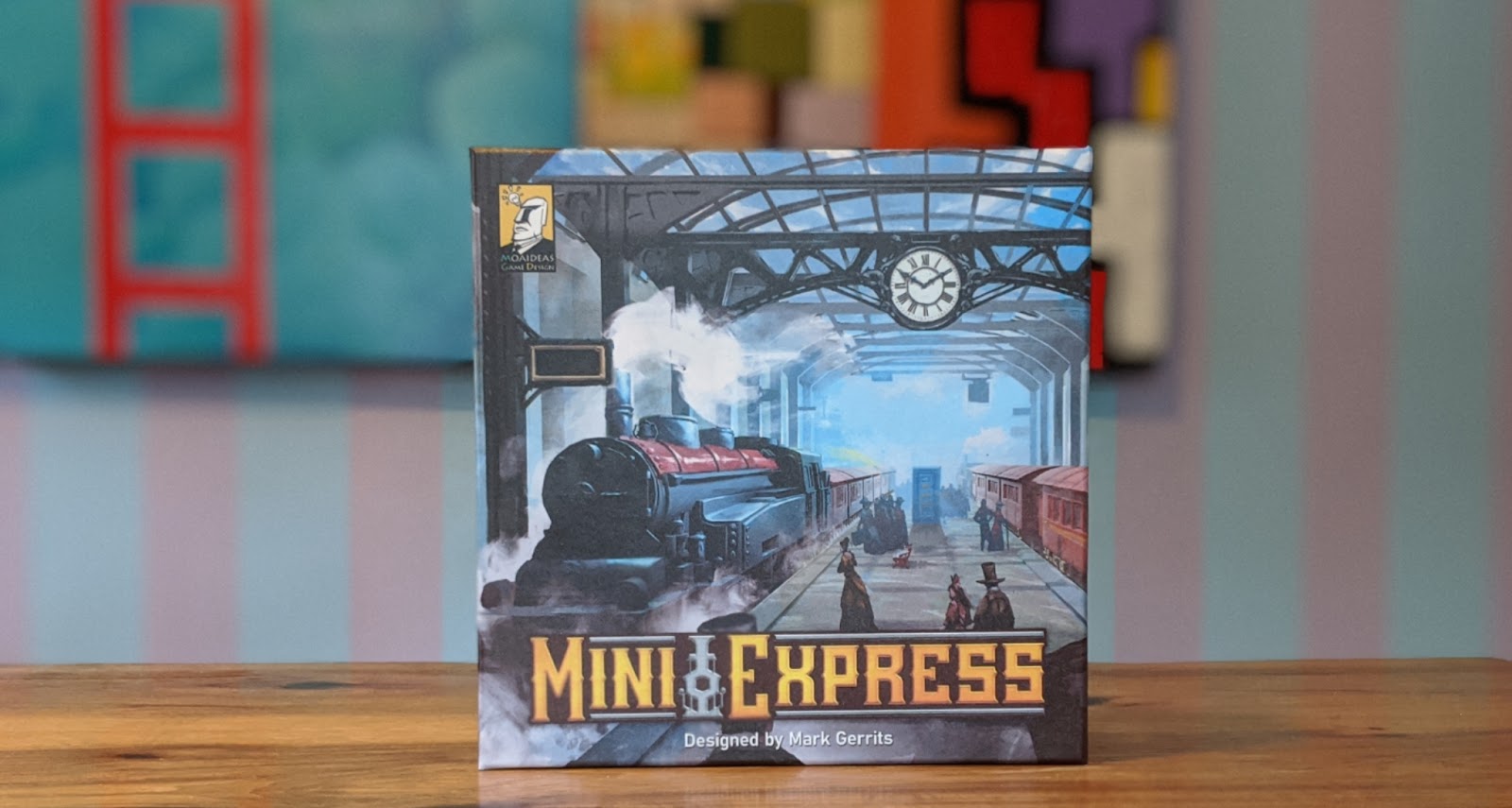
Designer: Mark Gerrits Publisher: Moaideas Game Design Players: 3-5 Ages: 8+ Times Played: 7 on a variety of copies, including a prototype they sent me
I first played Mini Express somewhere in the middle of unincorporated Macoupin County, IL. In this game, that’s sort of the hex where you’d expect St. Louis to be, but it isn’t. I was on a train, and Moaideas had been kind enough to send along some files so that Rand and I could play it during RollingCon last year, our annual mini-convention of train games aboard a train as we take the Amtrak from Chicago to Dallas for BGGCON.
I was excited because the designer had put out a few intriguing train games previously, with SteamRollers (a roll-and-write take on the Age of Steam system) and Mini Rails. While I try below to focus on Mini Express, there are a few times I compulsively talk about Mini Rails. If you’re not familiar with it, it won’t impede things; the talking points are that it is a svelte train game with minimal rules, no money, and only two actions: take a share or lay track. (I mean, I’d get on that elevator with you.)
Mini Express keeps the same turn structure (acquire a stock or lay track) and absence of money as Mini Rails, but applies them to the “cube rail” genre, where colored wooden tokens are laid across a geographic hex map, usually aiming to hit certain cities; likely some sort of cost to placing in the same location as another company; and placement limits for certain hexes. We have some of all that here, but a few things also have their middle parts turned topwise.
(This is a handmade prototype, so components subject to change, etc.)Continue reading →
Two-player games have a special place in our hobby. Not only are they historically significant — many of the classics like Chess to Go are for pairs of players — but they are also especially relevant for those of us that play a lot of games at home. Though these head-to-head games might be often overlooked by publishers (because they reportedly don’t sell well), many of the hobby’s most revered games are for two. The International Gamers Awards even have a special 2-player category.
Today’s article is part of our “10 Great” series that features 10 great games in a given subcategory. I pick a mechanic, theme, publisher, etc. In this case, I picked a set number of players. We here at the Opinionated Gamers then all vote behind the scenes to create a list of 10 great games that meet the criteria. We’re aiming for an article a month, and I’d love your suggestions about future lists.
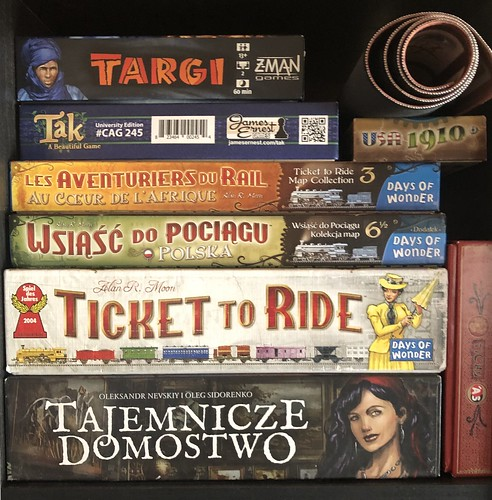
Over the next few months, instead of going with my Three Games articles, I am going to take a look at my collection and try to discuss why certain titles survived the great purge of 2019. During this process I may take a look at some games that didn’t survive, but only as a measuring stick for what did survive. Since I am silly, like a lot of gamers, I use Ikea Kallax shelves to display the games that we own. This makes it pretty easy to break things down cube by cube, so that’s what we’re going to do, twenty-four cubes, plus a top shelf for games that don’t fit in the cubes, over the course of a few months. I hope you enjoy!
If you are a BoardGameGeek user, you can also follow along on the Geeklist I created.
Recently, I have rekindled my love for the game Guildhall. It’s a wonderful hand management game with some fun, simple tableau building. Usually when games like Guildhall resurface into my rotation, it’s because there was another game from the same designer that we had recently played. This time it happened in reverse. We played Guildhall and then I went in search of other games from the designer, Hope S. Hwang. What I found was another game that features set collection and adds to it a light tableau building mechanism, Ganymede, and I decided to take a chance.
I left the table at a boardgaming con to use the facilities, after instructing the other players to choose a game. We had a dinner reservation, so I knew we wouldn’t be playing anything too long, but I came back to a very pretty box and a pile of plastic ladders. A couple of years ago I would have inwardly rolled my eyes and thought “oh great – a dexterity game” but over the past year or so I have developed a new appreciation for the genre and I was intrigued, so I decided to go with it. It turns out to have been a good decision. When I went to pick up a copy the next time I was ordering games, I was surprised to learn this game had come out in 2017; I had never seen it or heard of it.
The game comes in a square box that contains a base, 30 ladders, a die, and some wooden tears that are used to track points (which are bad).
You put the base in the middle of the table and place 2 straight ladders in any configuration that you’d like; this forms the base on which the rest of the game will be played.
On your turn you roll the die and then place a ladder on the structure, following the result of the die roll.
– place the ladder so that it is touching only one other ladder,
– place the ladder so that it is touching only two other ladders. Or
– place the ladder so that it is the highest point on the structure.
The structure may shift while you are placing your new ladder, but that’s fine as long as nothing hits the base or the table.
If you failed to place your ladder based on the die result or any ladder pieces fall to the table you have made the moon cry and you must take a wooden tear.
Play continues until all of the teardrops are gone. The player with the fewest teardrops wins.
MY THOUGHTS ON THE GAME
I really enjoyed this game the first time I played, and I am happy to report that my enjoyment has continued on repeated plays. It works well with any number from 2 to 6. The game lasts longer with fewer players, but then you get to enjoy more strategy as you spend more time actually contributing to the structure. With more players you get to spend more time sitting back and watching the chaos that may ensue, but it’s still fun.
The components are sturdy and well-made. Dexterity is not one of my strong suits, but I am still able to play competently enough, in part thanks to the fact that the pieces are ladders, since there are multiple ways to hold them to place them. Everything fits in the box well, and the box itself is very pretty.
The rules are clear and well-written and you can be up and playing in two minutes, including set up. While the rule book is a few pages long, that is mostly to include some nice artwork, as the rules themselves are very brief.
When we get back to actually being able to play with other gamers I see this as being the perfect filler while we wait for other tables to finish up. Until then, we’ll continue playing it 2 player and honing our ladder placement skills.
Comments from other Opinionated Gamers
Mark Jackson (2 plays): An enjoyable dexterity game that is very attractive… it would be a lovely coffee table piece in a home that doesn’t have small children and/or inquisitive pets.





10 Great 2-Player Games (Article by Chris Wray)
Two-player games have a special place in our hobby. Not only are they historically significant — many of the classics like Chess to Go are for pairs of players — but they are also especially relevant for those of us that play a lot of games at home. Though these head-to-head games might be often overlooked by publishers (because they reportedly don’t sell well), many of the hobby’s most revered games are for two. The International Gamers Awards even have a special 2-player category.
Today’s article is part of our “10 Great” series that features 10 great games in a given subcategory. I pick a mechanic, theme, publisher, etc. In this case, I picked a set number of players. We here at the Opinionated Gamers then all vote behind the scenes to create a list of 10 great games that meet the criteria. We’re aiming for an article a month, and I’d love your suggestions about future lists.
Continue reading →Share this:
Like this: