New Frontiers has players taking turns to select an action card, which then dictates the action that is performed by all players. Through the course of the game, players settle planets, build developments, and exchange goods for points or profit. Develop the best economy (be it building, exchanging, settling, or a combination of them) to be crowned the winner of the game.
New Frontiers Designer: Thomas Lehmann Publisher: Rio Grande Games Players: 2-5 Ages: 14+ Time: 45-75 min (review copy provided by publisher)
For many years, the top rated boardgame in the world was Puerto Rico, where players develop an economy through role selection (one person chooses, all players participate) and attempt to score points through building buildings and shipping goods. Five years later, much of the spirit of the game was copied with the now very popular card game, Race for the Galaxy. It has the same role selection, building things, and shipping goods. However, as a card game, there are far, far more buildings and other effects involved allowing for players to discover and exploit “combinations” of cards that produce synergistic effects. A second take on the game was in the excellent Roll for the Galaxy, which is a similar game but emphasizes the use of dice for selecting roles and developing ones’ economy. New Frontiers comes full circle to its roots, becoming a boardgame once again but retaining the space theme as well as its tendency towards allowing interesting combinations of special powers.
Author’s Note: This isn’t really a game review. It is more of an ode to game, and in particular, an ode to a particular gaming experience. There’ll be humor. At times I’ll veer into being a fanboy. And at times I’ll be critical. But this is mostly a story of one of the better gaming experiences of my life, preceded by a story about punching and sorting a comically large game.
Glen More is among my all-time favorite games. I have 60 logged plays, but I didn’t start logging plays until 2014, and I’m still bad about it, so the real total is likely in excess of 100 plays. But I eventually got a bit bored of the game, as I definitely have a strategy worked out.
So I was ridiculously excited when I heard rumors of Glen More II, and I was thrilled to get to play the Dragonboats Chronicle prototype at the Gathering of Friends a couple of years ago. When the game was on Kickstarter, I enthusiastically backed it.
My various game groups (and my family) met this weekend to play through all of the Essen games. This was our fifth year doing the event.
Shortly after Essen, I host a small weekend event where my game groups gather and play all of the titles I brought back from Essen. This is our fifth year hosting, and I call it Essen West, although we’ve looped it into a small gaming convention at the Lake of the Ozarks in mid-Missouri called 5C.
We have a big rating spreadsheet, and everybody rates games on a 1-4 scale (similar to the OG scale), though everybody is also allowed to give one 5 to their favorite game.
Design by Matt Leacock Published by Eggertspiele 2 – 4 Players, 1 hour – 1 ½ hours Review by Greg J. Schloesser
Designer Matt Leacock rocketed to designer stardom with his highly addicting game Pandemic, which won numerous awards and continues to spawn new versions and spin-offs. Indeed, one spinoff—Pandemic Legacy—sits solidly at #2 on the Boardgamegeek list of top games of all time. Leacock has also designed many other games, including the ground-breaking Roll through the Ages, which is a clever merging of civilization building and roll-and-write genres.
His latest is an evolution of the system pioneered in Roll through the Ages (RTTA). The dice rolling is there, but added to it is the feature of city-building, with players placing buildings into their growing town, hoping to form the optimal combination of buildings and fend off the many perils present in the Middle Ages. It is an interesting marriage of RTTA and games such as Ted Alspach’s Suburbia and Ted Cheatham’s City Square Off.
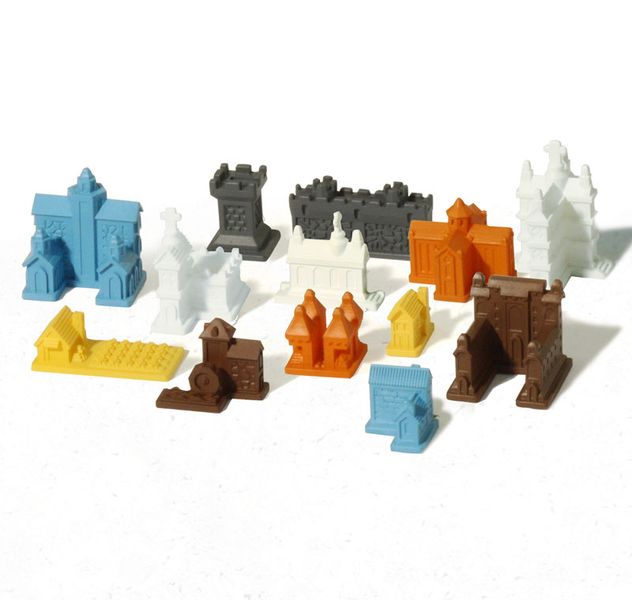
Before diving into a description and review, I must mention the components. There are a large number and variety of unique buildings, all impressive 3-D plastic miniatures. There is also a large collection of dice in four different colors, each set with unique symbols. The only disappointment is the player peg boards, which are entirely yellow, making it very difficult to read and decipher the symbols delineating the resources and turn phases. To their credit, Eggertspiele has responded to this criticism by making available stickers to place on these areas. One wonders, however, how this was not recognized during development.
Before the game begins, each player receives a few walls and buildings, which they secretly arrange on their player boards (player screens hide this set-up). Each building grants an in-game benefit, and/or provides victory points at game’s end. There are various incentives to place buildings in certain fashions. For example, buildings that are adjacent (touching each other) can pose problems if disease strikes, while other buildings give specific benefits based on their placement. For example, the market provides points for vacant spaces next to it, while buildings adjacent to a hospital are immune to disease. There is also an incentive to enclose buildings within the town walls, which will protect them from attacks. Players also begin the game with three yellow (peasants) and one gray (nobles) dice, which correspond to their starting buildings. More dice are acquired when certain buildings are constructed.
The turn sequence is strictly followed each turn, and it is easy to explain the game by describing these.
Roll. All players roll their dice behind their screens. They may roll up to three times, but must set aside (lock) any dice that show a skull symbol (disasters).
Collect. Based on the symbols on their dice, players collect resources. There are four types of resources—trade goods, stone, lumber and wheat—which are tracked on the player board. Resources are needed to construct buildings and feed one’s population.
Feed. Players must expend one wheat for each die that they possess. Each Farm constructed contributes one wheat. Failure to feed one’s population results in an increase on one’s Disaster track, which equates to negative points at game’s end.
Disasters. A disaster will occur based on the number of skulls a player has rolled. Most affect the player (increase on disaster track, loss of resources or building, etc.), while two (rolling three or five skulls) affect all opponents. For example, rolling just one skull forces a player to increase his Disaster track marker by one space and lose a resource, while rolling three skulls forces opponents to place a “Scorched Earth” marker on their player boards. This marker occupies four spaces and prevents a player from building in that location. Sometimes a player will continue rolling, hoping to get just one more skull so that his opponents will suffer, and not him!
Build. For each “build” symbol, a player may construct a building or wall by expending the required number and type of resources. Each building grants a special ability (more dice or resources, victory points, disaster protection, etc.), so players can implement their strategies accordingly.
As mentioned earlier, there are incentives to enclose buildings within one’s city walls (doubles the victory points and protects from attacks) and to not place them adjacent to other buildings. Further, one’s city grid is limited, so one must attempt to optimize the space available. Scorched Earth disasters will further limit the space available, and can even cause a player to destroy a building or two. Ouch.
Further, some buildings will grant the player an additional die. There are four types of dice, each with an emphasis on different aspects. For example, yellow dice (gained by constructing longhouses) tend to generate more resources, while blue dice (gained by constructing townhouses) give more trade goods, culture and building opportunities. One can tailor their strategy by constructing certain buildings and acquiring the desired dice.
Extort. This is, without a doubt, the phase I most dislike and find problematic. It introduces military into the proceedings and in a way I (and others) find a bit too harsh. The gray dice primarily depict swords (offense) or shields (defense). If a player has more military symbols than an opponent has either in military or defense, he may steal a resource from that player. An unfortunate player may well be attacked by multiple players and lose up to three resources in this fashion. While additional gray dice can help prevent this–and help increase one’s chances of being the aggressor–in practice this is quite harsh, especially since the aggressor gets to choose the resource he desires to steal. We have tried playing with a house rule where only the player with the most swords gets to steal a resource and that does make this phase somewhat more palatable.
Play continues in this fashion until five “colors” of buildings expire. Victory points are earned for buildings constructed (doubled if they are within the town walls), bonus points for meeting the conditions of special buildings (markets, guildhalls, universities and cathedrals) and one’s level on the culture track (which progresses when rolling the corresponding symbol). Points are then deducted based on one’s status on the disaster track (those pesky skulls). Of course, the player with the most points is victorious.
When it was first released, I was a big fan of the designer’s Roll Through the Ages. I enjoyed the challenge of constructing various cities, buildings and monuments, as well as achieving the assortment of available achievements. All of this was done in a very abstract “pencil and paper” manner, but it worked well. Enhancing the game by actually constructing a city with impressive 3D miniatures seemed like brilliance … and perhaps it is, but only up to a point. Yes, it does add a fun city-building aspect to the game that includes some Tetris-like puzzle aspects, and it is pretty nifty to see the finished product. However, somehow the game lacks spark. I–and nearly everyone with whom I have played–just wasn’t very excited by the experience. The game works just fine, but it fails to generate the excitement one might expect.
Why is this? I was fully expecting the experience to be incredible, marrying two very popular genres within the hobby–dice-rolling and city-building. Perhaps what held such promise is really not a marriage made in heaven. Perhaps it is just a combination of two familiar genres that works just fine, but doesn’t provoke the anticipated fireworks.
I also believe that perhaps there is an over-saturation of these types of games. Dice rolling– particularly of the “roll and write” variety–has become commonplace and, indeed, over abundant. It is a craze that I personally hopes abates soon. City-building has been around for decades, and while still fairly popular, doesn’t really break new ground. So perhaps it is this over-familiarization that has suppressed my excitement level.
Now, lest one think I have damned the game, I have not. Era: Medieval Age is a fine game, one I probably would have adored a decade ago. It is one of those games that I will happily play if requested, but I just won’t get terribly excited over or ponder or second-guess my moves and strategies during the following days. Ten years ago the game would have easily earned a place on my gaming shelf. Today, however, there are just too many other offerings that scratch a similar itch. For those who have a less extensive collection, or for those seeking a game to teach to casual gamers, Era: Medieval Age just might be a great fit. Indeed, perhaps that is its true target audience: casual gamers. Hmmm…I’ll have to give it a go with folks I know who fit into that category.
Thoughts of Other Opinionated Gamers:
Chris Wray: I enjoyed Era: Medieval Age. Though I, like Greg, have both praise for and confusion with the choices on component quality, I enjoy the gameplay here well enough. After a half dozen plays, I look forward to a half dozen more. The engine building aspect is fun, and I haven’t played the game the same way twice yet, showing that there are different strategies to explore and pursue (though I’ve learned the hard way that a couple of them are ill-advised!).
Joe Huber (6 plays, at various stages of development): First and foremost – I enjoy this game. It’s about as close to a “like it” rating as I recall, without quite getting there. The components are great. The switch (from Roll Through the Ages) to simultaneous play is a positive development. The choice to make a nicer product of the game than a simple roll-and-write works nicely. But – it’s just not a type of game that generally excites me, and it doesn’t quite make the top tier of the genre for me. It’s close enough that I’ll happily play it, though, and it is a game I can recommend for others who are more fond of roll-and-writes – the production will help the game stand out in that crowd.
Matt Carlson (4 plays): I enjoyed Roll through the Ages and was looking forward to this release. The simultaneous rolling is a welcome trend, although there was more “tech tree” developments in the original RttA and thus Era seems to have just a bit less depth. The plastic bits make me fear the game is over-produced, but if they attract more casual gamers to the table I can put up with it (although I mourn over lost shelf space if it had been a smaller game.) I was wary of several things going into the game. 1) Was there going to be an obvious victory route? So far, I’ve seen several different strategies win. I’m not sure how much luck plays into the game, although I tend to curse my dice in the early rounds – like failing to roll any “build” symbols to get my empire going. I have to reserve judgement a bit, as it may be I need to prioritize other dice first (buy one needs _some_ builds in the first few rounds.) 2) Is the Extort phase too harsh in multiplayer games. I’m fine with Extort popping up in a 2 player game, such is life. But in a 3 player game, one could (in theory) lose 3 goods in one round. In practice, I did not find this to be the case. Players extort after building, so the losing player has already used what they want that round, and the winner has to save goods until the next round to use them. People worried about it went for a second tower. It was rare in our games for anyone to lose 3 goods in one round, too often people were “bumping” into each other and only gaining one or two (and even then it was often slim pickings) goods from opponents. The grey attack dice do not produce much, so effort spent obtaining and rolling them is effort not spent on a more productive die and/or building. My current verdict: I like it. It is more approachable than Roll through the Ages, so may see more table play around here.
Craig M. (1 play): I was a big Roll Through the Ages fan, though it has largely disappeared from the rotation. I think the changes to the core concepts and the simultaneous play are fantastic. It is over produced, but that seems to be the way of things these days. Though given that, the fact that the information on the player boards being essentially unreadable is a big miss and really inexcusable. It seems like fixes will be offered, but it really makes me wonder how mistakes like this are not caught. I’m looking forward to more plays. It’s hard to predict if this will be hanging around a year from now, but I’m hoping it does.
Michael W. My 1 play (4 player) was a step above meh, but didn’t reach “I like it”. I miss the tech tree from RTtA and Era’s city building didn’t add much for me. In our game there was an early run on the grey dice and 1 player got locked out, leading to his goods being stolen (um, extorted, yeah) by at least 2 players _every single turn_. And it’s rare you can spend absolutely everything, so needless to say he was very much not happy with the game, despite not coming in last place – that was my honor. It’s not great as a filler and not deep enough for a main course. There’s nothing terrible about it, but there’s also nothing compelling about it.
Ratings:
4 (Love it!): 3 (Like it): Matt C., Craig M. 2 (Neutral): Greg S., James Nathan, Joe H., John P, Michael W 1 (Not for me):
Pass items back and forth as the central safe shouts out instructions in this cooperative real time game of bank robbery. Take on the role of one of four characters and follow the instructions on the battery-powered central cube. Pass items back and forth and then “use” them correctly to advance the timer. Success leads to the big payoff, while mistakes cost you money and perhaps the entire game. Heist: One Team, One Mission is a fast-paced game looks neat, is very family friendly, and plays in just a few minutes.
Heist: One Team, One Mission Designer: Rob Daviau, Bob Driscoll, Don Ullman Publisher: University Games Players: 2-4 Ages: 7+ Time: 5-15 min (review copy provided by publisher)
We all, at one time or another, have fantasies about being excavators, or treasure hunters, in the same vein as Indiana Jones or Lara Croft. Being out in the field excavating priceless artifacts, or discovering gold or diamonds. Are we going to accomplish that dream here? No, but we are going to be excavating via a choose and mark mechanism that is somewhat like another game that released this year, Silver & Gold.
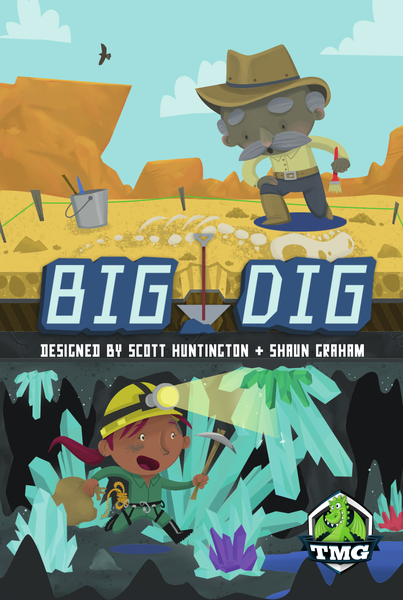
In Big Dig, two to four players are going to race to complete three goals that are revealed at the beginning of the game. The first to successfully complete all three goals is the winner, and the best treasure hunter around.







Anatomy of a Gaming Experience: Glen More II (Article by Chris Wray)
Author’s Note: This isn’t really a game review. It is more of an ode to game, and in particular, an ode to a particular gaming experience. There’ll be humor. At times I’ll veer into being a fanboy. And at times I’ll be critical. But this is mostly a story of one of the better gaming experiences of my life, preceded by a story about punching and sorting a comically large game.
Glen More is among my all-time favorite games. I have 60 logged plays, but I didn’t start logging plays until 2014, and I’m still bad about it, so the real total is likely in excess of 100 plays. But I eventually got a bit bored of the game, as I definitely have a strategy worked out.
So I was ridiculously excited when I heard rumors of Glen More II, and I was thrilled to get to play the Dragonboats Chronicle prototype at the Gathering of Friends a couple of years ago. When the game was on Kickstarter, I enthusiastically backed it.
Continue reading →Share this:
Like this: