So anyway, are you in or out, Rob? – Charlie “High Fidelity”
Small box card games are a dime a dozen. I have a coffee table full of them to prove this. What isn’t a dime a dozen are good, clever small box card games that inspire repeated plays.
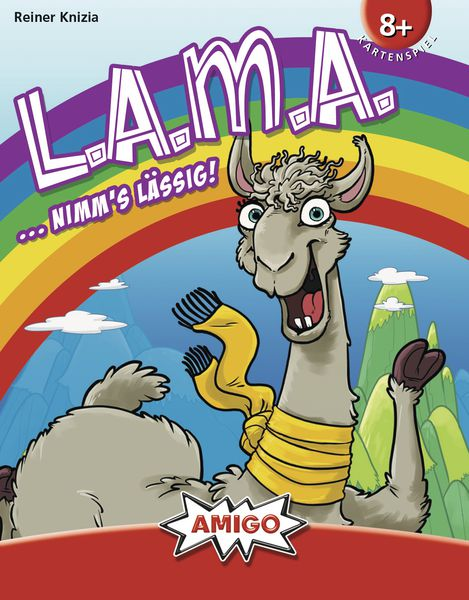
L.A.M.A. is a shedding game. What I mean by that is that you are trying to shed, or get rid of, as many cards from your hand as possible. L.A.M.A. is played over a series of hands and will end as soon as one player has forty points. The player at the table with the fewest points, is the winner.
There are times in my life when I look back at the things I planned to do… and then suddenly realize “Damn, I never did that thing I thought I was gonna do…”. I had planned to have a Too Many Bones review be my final review in the run up to SPIEL 2018. After all, I had bought the game back at GenCon (August 2018), and I had had a chance to play it a few times by then.
Times played: 1, with review copy provided by Plankton Games
From the publisher’s description: Doctor Esker has vanished, leaving behind only a mysterious book full of puzzles written in his own hand. Nobody has cracked his cryptic codes yet. Are you up to the challenge?
The game provides a deck of 72 cards which contain nine devious puzzles to solve. You can play through the puzzles solo or together with family and friends. Great for a party, a game night, or a lazy afternoon.
Each puzzle is composed of a set of cards. You can solve the puzzle by reading, comparing, arranging and pondering the messages, drawings, and artwork on the cards. Solving the puzzle reveals a sequence of numbers. When you think you’ve got it, gather the solution cards corresponding to the number sequence and flip them. If you see a message or image, you’ve solved the puzzle. Persevere to the end and receive Dr. Esker’s greatest praise.
I received a copy in the mail from the publisher, and the game is a self contained affair in a single deck box. All of the instructions fit on a single card – and I will summarize those here. Go thru the deck and separate the card by back art – this will give you nine puzzle sets. There are also ten solution cards which should be kept separate. The players should start with the set cleverly labeled “START”. Those cards are flipped over and the puzzle is figured out. All of the puzzles here are numeric in nature, and you have to work together to solve the puzzle. When you think that you know the answer, you flip over the solution cards that match the code that you found – and if you have done this correctly, the answer cards (in the right order) will tell you which puzzle to do next.
If you get stuck along the way, there are hints available online at the publisher’s website… The hints are well designed – there are a total of 9 hints for each puzzle: 3 small, 3 medium and 3 large – with the final hint essentially being the solution to the puzzle. In our game, we had three veteran puzzle solvers playing, and we ended up needing to take 1 small hint and eventually 1 medium hint over the course of the game. We later went back and looked at the clues, and they are well done to give you the nudge that you might need.
I know that it may be hard to visualize how this particular game works – and the publisher has put out a short video on YouTube with a sample puzzle (not one of the nine in the game): https://www.youtube.com/watch?v=5OFOygI5h-U
In short, you work on a puzzle, and when you think that you have the answer, you pull out the matching number cards from the number/answer deck and place them in order and then flip them over. If you have the right answer, you will see a picture/word/phrase/something that confirms that you have done it right. This is a really neat way of having the game be able to self-check your answers. I might wish that there were some red herrings on the answer cards because it’s hard to stop yourself from looking at all the different bits on the answer cards and unintentionally making notes of which cards seem to go together for another puzzle answer. If there were some misleading images/words on those cards, it would be a lot harder to unintentionally (or perhaps intentionally!) spoil the answers to a later puzzle.
So, without spoiling it, what can I say about the puzzles? The puzzles are varied in difficulty, with some being solved in just a minute or so, and others taking maybe 20 minutes (while needing a medium hint). But again, though some of the puzzles are quite challenging, you can take as much time as you like with them, and then when you think you’ve hit the wall – look up the first hint and see if this gets you going in the right direction. In our game, with one of the puzzles, which now looks simple in retrospect – our group had gone the wrong way in trying to solve it. We took a small hint, and the first of the nine hints got us back on track and we soon after solved the puzzle.
Our game took just over 80 minutes, though we were in no rush, and we were interrupted by a few phone calls and an Oreo break or two during the game. It was a great experience for the three of us, and that number felt good – as the puzzles come on playing card sized cards, they were often held and examined closely, and with maybe more than 3 or 4, there just isn’t enough stuff to go around.
From the Plankton Games website – it appears that there are at least two further adventures planned (if this one does well) – and I hope to try out those other scenarios as I really enjoyed this one.
James Nathan: I was pleasantly surprised with this! I’m a judgy and cynical person, and was dismissive based upon the box art, but I should not have been. I liked that I knew what pieces went to which puzzle. I liked how the system worked to check your answers (though I also agree there should perhaps be some misinformation as we did accidentally spoil part of a future answer, though not the exact number).
The puzzles were clever and largely they were both new-to-me and challenging-while-achievable. That’s pretty much what you want, right? For the most part I was engaged in solving the puzzle, putting things together in a new way, and appreciated how creative they were when I finished one.
Times played: 3, with review copy provided by MOZI
In Horticulture Master, players vie to have the most beautiful garden on their board. The game has a number of tiles, each depicting a different part of a garden: ornamental grasses, cabins and temples, trellises, docks, rock formations, etc. Each of these stacks gets an animal marker placed on top of it. There is also a deck of cards which has elements and tools in it. There is a central board which has a display of tiles available to the players as well as a 3×3 array of cards. Each player starts with an empty garden board and 1 Magic Mushroom card in hand.
As some of you may have seen on Twitter, this past weekend, Dale and James Nathan brought together a wacky idea that actually ended up with a pretty darn good result… James Nathan had been toying with the idea of combining games or playing them simultaneously. He posted a mysterious picture of Patchwork pieces with Bamboleo on social media earlier in the week. That picture got me thinking – what else could we mash up?
By Friday morning, I came up with the idea of playing simultaneous roll-and-writes. I had just received my review copy of Corinth in the mail from Days of Wonder, and I had just chatted with Brandon Kempf about his roll-and-write review series. Anyways, my brain is totally about rolling dice. I started to consider all the games in my Roll-and-Write travel kit, and I realized that many of them used the same dice. So… what if we set up a system where you could roll the dice and then use the results across multiple games? This could be the ultimate challenge for dice chucking and dry erase markering!
Times played: 6, with review copy provided by Asmodee NA
Narabi is a pocket sized cooperative game where players work together to “Create tranquility out of disorder”. There are 15 stone cards, with ten of them numbered from 0-9 – and 15 limit cards, each with a rule printed on them. There are also 15 card sleeves in the game, and to set up each game, a restriction card is randomly paired up with a stone card and placed in a sleeve so that you can read the restriction text on one side and see the stone on the other. Try not to read the restriction text as you place the cards in the sleeves.



Dale/JaNate: Roll With It – the Opinionated Gamers’ Roll and Write Decathlon
As some of you may have seen on Twitter, this past weekend, Dale and James Nathan brought together a wacky idea that actually ended up with a pretty darn good result… James Nathan had been toying with the idea of combining games or playing them simultaneously. He posted a mysterious picture of Patchwork pieces with Bamboleo on social media earlier in the week. That picture got me thinking – what else could we mash up?
By Friday morning, I came up with the idea of playing simultaneous roll-and-writes. I had just received my review copy of Corinth in the mail from Days of Wonder, and I had just chatted with Brandon Kempf about his roll-and-write review series. Anyways, my brain is totally about rolling dice. I started to consider all the games in my Roll-and-Write travel kit, and I realized that many of them used the same dice. So… what if we set up a system where you could roll the dice and then use the results across multiple games? This could be the ultimate challenge for dice chucking and dry erase markering!
Continue reading →Share this:
Like this: