Kenichi Tanabe has become one of my most watched designer these days. I have really enjoyed Kaigan and The major four of Heizei. One of his newest games is Guild. These 3 games have all interesting card drafting mechanisms.
One of the best things about Guild is that it comes in a nice small box so it doesn’t take up excessive room on the game shelf. These days this is a huge plus factor for me! Guild does, however, take up a fair amount of table space when being played. The game comes with Japanese and English rules and the components are all language independent. The game comes with 3 sets of cards. Double-sided Kingdom cards which are standard Euro size, and Guild cards and Support cards which are mini sized cards. It also comes with bidding chips and cardboard money and meeples and your standard wooden cubes for the resources. One minor quibble is that the brown and black cubes are almost indistinguishable even to me and I usual don’t have any problems with colors. The art on the cards is nicely done and the icons are easily deciphered after a few turns.
The goal is to earn the most points by building a large guild, pyramid style, with guild cards and support cards. The guild cards form a production engine for resources and money and form an upright pyramid. Support cards give game end points and a few provide some in game benefits and form an upside down pyramid. You can also earn points at the end of the game by winning the war.
First Kingdoms cards are randomly selected (the number of players +1) and placed either dark or white side up. Each side has a slightly  different although related special ability. Each player starts with the same 4 basic guild cards which produce either, rice, wood, stone or a soldier. The also receive 7 bidding chips and 1 meeple.
Each player selects 1 of their guild cards and places it in a pile. These are collected and then shuffled and 1 is placed under each Kingdom card and then guild cards added from the deck until each Kingdom has 2 guilds. Guild cards come in 3 levels and the number on the card determines which level they may be built in.
A start player is chosen and the next player receives 1 money from the bank, the next 2 etc. and the game starts.
Income of 7 money is collected by each player.
Next is the Auction phase. Players blind bid a number of chips from their supply. If you wish to bid more than 7 chips you add money to your bid. Your bid determines player order for the round and 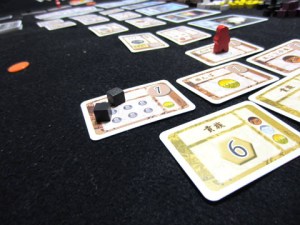 importantly it determines the number of guilds you may buy as well as the cost per guild. So if I bid 3 chips, I can buy up to 3 guilds at a cost of 3 money each. Ties are broken by the start player or closest to the start player.
Next is the Action Phase. Players may purchase guild cards from one Kingdom. They may then play the cards into their own guild. Some guild cards cost resources. In addition the guild is built into a pyramid. An additional money cost of the level that the card is built is added to any resources required. Support cards also require resources and the level +1 money to build in a reverse pyramid at the bottom of the guild. Support cards must be bout Nobles first, then Churches and then Merchants.
Players may also produce goods. The players place their meeple and cards in the line of the meeple produce.
Finally, if guilds have been purchased that turn a player may use the Kingdom’s special ability.
Next is the war phase. The support cards are initially separated by type. Noble cards are worth 6 pts, Church 5 pts, Merchants 4 pts. The other support cards are worth 3 pts and may be bought in any order. Once all the Nobles have been purchased a war occurs. Two cards are flipped face up from the guild deck and their levels determines the strength of the attacking army. Starting with the start player, each player must either fight and give up a number of soldiers equal to the attacking army earning a card or lose one of their topmost cards in their pyramid. When the Church cards are gone, 3 guilds cards are flipped and when the merchants are gone it triggers the final war and end game. The game may end sooner if you run out of guild cards. In the final war you earn 3 points if you defeat the attacking army.
Final scores are equal the points from support cards, plus each card in your pyramid is worth points to the level it’s built in and finally 1 pt per silk cube.
So I found Guild pretty challenging. Blind bidding isn’t usually one of my favorite mechanisms but it works fairly well here. I like the fact that what you bid determines the cost and how much you can buy.
The activation for resources is also interesting, since in a 3 high pyramid you will be missing one guild (the center of the base) and have to try and adjust and plan for it as you build. I always feel like I am one resource short and have to activate before I build! The guild cards feel fairly well balanced, in one of our first games we played one of the cards incorrectly giving someone their choice of resource each turn instead of once only.
I have played with 2, 3 and 4. The game moves really fast with 4 as the Guilds disappear rapidly. I would prefer to play with 2 or 3.
A good card game with some interesting twists to the standard auction and resource collection mechanisms.
Thoughts from other Opinionated Gamers:
Joe Huber (3 plays): One of the most notable aspects of Guild is that it doesn’t feel much like any other game I can think of. The bidding is not dissimilar to New England, and there is certainly a familiar effort of collecting and then spending resources, but on the whole the game feels unique. The war aspect is very nicely done; players can either plan for it, or choose to ignore it, and the rewards for being prepared for war and penalties for not being prepared are well balanced such that it is viable, if difficult, to plan to lose wars but win the game.
What really makes the game stand out for me, though, is how interesting each turn is. You have many things to do each turn, and great freedom as to the order in which you carry them out. Those choices are fascinating; but contained enough as to not lead to analysis paralysis in my experience.
Overall, I really enjoy the game; it will take another few plays to determine whether it’s an all-time classic for me or not, but for now I’m really enjoying exploring the game. There is certainly enough variability in the game for it to grow into a favorite.
Rating Summary from other Opinionated Gamers:
Love It!
Like It. Lorna, Joe
Neutral. Jennifer
Not for me.
Like this:
Like Loading...

 A Fistful of Penguins has started arriving in stores this week.



Opinionated Gamers Roundtable Discussion: What’s with all the new games?!
You’d be amazed at some of the email conversations that get started with a simple off-the-cuff question. Here is a (somewhat edited) thread which popped up last week while all of us should have been working…
Nate Beeler:
From [a recent] game day invite:
“Do you have new games you got over the holidays you are eager to try? Are there new Essen games you want to play before buying (and before the new Nurnberg crop comes out next month)?”
See, this is what I’m on about. I like new games. It’s fun to explore a game you haven’t seen, or to try out (hopefully) new mechanisms and themes. But that’s only part of the gaming experience for me. I also like exploring games I’m familiar with but haven’t played to death. Further, I enjoy playing amazing older games and looking for hidden depths, or at least playing with a comfort level that allows me to think beyond “ok, what am I allowed to do” easily. Why is gaming so much about new new new for so many people? What is it about the new quality that overrides all else? I simply do not understand. Can anyone help explain this?
[Edit: Made clear in the original email, before personal stuff was removed, was that I wasn’t saying anything bad about my friend that wrote the invitation above, but was more talking about the fact that she was expected to sell the game day this way, and that her audience was receptive to that pitch. Note also, most of the people that were invited have a steady stream of new games coming in, so new games aren’t any kind of novelty to them, and yet “day of new games” is clearly more appealing than “day of games”. – Nate] Continue reading →
Share this:
Like this: