[Note… Sorry to be away from the blog for so long, but a few changes in my real-life job have significantly reduced the time I have for writing (and even for playing games). Things should be getting back to normal in the next few weeks, so hopefully I’ll be able to catch up on the backlog of Essen releases that I want to review! DY]
Walnut Grove was initially touted prior to Essen 2011 as a mashup between Carcassone and Agricola… As these are two of my favorite games, I was definitely interested in getting a copy and trying it out. I’ve now played over 20 games, and I must say that it is one of my favorite releases from Spiel 2011 for sure!
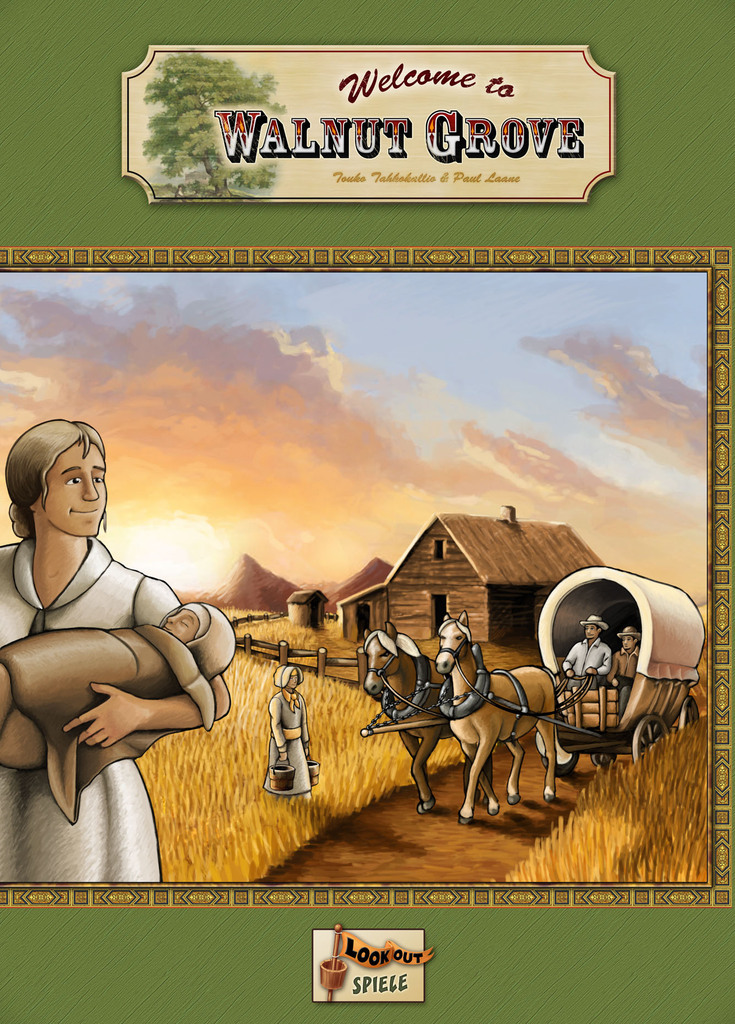
Welcome to Walnut Grove
Designers: Paul Laane and Touko Tahkokallio
Publisher: Lookout Games
# of players: 1-4
Time: 45 minutes
Ages: 10+
Times Played: 20+ total with review copy, at least 12 of these solo plays.

I previously had written a preview of the game where I outlined the flow of the game. Rather than re-invent the wheel, I’m going to just copy and paste that section into this review…
—
I’ll start by describing the game components. There is a board which depicts the town of Walnut Grove. There is a circular track on which the pawns move, with spaces in front of the multiple town buildings (such as the city hall, hardware store, church, saloon, etc). Some of the buildings are places where you buy stuff – such as more meeples or tiles to be placed on your player board to improve it. In the center of the board is a space where a disc is placed that shows special actions available in each of the 8 turns of the game. Additionally, each player in the game has his own player board which gives him room to house his workers, store his goods, and attach land tiles to. Continue reading →
Like this:
Like Loading...

 impressive, studded with the likes of Mr. Jack and Jamaica, but particularly relevant because Laget’s Mare Nostrum from 2003 is the inspiration for Mundus Novus. Much of that sprawling 2+ hour game has been stripped away, but what is left is the core card reallocation mechanism. This is a great foundation on which to base a game, but the problem is that there’s almost no game left in the overly streamlined and vacuous Mundus Novus.
 found in the previously mentioned, hinted-to names of this ninja game. Your enjoyment of that style of game will definitely impact your opinion of this game. That said, after two plays, I would say this is a really clever implementation of the genre. The game pits guards of an imperial palace against two intruders: a traitor and a ninja. With two players, one plays the guards and one player plays the intruders. With three players, one plays the guards, one plays the traitor, and one plays the ninja. With the addition of a fourth player, the guards are split into two factions based on their colors and are controlled by two separate players. For first time players, fifteen minutes should be set aside for rules and clarifications. Once you have played, everything is very intuitive and you can get into the game very quickly.


Opinionated Gamers Roundtable: Is Crowdsourcing good for our hobby?
In a previous roundtable (on New Games), Jeff Allers brought up the current trend of “quantity over quality” that has been seen in the hobby over the past few years. To quote him:
The whole trend actually pushes both publishers and designers to emphasize quantity over quality. If someone wants to make a living from game design, they need to release lots of games (including variations of the same game for different markets), as most will only sell a few thousand copies before they are out of print. The solution? I think the bubble is destined to burst at some point. Most people will stop buying so many games (perhaps, it’s already begun), and publishers will either limit their new releases to 1 or 2 every year or they will go out of business. Competition among designers will grow, but that will also force all of us to work harder in distinguishing our games from our competitors rather than producing so many games that work well but feel similar to those already out there.
Jeff raises a good point that there is a lot of “quantity” going on right now. I think that this issue is being exacerbated by both the “mainstream” industry players as well as Kickstarter. For better or worse, Kickstarter lowers the financial barrier to publishing a game. There are a lot of games that would not exist in published form were it not for crowdsourced capital. Is that good? I think the jury is still out (at least in my mind) — crowdsourcing has definitely led to more games coming out, but what about the quality of those games? Will Kickstarter end up being a boon or a obstacle to those looking for good new games…
Thoughts?
Continue reading →
Share this:
Like this: