
Soul Raiders
- Designer: Marc Andre
- Publisher: One For All
- Players: 2-4
- Time: 10+
- Time: 3 to 4 hrs per chapter
- Played with review copy sent to us by the publisher

I have been excited about Soul Raiders since meeting up with Marc Andre at SPIEL 2018 – where I got to finally meet one of my favorite designers and also get a sneak peak at his new narrative style game. From the little bit (first 2 locations) that I was able to see, I instantly wanted to know more about the game.
[note – to avoid spoilers, I’m mostly using pictures from the publisher or plain pictures that do not include content of the actual quests you will undertake]
In the intervening years, the game has apparently been worked on and refined over and over. The finished game has three chapters, each with over 40 locations. There are over 1,000 cards to support the playing through those locations! After a wait of seven years, the game is finally done and has been distributed to its backers. The Grimoire edition comes in a giant box that actually looks like a book – a pretty cool package, I must say. While we haven’t played through the entire game yet, I wanted to talk a bit about the game after our first two sessions.
In this fast-paced narrative game, the players become powerful heroes. They will be able to roam freely in a variety of settings, cooperating to overcome the threat of an impending doom before it is too late! Below is the description of the game from the publisher:
An epic narrative game
- Soul Raiders immerse the players in a high-fantasy setting; as powerful heroes, they will overcome the many threats to their order of warrior-mages and the universe as a whole.
- Designed like a book, the game is divided in chapters, or game sessions (2 to 3 hours per session). Each chapter depicts a specific setting in which players will complete quests, collect information and increase their power to progress through the overarching story.
- Soul Raiders will spread on several chapters, weaving an epic tale around the players and their characters from one book to the next.
A fast-paced and cinematic game system
- The game system features a fast-paced and streamlined gameplay’, entirely geared towards the experience of a story-driven, cinematic and cooperative adventure.
- The players act simultaneously to explore their surroundings. Without turn order, they can progress together or split the party as they see fit to hop from one scene to the next.
- Each setting is composed of a set of tiles, places where the heroes can interact with their environment. Taking a variety of actions while battling the forces pitted against them, they jump from one tile to another as the story unfolds, sometimes spread out on different scenes, always focusing on the heart of the action.
Building cooperative tension
- The heroes live and die as one. Their health points is a common pool, tracked on the side of the board: each time a player takes damage, the marker progresses. If it goes too far, the whole party fails at completing the chapter.
- Even if they manage to stay safe, time runs out fast… The Threat track is another timer that brings the heroes to their demise. It progresses as they encounter new creatures and events, leading to their capture if they stay idle for too long.
Narrative story with a strong replay value
- If they cooperate efficiently, any path can lead to the completion of the current chapter, as the players do not have to follow a specific set of events, but try to achieve independent and interwoven quests.
- If the party fails, it can still move onto the next chapter, triggering a unique setback. Only the final chapter of the story needs to be completed successfully — or else they will go back to the beginning of the tome.
- This non-linear approach to a narrative system, combined with the time pressure and the possibility to push the story further, ensure a very good replay value to the gaming experience.
Summary of play

To set up, the main board is set up on the table, and the deck of Random enemy cards is shuffled and placed next to the board. This board has a Vitae (group life) track around the outside. In this game, the group has a single Vitae value – each time the marker goes all the way around the track (loss of 30 Vitae), the Exhaustion marker goes down one space on the Exhaustion track (which in turn determines how many cards the Heroes draw each turn.) Interestingly, the team can never gain more than 30 Vitae, so once you lose an Exhaustion, you never gain it back, even if you were to gain back some Vitae. The Threat track is also found on this board, it marks the danger level – there are three different colored areas on this track, and the location of the marker can affect how certain Locations, enemies or effects resolve. For both the Threat and Exhaustion tracks, if you get to the final space, the team automatically loses.

Each player gets a hero board, and the miniatures that match the chosen hero. There is also a deck of Action cards for that hero which are shuffled to make a deck. (There are also Heroic Action cards which are set aside, and can be gained later and added to the Hero deck). These cards have varying numbers (1 to 5) as well as a special ability on the lower half of the card. These cards will be used to accomplish actions, and in each round, players take actions until they run out of cards.
For the specific chapter, place the Location sheets on the table as well as the Scripted Enemies and Story cards. Two event cards for the chapter are placed on the main boards. Read the first Location sheet to understand the main and secondary goals for the chapter. This sheet will also tell you which location or locations are available to the group at the start of the game – these sheets are revealed (on the A side) on the table.

The Location sheets show all the different parts of the world that you can explore in this chapter. As you encounter a new area, place it on the table – remembering also to keep the A side visible! You should not ever flip a Location sheet over unless instructed by the game to do so. At the top of the sheet, you’ll see an identifying number and title – and beneath this are Location entrance effects – things that happen to the Hero who first enters said location. If another Hero enters the location, they would only have to apply specific entrance effects that target “Any Hero”.
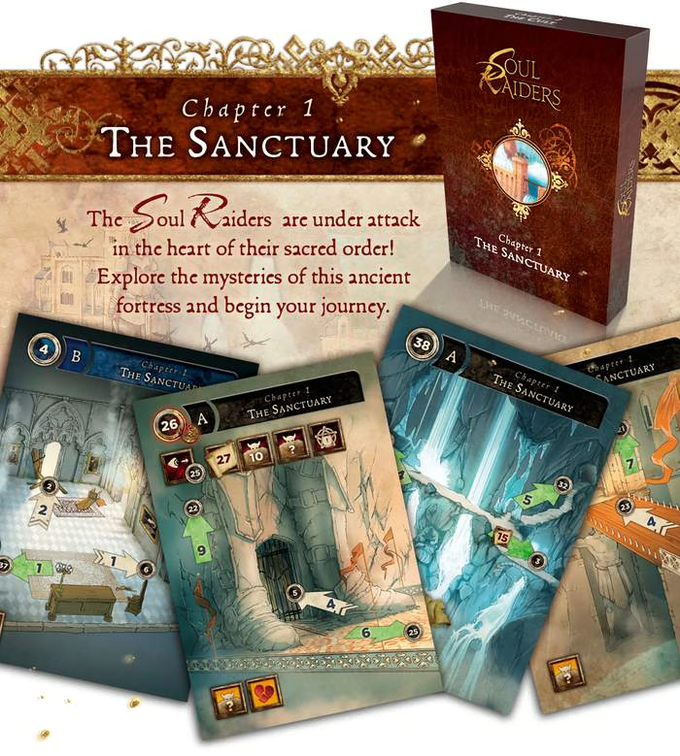
Locations can flip to Side B if certain events tell you to do so. Also, if a Hero re-enters a location (with no one on it), that may also trigger the location to flip over. The counters/markers on the sheet are placed on the opposite side; this new image will usually show a slightly different situation – maybe new doors are available, or previously open doors are now shut. Once a sheet is on the B side, it remains on that side for the rest of this run. When a card flips over, you apply any blue colored Entrance effects (but not the red ones). There may be Reaction (yellow box) effects at the bottom of the location – these are applied at the end of each round if a Hero is present. There also may be some conditional effects that are resolved if the conditions are right (usually a specific Threat level, etc).

So now, you know what the components are – but how do we play the game?! Remember, from the intro – the game is played in a series of rounds, but each round is fairly free form with players able to take actions in whatever order they like – there is no set turn order as in most games.
To start each round, players draw cards into their hand – equal to the number seen on the Exhaustion chart – at the start of the game, they get 4 cards per round. Later, it could be as few as 2 per round.
Then, players simultaneously participate in the action phase. Players can act independently and can sometimes collaborate, and there is no specific turn order. However, actions never take place at the same time as their effects can alter conditions for other players. As actions are announced and completed, they are resolved.

There are four types of actions: movement, combat, scripted action, spell. You can also discard and play to/from the reserve as well as spend Heroism tokens.
Movement – Movement usually follows arrows on the location sheet. The number in the arrow tells you the difficulty; and you must play cards from your hand that equal or exceed that number. The number at the end of the arrow tells you where you go when you move. Only one movement can be taken per action.
Scripted Actions – these are actions seen on the Location sheet in scrolls. If you are not engaged with an enemy, you can perform the printed action. If there are other Heroes who are not engaged, they can assist by also playing cards. However, only one Hero will take the action, and that chosen hero will get all the effects of the action (good or bad).

Combat – play cards to fight enemies. Each enemy card has potential special abilities found on their top edge. In the bottom left, you will see one or more shields; this shows how many points of damage they take per hit. You always go from left to right. You can never hit an enemy more than once per action, but you can hit multiple enemies if your action value is high enough. If you have defeated the final shield, the enemy is beaten and the card is discarded. If there are any effects in the bottom right corner, they are resolved now. You could also choose to flee the fight – if you do so, these enemies will engage any other hero still in the location; if there are none, they are simply put back into their respective decks.
Spells – Some of the cards have spells on the bottom half. Based on the text, they could be instant effect, temporary or ongoing. Certain spells are notated as “Single-Use”; if they are cast as spells, those cards as discarded to the box, not to be used again during this entire run.

Reserve – you can choose to play cards into a reserve area, essentially saving them for a later round. Later, you can pick up these cards from your reserve area. This is helpful to keep a good spell or other card for later use
Discard – you can also simply discard a card without attempting an action in order to speed up the end of a round.
Play Heroism Tokens – you earn these tokens primarily by defeating enemies. You can spend 3 tokens to take the topmost Heroic Action card from your supply. This is a little bit of deckbuilding as each newly added card will improve your deck. However, there is no choice on which card to add, they are added in numerical order from your personal supply of extra cards. You can also spend 2 Heroism tokens to draw the top card of your Action draw pile into your hand. This can be useful when you need one more card to finish off an enemy or make a daring escape from a room..
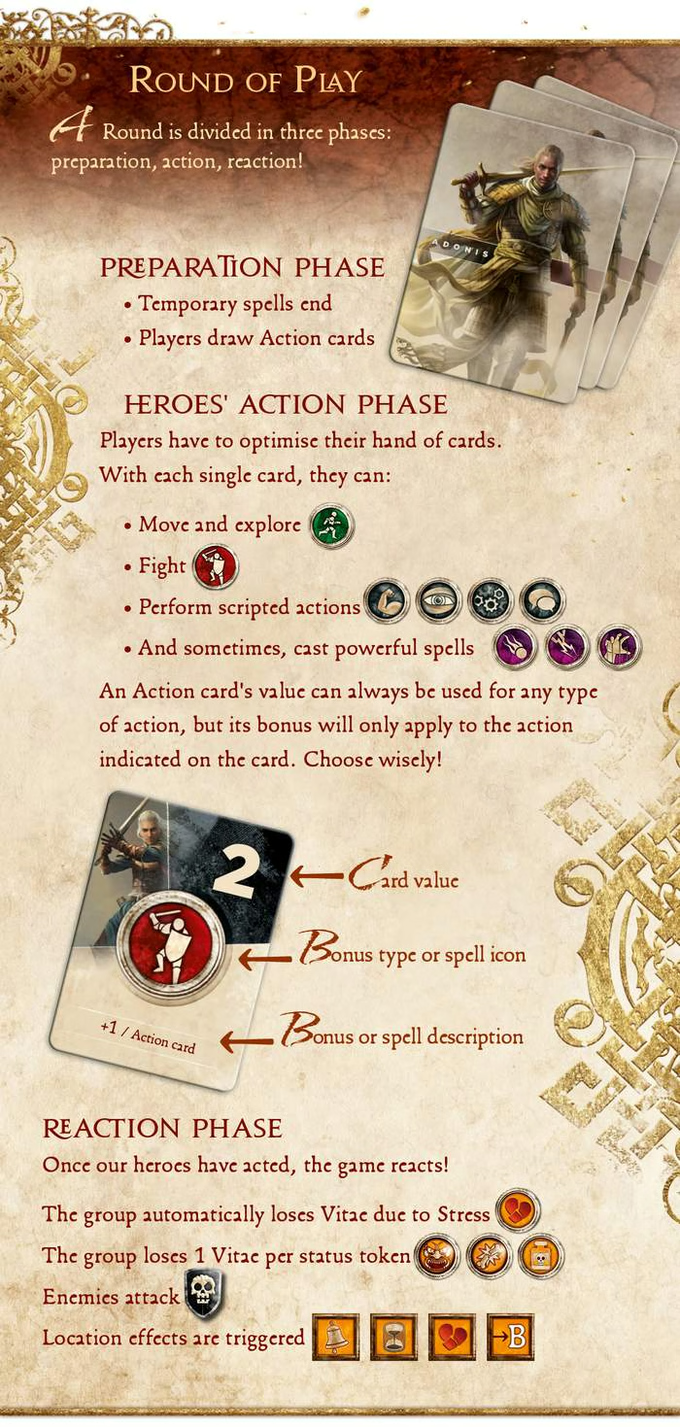
When all players have played or discarded all their cards, there is a reaction phase. Due to stress, the team loses an amount of Vitae equal to the current Threat value. Also, the team loses 1 Vitae for each poison, fracture or fear token found on their player boards. The enemies engaged with the heroes also now attack, with a base damage of 1 Vitae per visible shield on their card (sometimes enemies have other modifiers on the damage they cause). Finally, each Location that has a Hero in it will resolve any orange effects found at the bottom of the Location sheet. If there are multiple Locations, they can be resolved in any order that the team chooses, but each Location must be completed prior to moving onto another one.
Now, check to see if the game ends. Have the Heroes met all the victory conditions? If so, the game ends in a success. Are the Exhaustion or Threat markers on the final spot? If so, the team loses. Otherwise, start another round by drawing cards into your hand…
If you have won (by getting a card with a red star on it), read the appropriate section from the Chapter sheet. If you win, you can move onto the next chapter – though it is recommended to create a save page at this time. The game is mostly reset between chapters; you will keep your current Action deck (including any Heroic Action cards that have been added), unspent Heroism tokens, Quest cards and artifacts. You can either do this on paper, or collect all the Hero’s stuff in a separate ziploc bag which can be quickly retrieved next time. You can score how well you did in a chapter by counting up the number of black stars that you collected; these black stars are secondary goals.
If you have lost, you can reset the game and play the chapter again. You don’t keep anything that you have earned this run. You could start from scratch or resume from a previous Save state. The one thing that you carry through is the knowledge of the Locations and enemies from your experiences; this is (in game terms) the intuition of your Hero…
Initial thoughts on the game
In our initial play of the prologue (a few years ago), our game ended in a success; and it took just under an hour. Interestingly, we managed to win the chapter and we did not see all of the location sheets. We didn’t know if we had inadvertently taken a more direct path to the end, but it made us think there were some good areas for replayability. I think it’s nice that a team doesn’t see everything in a run – maybe we managed to finish the chapter, but we missed out on a side path that would have awarded us some epic artifact that would have come in handy later in the game. With the finished version, we took about 45 minutes to find the end. We all remembered the art and the basic story, but not the puzzle of how to solve the prologue, so we essentially got to experience it again.
One mechanic that seems to be baked into the DNA of the game is trial and error. On nearly every exploration choice, you have at least two options, and you really have no guidance as to which would be better**. Essentially, you come to a fork in the road, and you must choose left or right. Soul Raiders wants you to choose one more-or-less at random, and then see what happens. If it’s a really bad outcome, you’ll remember it for the next run and not make the same stupid mistake.

** If you have the Grimoire edition, you get a 70+ page hardback book filled with the backstory of the Soul Raiders universe. Interestingly, if you actually take the time to read through this book and carefully examine the illustrations, there are clues hidden in the book! I suppose if I were hard-core about Soul Raiders, I’d keep the book open for reference as we played, but well, I’m not that kinda guy. Also, it’s a bit weird that this reference filled with hints was only made available to the highest level of KS backer – making me think that it’s not necessary for the full enjoyment of the game. (In fact, it may detract from the enjoyment because the hints could possibly reduce the number of runs needed to win which then reduces the total gameplay time thus possibly reducing overall enjoyment).
Having prior knowledge of the locations is important in succeeding here. For example, remembering that a certain location has an initial action of 3 large enemies plus a threat level of regular enemies would be helpful; you would not want to enter that location near the end of the round as you would set yourself up for a huge counter attack at the end of the round. You might also remember where certain traps were found, and not waste the Vitae or time of your team by avoiding that trap in the future.
Speaking of Vitae – I really like how the group health system works. It makes it easier to calculate how the damage will affect your team and prevents you from having to nurse a particularly weak character around. Also, the interplay between your life force and your ability to draw cards meshes well and is a nice organic system to mimic the effects of stress and fatigue on a hero’s ability. It does also send the game into a bit of a downward spiral as the game closes; your turns become shorter and shorter as you draw fewer cards, and this also makes it harder to generate good combinations (say when you are fighting the strongest boss monsters at the end of a chapter). The game can quickly end as your team takes multiple rounds of damage due to the smaller hand sizes at the end.
The pacing of the game is interesting – in one way, it is free-form, and there aren’t really turns. However, the rules specifically say that no actions take place simultaneously, so there is still an order of sorts. Also, it is probably to the benefit of the heroes to get their actions in order, so a little bit of discussion can help everyone be more efficient in using their cards. Like any cooperative game, there is some possibility for quarterbacking, but it’s not that large here as each player has their own hand of cards and is control of how/when those cards are played.
The card system works great. I really like the way that every card has multiple possibilities. I wouldn’t say that there is a great sense of deckbuilding in the game as you don’t really have a choice on which cards to add, but it is a nice puzzle each turn trying to manage the abilities of the different cards, using them at the right time, sometimes even having to put them into your reserve to wait for the exact best moment to use them.

The artwork is fantastic. All of the scenes are richly illustrated on the location sheets as are the enemies on the cards. The icons however are a big mess. There are so many things about the icons not explained well in the rules. We inferred the meanings of many of them through play. What was really frustrating is that you will eventually encounter icons that you have not seen before. And the rules essentially tell you that if you don’t know what an icon does, you simply ignore it until you are told what it means – and then at that point, you must do what the icon says.
From my gamer standpoint, this is a bad situation and one that causes undue confusion. The rules are not organized well and anytime we had a question, it was not uncommon to have to flip through the whole rulebook to make sure that the answer wasn’t hidden in the four or five possible different sections in the book where it could have been. So… when I see an icon I don’t necessarily understand, I am rummaging through the entire rulebook to make sure that I really don’t know what it means.
It would have been so easy to include a small explanation on the rules sheet for a chapter – essentially saying – Icons X, Y and Z are only applied once the game tells you what they are. It’s not like the icons themselves are hidden – as soon as you enter a location with one of them, they are in the open. Why not just be clear about which ones are new? Mark them with some sort of notation just to tell me that if I don’t understand this, ignore it until I know what it is. Don’t make me guess if I know it or not. In our Chapter 1 experience, we were a good 90 minutes in before we read a card that explained what one of these very prevalent unknown icons was for. Why not tell us at the start that we shouldn’t know what it is, and just wait until you learn about it. It was a very frustrating part of our experience, and one that I think could have been easily solved. (We also unintentionally spoiled some things because we initially tried to resolve said unknown icon before we were allowed to).
The rules are not organized in a way that works for me. The game talks a bit about the components at the start and then includes some rules there. Then about halfway through the rulebook, it actually talks about the flow of a turn, and you get more (different) rules there. Then, after the turn flow is done, it goes back into detail on a couple of sections, and you guessed it, this is another opportunity for rules. Thus, when you’re looking for something, this is why you have to flip through the whole book as a single component might be discussed in three different places.
Also, the game would seriously benefit from some player aids. First, a simple tile to review the flow of a turn as well as the reaction phase process. It could have even have been printed on the main board. Second, an icon reference would have been nice. There is a summary on the back cover of the rules, but we couldn’t really leave it on the table for reference because it felt like someone was always leafing thru the rules trying to find something. Finally, why isn’t there some sort of short synopsis on the different characters so that you can pick one for your campaign that suits your temperament. (If you have the Grimoire edition, you could read a long-ish bio in the book, but really, why not put basic stats/spells on the back of each individual character box).
OK, complaints aside, the game experience was rather immersive despite the periods of frustration. It was fun to be able to mostly roam around freely; discussing with teammates when needed, but then able to do things as I wanted. In a way, it felt like a point-and-click adventure on the computer. Let’s pick a path, play cards to do the thing and then see what happens! Much of the story plays out through the story cards, and it does feel like a lot of work was put into building the backstory of the Soul Raiders world as well as the individual chapters.
If you like games like Time Stories, this will probably appeal to you – in the sense that you should plan on playing multiple runs through the scenario, learning tricks each time to save you health/time/energy/heartache/whatever in the future. It is unlikely that you will succeed on your first run, so taking notes or remembering things is key. Even if you do succeed, you might want to go back through the chapter to play again, searching for more black stars (secondary goals) to gain a better score.
So after a brief taste of the game, my group is divided. We all liked the overall game system. The exploration part was cool, and it’s a fun puzzle to try to maximize the combos in your cards to get the most out of them. The rules questions were really frustrating at times, and that is somewhat tempering plans to move forward to Chapter 2 immediately. I think our current plan is to wait for others to gain experience with the game and hopefully pose questions online so that we have answers available to us when we have those same questions. The overall game system has so much promise, and I am honestly interested to see how the game plays out – but I want a more streamlined experience, and this will probably only come when enough people have asked enough questions for an official FAQ to be produced. (Also, I want to make sure all the typos have been found – for instance, there is one location in Chapter 2 that has errors on it, and the publisher has provided a pdf of the fixed location).
We’ve only played about 40% of the game – the Prologue and Chapter 1 – so it’s hard to really give this a rating. If I had to say something, I’d say that I love the game system and the idea, but I’m currently neutral on the actual gameplay due to rules issues. I’m hoping that plays in the future will improve if there is a support structure in place to answer those inevitable questions. We’re likely going to wait until there have been more questions posed online (and answers given) to try to optimize our experience.
Until your next appointment,
The Gaming Doctor


