
Zenith
- Designers: Gregory Grard, Mathieu Roussel
- Publisher: PlayPunk
- Players: 2 or 4
- Age: 10+
- Time: 30 minutes
- Amazon affiliate link: https://amzn.to/44KxnyW
- Played with review copy provided by publisher

In the far-off future, the solar system is inhabited by 3 races: Humans, Robots, and Animods.
Civilization runs off of Zenithium, a clean and renewable energy source, but coexistence is a struggle.
Your goal: unite the planets to gain control of the senate!
Players will struggle to gain Influence on the 5 planets: Mercury, Venus, Earth, Mars, and Jupiter. This Influence is represented by discs in different colors.
In Zenith, there are 3 victory conditions:
- Absolute victory: Gain 3 Influence discs from the same planet.
- Democratic victory: Gain 4 Influence discs from strictly different planets.
- Popular victory: Gain 5 Influence discs (from any planets).
The game ends immediately as soon as one player meets 1 of these three conditions.
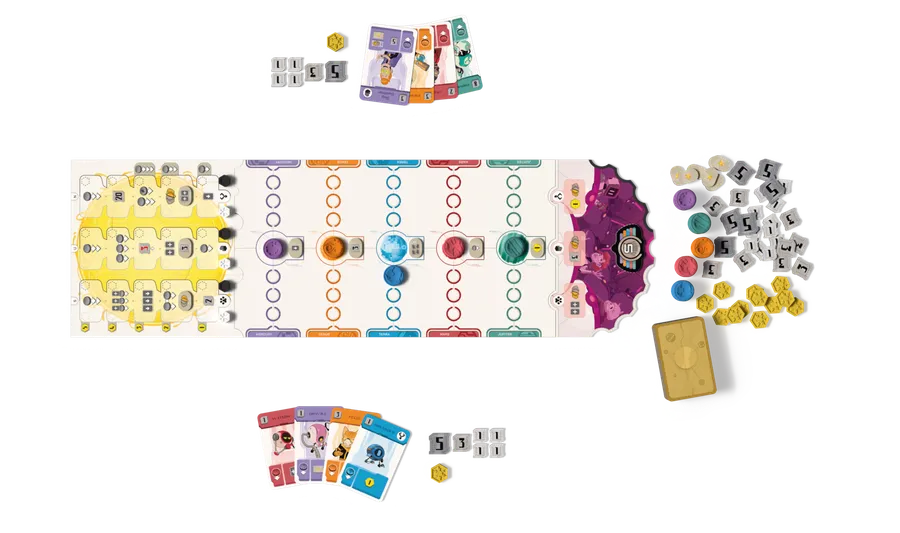
To set up the game, place the three boards between the players – the main Planet board in the middle with the Technology board on one side and the Diplomacy board on the other. One influence disc of matching color is placed on each of the 5 planets. This planet space is the central spot of a 9 space tug-of-war track for that particular planet. A random bonus token is placed underneath each planet token in setup. On the technology board, each player puts a tech marker in their color at the bottom of each of the three tracks.
The deck of agent cards is shuffled and each player is dealt a starting hand of 4 cards. Players each also get 12 Credits and 1 Zenithium. Before the game starts, each player is allowed to discard any cards from their initial hand and get replacements from the deck. The player aids are shuffled and given to the players. One player will become the starting player; the other will get one influence over Terra, the blue planet. Slide that planet one space in the direction of the player who will play second.
As I mentioned earlier, each planet is on a track of essentially 9 spaces. If a player can ever move the planet token to the space closest to them (4 away from the central space), they will gain control of the planet. The planet token is removed from the board and placed in one of the slots on the Diplomacy board – which also serves as the scoreboard for the game. If this is the first time this particular planet has been controlled, the player who just took control also gets to immediately use the power of the Bonus token on that row (and then discards the token).
Anytime a player takes a Planet token, check to see if one of the three victory conditions is met – 3 of one kind, any 4 different tokens or and 5 tokens. If so, the game immediately ends.

On a turn, the active player must play a card from their hand and then do one of three actions with it: Recruit the card, develop a Technology, or Become the Leader.
To recruit the card, place that card in the slot on the side of the board that matches the color of the card. Then you must pay Credits equal to the cost found in the upper left corner – though you get a discount of 1 Credit for every previously played card in that color. Finally, apply the effects of the card (seen at the bottom) from left to right. The actions on the card will allow you to move the planet token towards you, gain credits, gain Zenithium. You might also be able to Mobilize a card (draw the top card from the deck and place it in the corresponding planet’s column WITHOUT getting the card effects), Exile a card (discard the last played card of any column), or Transfer a card (take the last card from an opponent’s column and place it in your own column of that planet, though you do not get any card effects).

To develop a technology, discard a card from you hand, and reference the icon in the top right corner (Animod paw, Human hand or Robot pincers). Look at the Tech board in the column that matches the icon, move your marker up one space and pay the associated cost in Zenithium. Now apply the effects of the newly occupied space on the track AS WELL AS all the spaces below it on that track. Bonus tokens are granted to the first player to reach Level 2 of each track. Further, when you get all three markers to Level 1 2 or 3, you can take a bonus 1,2, ir 3 influence on any planet.
To become the Leader, discard a card from your hand and again reference the icon in the top right corner. If you do not have the Leader badge currently, take it from your opponent and place it on the Silver 5 side. If you already have the Leader badge, turn it to the Gold 6 side. The number of the badge tells you how many cards you are allowed to have in your hand at the end of a turn. The icon of the card played tells you which of the three special actions you also get to take when you become the leader.
Once you have taken your action, refill your hand to your limit – normally 4 cards, but it could be 5 or 6 cards if you have the Leader badge. Then, if you claimed a Planet token this turn, place a new Planet token on the middle space of its track. The next player then takes their turn.
Again, the game immediately ends when either player reaches any of the three win conditions: 3 identical planet tokens, 4 unique planet tokens or any 5 tokens.

The game can also be played in a partnership version if you have 4 players. Much of the game stays the same. One difference is that the player sitting on the left can only recruit agents to Mercury, Venus and Terra while the other player gets Terra, Mars and Jupiter. A team takes their turns in order (though the team can decide which partner gets to play first). Additionally, the Leader action includes an option where you can pass two cards to your partner. The win conditions remain the same.
My thoughts on the game
Zenith is an excellent tug-of-war game with the two sides fighting over control of the five planets. The intriguing part for me is that you will often want to do multiple things on your turn, but you’re generally limited to just choosing one action each turn. Further, sometimes you’ll know exactly what you want to do, but you won’t have the right cards in your hand to accomplish that action – so then you’ll have to scramble for the next best option. Third, your opponent may sometimes force your hand. If they get a planet to the penultimate spot, you will have to decide whether you need to pull that planet back towards you – or maybe the better play is to just give up on that particular planet and make a move somewhere else…

The main way you influence the planets is by recruiting cards of the matching color. However, it will cost you credits to do this, so you’ll always be looking for ways to get money. Maybe it will be through tech advances, possibly through the actions of other cards or the Credit bonus for becoming the Leader. Of course, don’t forget the bonus of -1 Credit cost for each card already played in a color; this does make it easier to concentrate in a particular color; but, of course, if you don’t spread your forces around a bit, it’ll be harder to play cards in the other colors where you don’t have the discounts.
The tech track is a long term play, but it probably should not be avoided. While you need to collect Zenithium in order to advance on the tracks, if you’re able to get high enough on a track, the immediate effect can be huge – don’t forget that you get to take all of the actions from your new space and below… When you get three or four actions all at once, the momentum of the game can swing in an instant!

Most of the games that I have played so far have been filled with the back and forth tension as the fight for the planet tokens rages on. The three different methods to win the game also increases the possibilities for strategic play as the game nears the end. Despite all that, the game moves along quickly, usually ending under the half-hour mark. There are plenty of different actions on the cards, but each player gets a double sided reminder card of all the possible actions, so figuring out the icons shouldn’t be too much of a problem.
I’ve played a lot more 2-player games in 2025 than usual, and I must say that Zenith is pretty near the apex of that category for me. The first PlayPunk release (Captain Flip) was nominated for the Spiel des Jahres, and this second game from the company just got a recommendation for the same award… That definitely marks PlayPunk as a publishing house to watch in the years to come!
Ratings from the Opinionated Gamers
- I love it! Dale Y, Eric M
- I like it.
- Neutral.
- Not for me…
Amazon affiliate link: https://amzn.to/44KxnyW


