
Corps of Discovery
- Designer: Jay Cormier + Sen-Foong Lim
- Publisher: Off the Page Games
- Players: 11-4
- Age: 14+
- Time: 45-75 min
- Amazon affiliate link: https://amzn.to/4kjjigT
- Played with review copy provided by publisher

Lewis and Clark are tasked not only with exploring America, but with ridding the land of numerous invasive monsters that have appeared. Corps of Discovery: A Game Set in the World of Manifest Destiny is a co-operative deduction game in which players each take the role of one of the crew on the expedition and set out to explore the land. The game board allows for different maps to be inserted into it, so you have many adventures ahead of you.
In addition to finding and killing monsters, you must also complete numerous daily challenges that require specific resources that you can find on the board. You have to use logic and deduction to reason out where the resources you need are located. Ally yourselves with Sacajawea and the indigenous people of the area to help you on your quest. The game comes with two chapters: Fauna and Flora. Each has new mechanisms, a different goal, and new components to give each chapter a different feel.
In the game, your group will collectively explore the land and use their talents to either kill 3 Minotaur (in the Fauna chapter) or destroy the Giant Plant (in the Flora chapter). Each chapter has ten different maps, and to start the game, you’ll have to choose a map to play on and slide it into the board. There is an opaque sheet that you can use to block you from seeing anything on the map until you have managed to put it into the board and covered all the holes up with tokens. Essentially every space on the map will start out covered, though the map will tell you one space that has a “peak” on it and some general rules for where you can start exploring from. You’ll also have a handy reference sheet for each chapter – outlining the logic rules that are always in effect as well as all the other little reminders that you want when playing the game.


Each player chooses a character card (each with their own ability) and gets some gear cards – this gives a little bit of asymmetry to each player’s turn. A start player is chosen and then play goes clockwise the rest of the game.

There is a second board that the party uses to track their inventory as well as their general progress through each day of the game. In each day, there will be three tasks (on challenge cards) that must be accomplished. Each of them has a time limit on the upper right corner, so you’ll have X turns in which to do the things that the card wants you to do. When you pass a test, you usually get a reward, and when you fail, there is always a penalty – generally a loss of water. This is bad because water is the resource that will lose you the game when you’re out of it.
So, the scenario will tell you where to start exploring, and then after that, generally you have to explore orthogonally adjacent to any previously explored space. Every turn, you must explore one space, and this path marker goes onto the current challenge card to show how many turns have been taken thus far for that card.

If you find a resource, you keep it. If you find a hill, you’ll get some information on the map. If you find a tipi, you can trade water/resources for other water/resources. If you find a skull, you draw a Threat card which might be a monster or it might be an ongoing misfortune. Finally, there are bonuses granted each time you completely explore a row or column of the board.

You also have the option of a bunch of free actions:
- Use your Character Ability – use the ability written on your card
- Use a Gear Card – use the action of the gear card
- Remove a Threat – if you meet the criteria to remove a Threat card, you may do so
- Use a Destiny Card – These are beneficial cards that you gain as bonuses; if your group has one available, you can discard it to resolve the action on it
- Build a Shelter – If you have an explored Field space, you can build a shelter. This will nullify the Fatigue penalty
- Build a Fire – 2 wood or 2 stone (huh?!) make a fire.
- Backtrack – discard 2 Fire tokens to essentially backtrack on your exploration decision, put the Path token back down and nothing happens from your bad choice
- Discard a Resource Token – usually only done to prevent being Fatigued (when you are carrying 5+ things)
Once you have explored one space and done any free actions that you want, your turn is over. Check the supply board and discard down to 6 Resources and 10 Water. Check to see if it is time to resolve the current Challenge card. Whether you pass or fail, you then check to see if you are fatigued (if you are carrying too many objects or carrying particular objects). If so, you’ll have to discard water or use the power of your Shelter to avoid this.

If you are resolving the third Challenge card of the day, then the Day ends. You must feed your group by discarding a food token. If you don’t have one, you starve and lose the game. Check to see if there is a monster in play – if there is not one, then draw a Threat card and resolve it. Reset all the players and gear and deal out three new Challenge cards for the next day.

Continue this until you win the game – that is meet the win condition for your chapter. In the Fauna chapter, you have to kill the three Minotaurs from the Threat deck. In the Flora chapter, you have to bring the Greek Fire item to the Giant Plant’s space to burn it down.
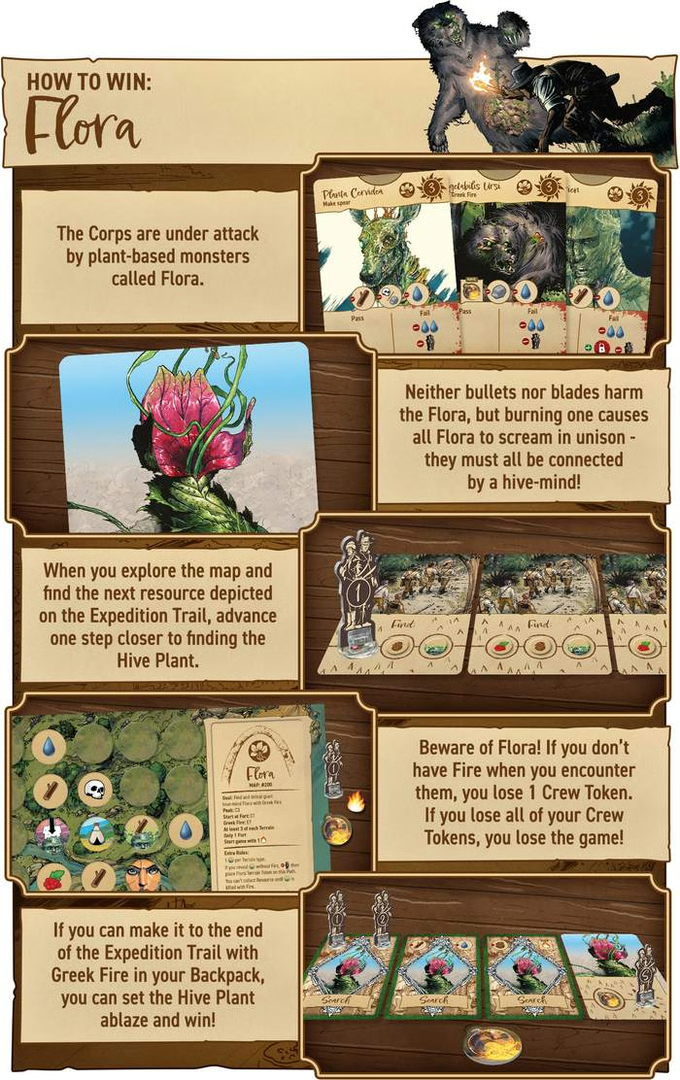
The game also ends in a loss if you run out of water, if you cannot feed yourself at the end of the day, or you’ve wandered around so much in the wilderness that you run out of Challenge cards to draw.
If you have won, you can gauge your success by counting up the Time Limit remaining on the unused Challenge cards.
My thoughts on the game
So, this is another game from Off the Page Games that is strongly influenced by a comic book. The first one that I played was Mind MGMT. Like that previous game, I knew nothing at all about the comic Manifest Destiny on which the game was based – https://imagecomics.com/comics/series/manifest-destiny – but it certainly looks interesting. There are a number of hardbound compliations of the comic – https://amzn.to/3Ss76hA – and I’m thinking about getting one to check out. At the cost of having to view a few ads, you can also read the comics on Scribd: https://www.scribd.com/document/767314143/manifest-destiny
This game uses the background story and wonderful art as part of this cooperative deduction game. Thus far, we’ve found the game to be moderately difficult. There is a big learning curve figuring out how to make all the needed deductions on what terrain is where. Heck, we even had trouble finishing the Training Mission! (Well, once we set it up correctly. Due to the rulebook, my first solo go at the Training mission was impossible to win…)

There is a really great balance here between working towards the overall goal of the mission and getting through the day itself. The challenge cards generally require you to find certain resources and then discard them to pass the test. However, you need these same resources in order to win the game. More likely than not, your group will have some discussions over a decision to purposely fail a challenge card in order to save the resources that would have been otherwise spent – so that progress towards the real goal can be made! Oftentimes, you will lose the same number of resources, it might just depend on which ones you’ll have to give up (or whether you can choose the ones to give up).
The Challenge cards definitely drive your exploration. They give you interim goals of things to find, and this will give you purpose to your deduction. And, the deduction is the heart of the game. With the 4 two-way rules and 8-10 one-way rules (at least in the Fauna module), you’ll have to work hard to figure out what is hidden underneath those path tokens. You’re free to choose any adjacent token, but since you’re limited in turns, you’re going to have to work hard to make them count. Additionally, the Challenge cards add variety to the game as they are random other than the first card of the first day. If you get a particularly tough one for card two of the first day, you good start down a spiral that is difficult to escape!
As you can see, a lot of your planning will be to try to find the right items at the right time. Early in the game, you may not have a lot of deduction going on as you just don’t have enough information to work with. But as you keep exploring the board and revealing more terrain bits, you should be able to sit down and puzzle out where things are on the map. Again, knowing where things are is only half the battle, you’ll also need to reveal things at the right time.
The other aspect of timing to think about is trying to maximally leverage your player and gear abilities. Your turn order is fixed from the start, and you’ll have to carefully consider how to best use the unique effects that each player has on their turn. As I mentioned earlier, the game is can be quite difficult. And as a result, you’re going to have to use all of your abilities just to survive to fight another day.
Can the game be quarterbacked? I mean, sure, to some degree it can be. But, the logic puzzle here is pretty complex, and I feel like everyone in my groups thus far has contributed – even if it’s to double check the person who thought they solved the puzzle first. From another angle, it’s honestly not the sort of cooperative game to need a quarterback. There is a single puzzle here – the logic bit of figuring out what terrains are under what covers. There are rarely times when the group is faced with two choices, each leading down a different unknown path. I have yet to come across a do-or-die situation like I do in games of Pandemic or Ghost Stories – where different players will passionately argue about going in this direction to kill thing A versus going over here to collect these items which we also need. Our group just had more general acquiescence to whatever plan was suggested. Of course, YMMV here.
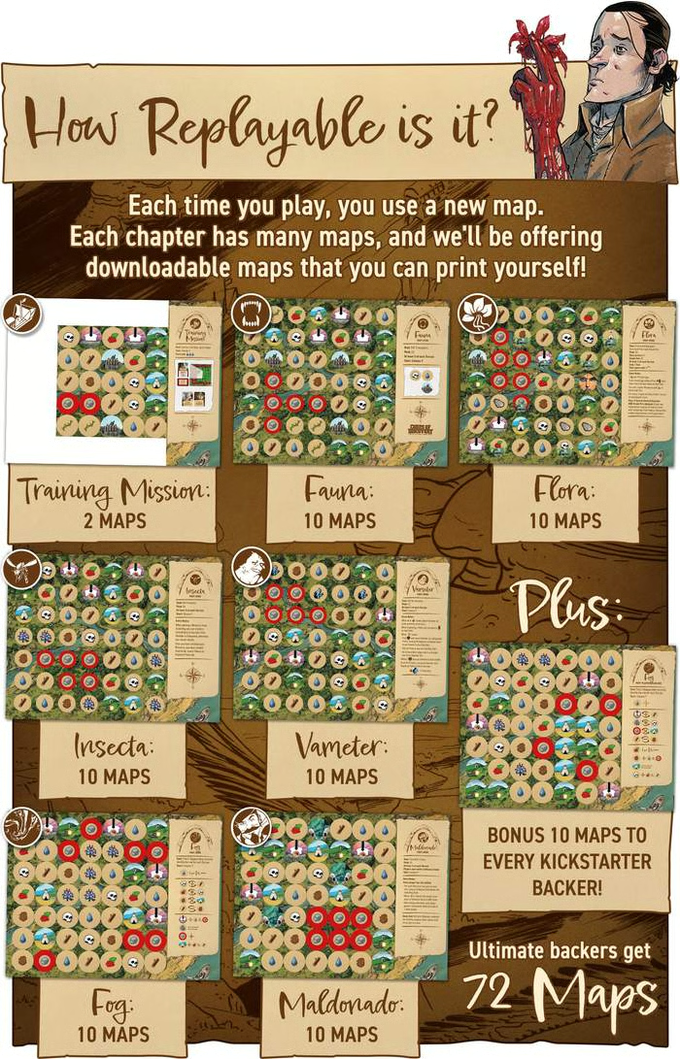
Is there enough variety in the game? Welp, I don’t think I’m ever going to play this so much that I run out of maps to use – and certainly not rapidly enough that I’d remember the layouts of 20 different maps! Also, if I was really worried about that, I could always go online and download extra maps from Off the Page (or buy professionally printed ones in an expansion).
FWIW, the rules are just OK, though there are a few things that have been cleaned up since the print run. An updated rule set is online (mostly dealing with clarifications on the training mission). In general, I had a bit of a job trying to figure out how to set up the game – this is one of the few games where I would have wished for a separate single sheet outlining the speicifc things/cards I would need for each mission type. Figuring out what should be in the Threat Deck was way more work than it was worth. As it turns out, it’s pretty simple: the Threat Deck is just all Threat cards from the Chapter/Expansion that you’re playing plus two random Threat Cards from the core set of 8. But man, I had a hard time figuring that out. Again, everything is in the rules, but I got turned around having to reference the regular setup on pg. 6 of the rules and then mash it together with Scenario specific rules on page 21. So, the problem certainly could be me. But the number of questions online about setup and other rules points against this being the case.
Further, it wasn’t overly clear in the rules how a turn would actually go. Most everything is in the rulebook, just not in the order my brain wanted to read it in. It’s a pretty dense 28 page rulebook, which supports the claim that everything is in there – but the length and layout make it sometimes hard to find the specific thing you’re looking for. There is no index, and unfortunately, keywords aren’t in bold, so you can’t just scan a page looking for a particular thing you have a question on. Having written rulebooks myself, I can sympathize with Off the Page – this is a fairly complex game rules-wise, and there probably isn’t a way to write the rules that satisfies everyone. So, I mention the rules issues not as a complaint but rather as a caution to check things online or find a FAQ should you get stuck.
Additionally, there is a set of errata maps which you are to use in place of a few original ones with misprints. If you try to play with the erroneous maps, your logical conclusions will all be wrong! Thankfully, this was right on top of everything when I first opened the box, so it was simple enough to swap out the maps. I then marked the bad maps with a sharpie and now use them as example maps for my teaches (of course, making note of the errors when they arise). EDIT: Now, I discover there are some puzzles available online – for example – https://boardgamegeek.com/thread/3507593/how-does-deduction-work-in-corps-of-discovery – print one of these out and use it for your teaching examples. Brilliant!
In short, if you like logic puzzles like Sudoku, Minesweeper, or Kakuro – this is going to be your jam. If you like comics, especially those themed about an America over-run by mythical beasts – then this is going to be your jam. If you want a game where the team is going to passionately argue over the different options, maybe choose a different cooperative game. If you like cooperative games that are a touch on the quiet side where everyone is working on the same puzzle, then this is going to be your jam.
Once you have mastered the base game, you can also look to get some of the expansions – four of them are planned, with the first one being released this summer, Insecta.
The story: The Corps of Discovery ventures further westward only to find the woods teeming with giant insects. Only an airborne insecticide can put an end to the menacing masses that threaten to overrun the Corps. The ingredients needed to concoct such a poison are readily available from the land itself, but all of your precious scientific gear is back on your boat. In order for you to be able to shuttle resources back to the boat, you must first deal with the Ranidae–a monstrous, frog-like creature that lies in wait just beneath the surface of the river, somewhere between the shore and the ship.

The expansion includes ten new maps, and they actually feel quite different – because now you have to get your resources back to the ship – this makes the timing of your actions that much more important. I’ve only tried one scenario so far and it’s definitely more challenging to figure out!
Ratings from the Opinionated Gamers
- I love it! Erik A.
- I like it. Dale Y (solo), Steph H
- Neutral. Dale Y (group coop), John P
- Not for me…
Amazon affiliate link: https://amzn.to/4kjjigT


Finally a more honest review. Rulebook is crap even the 1.5 version. Training mission now starts with 4 water and a food but still is impossible even with everything discovered.
Bad start that makes me distrust the puzzle design capacities of the creator.