
10 Days in the National Parks
- Designers: Alan R. Moon and Aaron Weissblum
- Publisher: the Op
- Players: 2-4
- Age: 10+
- Time: 30 minutes
- Played with review copy provided by publisher
- Amazon link: https://amzn.to/4oGJi8A

LET THE JOURNEY BEGIN! Set out the map and plan the perfect vacation, traveling around the country to visit scenic national parks. You will strategically hike, boat, fly, and drive to connect one park to another. It is a race to complete a 10-day trip through America’s National Parks!
In a review paraphrase below by our own Greg S. – this game is described in one sentence as: “Rack-O with a geography lesson”.
The comparisons to Rack-O are inescapable. However, instead of attempting to get numbers in the correct sequence, players must plan a cohesive and logical vacation through the National Parks of the U.S.A. This vacation will be planned by each player on their private rack, into which they will place the park and transportation cards in attempts to form a logical path for their whirlwind tour.

The racks of the Op version are molded plastic. They don’t have much weight to them, but they do a decent enough job to hold the cards in place. They are linear as opposed to the curved plastic racks in Europa Tour, so they do occupy a bit more table space. I find that I often stagger them, one above the other to keep them in front of me in my own table area, and to be able to turn them away from the other players so they can’t see my travel plans.

The cards are very nicely illustrated, each showing an illustration from the park at the top, and a guide to find the park on the bottom. On the map, the parks are divided into various easy-to-distinguish colors. Note that the regions on the map do not equal the actual borders of the parks, they are blobs meant to separate them and to allow for good gameplay. There are cards for each of the parks shown on the map, and a few parks have two cards in the deck. There are also a number of transportation cards, each showing two different modes of transportation on them.
Parks can be connected in one of three ways:
Land: If parks are geographically adjacent and share a common land border, then they are considered adjacent. You can walk by foot between these areas.
Air: If two parks have the same color, they can be connected by an air route, provided a player places an airplane card between the two countries on their rack.

Motorhome: Any two parks can be connected by motorhome, provided there is one intervening park that shares a common border with both of them. A player must place a motorhome card in their rack between the two parks.
Boat: Any two parks on the same ocean can be connected by a boat card in between them.

There are a couple weird rule exceptions that are clarified on the back cover of the rules. The parks that are considered to be foot-adjacent would have been more helpfully denoted with lines connecting them to their adjacent areas rather than having me have to remember how the special rules work.
The game begins with each player randomly drawing cards one-at-a-time from the face-down stacks until their racks are filled to the ten card capacity. As in Rack-O, a player may not move cards around within his rack. Once they are placed, they will remain in that position unless discarded on a future turn. The challenge, then – and the frustration – is to get them into the proper sequence.
The rest of the cards are placed in a deck, and then the top three are revealed and form the “draw” piles. On a turn, a player may select one of the three face-up cards, or take the top card from the face-down draw pile. He must then discard a card from his rack and replace it with the newly drawn card. Or, if he so chooses, he may simply discard the card he just drew.
The idea is to form a connected network of Parks. Parks that share a land boundary need no intervening form of transportation between them. However, if a player wishes to travel by air, the parks must be of the same color and a player must play a plane card in his rack between those two cards.
If a player wishes to travel by motorhome between two parks, the player must place a motorhome card between those two parks. Remember, there must be an intervening park between these two which shares a common border. Motorhomes are not color-sensitive. Since many parks share common borders, it is possible to reach numerous other areas via the use of a motorhome. Thus, these cards are very valuable and should be scooped at every opportunity. They rarely go to waste and give you much flexibility in your planning..
The first player to complete his vacation by logically connecting all ten cards on his rack is victorious and enjoys the fruits of a well-planned vacation. To prove that he/she has won, he transposes his cards from his rack to the spaces at the bottom of the board and everyone makes sure that the trip route is valid. You must start and end from an actual park card, you cannot use a transportation card as either terminus.

10 Days in the National Parks is a great family game – it is part of a very successful series of 10 Days games. The rules are easy, and at least for most Americans, the basic knowledge of geography makes it also easy to pick up. There are no deep levels of strategy or numerous tactics to be employed here. That doesn’t mean, however, that the game is completely bereft of strategy. One should place cards so as to keep as many options available as possible. So, spot the parks that give you the most options and try to utilize these in your rack.
There is also definitely a skill to the initial placement of the cards in your rack – and everyone seems to have their own strategy on this. I like to place the first well-connected card near the middle (position 5 or 6) and then only place cards adjacent to this which are valid connections (or transportation cards). Cards that don’t fit well end up on the outsides of my board. Then, when the game starts, I already have a nice linked middle section and I just work on making the outside ends connect.
Further, when discarding a card from your rack, you are usually free to discard it atop any of the three revealed stacks of cards. Try to cover cards that you don’t wish to use, but which may be beneficial to your opponents. This will thwart their plans and often force them to completely rearrange their itinerary.
As with all the games in this series, there is certainly a degree of frustration involved. It can be quite maddening to never have the card you need surface, or to have them scooped by an opponent before you have the opportunity to grab them. Often, you find yourself being forced to re-plan your itinerary, which is time consuming and fraught with its own perils. And, there is always this nagging feeling that your opponents are one step ahead of you in the rush to complete their vacation plans. These elements are what makes the game “click”, however, and help make the game quite enjoyable and moderately tense.
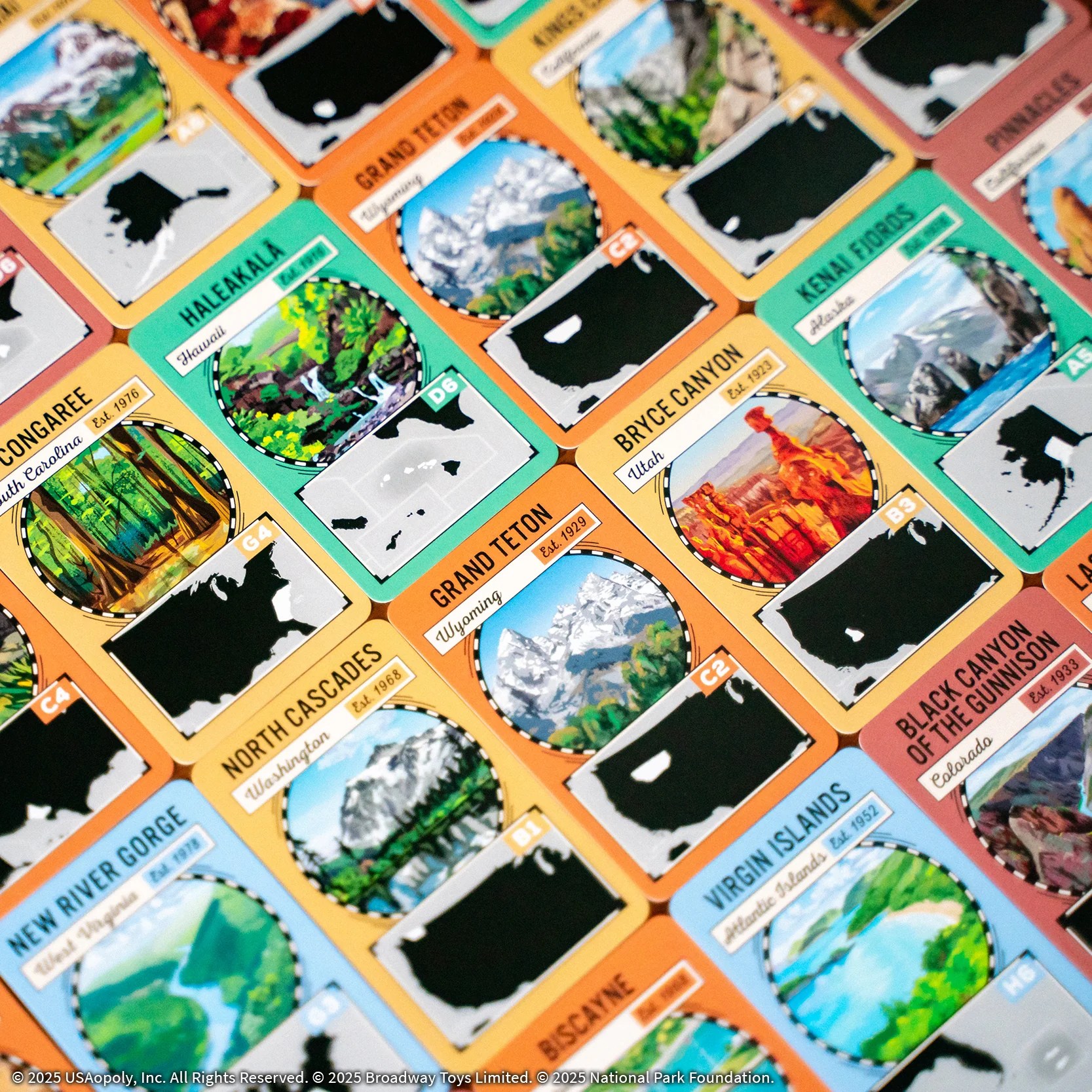
In this version, there are a lot more park cards (76) than states (50 from the original game) – so it might seem like it is harder to connect things. The new transportation rules, i.e. the boat rules, make it easier to connect coastal parks. Additionally, having two different transportation modes available on each transport card gives you a lot of flexibility. It’s pretty much a slam dunk decision to pick these up whenever they are available IMO.
The game can be played with 2 – 4 players and is quite enjoyable with any number. With two players, however, it is a bit more strategic, as you can plan your discards and control your card choices with a bit more certainty. Maneuvers can be made wherein you discard a card, only to pick it up on your next turn in order to position it in your rack more advantageously. With 4 players, this tactic is much more difficult as the likelihood that the discarded card will be taken or covered by an opponent before your next turn arrives is far greater. Higher player counts also make it more risky to play a strategy where you are waiting for a single card that will complete your route – as there are always 30 cards out of your reach in the other player’s racks, and a much higher probability that it is locked away in someone else’s hands.
There is no escaping the fact that this is primarily a light family game – which is not a negative thing to say about a game. There are definitely games that work better in different situations, and this is one for more causal gaming for sure. There is a healthy dose of luck involved, and some folks might find this aspect not to their tastes. I’ve always enjoyed Rack-O, however, so I can enjoy any of the ”10 Days” games for what they are: Rack-O with a geography lesson.
Thoughts from the Opinionated Gamers
Joe H (never played) – I just spent a minute trying to figure out how 63 National Parks turned into 76 park cards, but a look at the map explained it – 13 are duplicates. But – assuming the game works the same way as the others in the series, there’s something that bothers me about it. I’ve been to all of the National Parks in Alaska, and the notion that you can reasonably get from one park to another by any method other than flying is absurd. It breaks the theme for me entirely – in spite of my interest in the NPS, I’d likely rather play any of the other 10 Days games as a result.
Ratings from the Opinionated Gamers
- I love it! Dale Y
- I like it.
- Neutral.
- Not for me…
Amazon link: https://amzn.to/4oGJi8A


