
Koi
- Designers: Rosaria Battiato, Massimo Borzi, Martino Chiacchiera
- Publisher: dv Games
- Players: 1-4
- Age: 10+
- Time: 45 minutes
- Amazon affiliate link: https://amzn.to/3KqS5f2
- Played with review copy provided by publisher

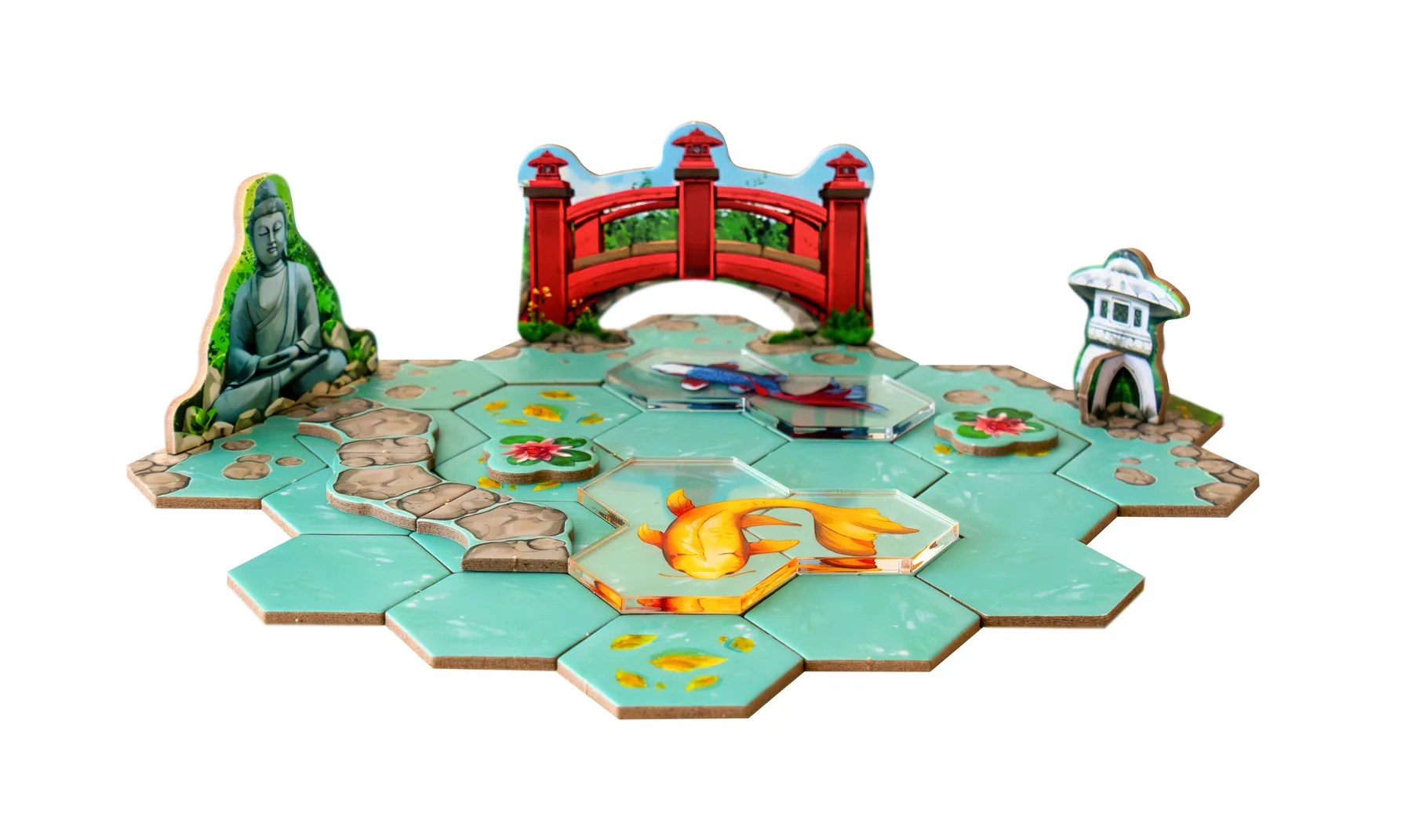
In Koi, you build an authentic 3D koi pond, so the challenge is to bring your reservoir to life and make the most of the actions at your disposal to create something truly magnificent.
From the creators of Bonsai comes a brand-new, serene, strategic journey through nature.
The Japanese term “Koi” means multicolored carp, known as “swimming flowers”, considered living jewels, and a symbol of perseverance and virtue. Now you can welcome them into your pond and contemplate them to achieve luck and success!
Inspired by the peaceful elegance of Japanese gardens, Koi invites players to build stunning habitats, populate them with koi, and compete for harmony, beauty, and victory points.
With a highly customizable, multi-layer tile placement system and beautiful 3D elements like bridges and lanterns, no two games are ever the same. Complete dynamic goals, unlock new features, and gaze at your own stunning creation while it comes to life! Includes a robust solo mode for peaceful solitary sessions.
To set up, each player gets a sensei board, a starting spring tile, 2 coins and a luck token. The deck of cards is constructed based on player count, shuffled, and then the top 5 cards are dealt out to the main board (placed in the center of the table). A starting player is chosen and then players gain water tiles and/or koi based on their starting turn order slot. 3 Goal tiles are chosen for the game.

Each turn unfolds with two core actions:
– Meditate: draw one of the face up cards from the central board – possibly gaining bonuses or paying a cost for the card depending on its position in the market. Some of the cards are helper cards which provide you with a once-a-turn ability. Other cards give immediate benefits while others provide end game scoring abilities. Afterwards you may purchase a koi.
 – Work: use one of your Sensei’s abilities to shape your pond by placing your tiles. The four possibilities are listed on the sensei board. You can also activate any or all of your Helper cards once in this phase. After placing tiles, check to see if you have fulfilled any goal tile conditions; if so, take the Goal and place it immediately in your pond.

The game continues until the deck is exhausted or the last koi is taken from the supply. Continue to the end of this round and then play a final full round after that. Then tally your scores
- Koi: 2/4/6 pt base score for sm/med/lg. Then +1 pt for each adjacent water lily. Then x2 total score if fully surrounded by water
- Lanterns: 1vp per every hex in a straight line in front of it
- Parchment: VPs awarded based on the number of Parchment cards collected
- Goal tiles: each goal scores a specific number of VP
- Luck Tokens: 1VP per unused luck token

The player with the most points wins. Ties broken in favor of the player with the most coins left over.
My thoughts on the game

Koi is a beautiful game that feels familiar as it uses many common mechanisms, but at the same time, doesn’t rely on any one too much. There is a little bit of tile-laying and spatial puzzling as you make your own pond. There is a bit of engine building as you hire different workers in order to improve your Work turns. There is also some resource management as you’ll soon find that you are often constrained by the small amount of storage that you have at your disposal.
The rules themselves are quite simple – there are only two different options for your turn, and both are easily grokked. Meditation turns offer a chance to gain a useful card, though there are certainly times when you end up taking a particular card more for the options offered by its slot in the market more than the card itself. Work turns start out quite simple as you may only have one thing to do, but as you add in more and more helper cards, they can become quite complex indeed.

There are a number of different ways to score points. The most obvious being placing (and hopefully surrounding) the beautiful Koi tiles. The three goal tiles can also offer nice VP payouts, though you do have to race against your opponents to get to the goal before they do. The parchment cards also offer individualized goals if you choose to draft them on your Meditation turns.
As I mentioned earlier, the game is quite beautiful, and it is interesting to see ponds evolve on the tabletop. The clear Koi tiles certainly add nice splashes of color to the water’s surface. I feel like the icons are clear and should be easy to understand – but thus far, in every game I’ve played, the gamers have had issues remembering which icons mean play tiles from your personal board to your pond versus taking tiles from the supply and play directly to your pond. As I said, I don’t think this is the fault of the components; everything is clearly marked (and clearly explained in the rulebook) – but it’s interesting that, for whatever reason, the gamers in my games have consistently made errors in where they try to place tiles from.

Thus far, all the games have felt a little different due to the random goals that were selected for the game; obviously this changes the relative value of certain game elements. In addition, due to the everchanging nature of the drafting market, you’ll have to constantly be reassessing your options and considering strategy shifts mid game based on which cards are available to you (or what helper cards or parchment cards you have been able to acquire).
Individual turn length is variable – some turns are super straightforward while others take a bit more time to think through the options. That being said, the game overall usually moves at a moderately fast pace, and 40-50 minutes seems to be the length of our games here. Koi is a solid Euro game that I really like – I enjoy having my own little pond to create and massage into what I want. Like an earlier release from dv games, Bonsai, this is my sort of tile laying game – not quite putting me into a state of zen – but certainly an enjoyable experience with each play.
Ratings from the Opinionated Gamers
- I love it!
- I like it. Dale Y, John P
- Neutral.
- Not for me…
Amazon affiliate link: https://amzn.to/3KqS5f2


