
Timespan
- Designers: Kenneth Minde, Kristian Amundsen Østby
- Publisher: Alion
- Players: 1-5
- Age: 12+
- Time: 90 mins
- Played with review copy provided by publisher

Timespan is a streamlined, friendly and highly varied civilization game from the designers of Automania and Bad Company. Combine one of six asymmetric civilizations with one of six unique technology boards, and customize your civilization further by recruiting among 175 historic persons, buildings, technologies and wonders.
Large parts of the game are played simultaneously, allowing you to lead your civilization from the stone age to the space age in about 90 minutes. There is no warfare: Timespan focuses on the peaceful sides of civilization building, the exploration and on building an economic engine.
(Forgive me for the brevity in the rules recap – but I’m trying to write this at night while at Spiel, and well, I am going more for giving you the essence of the game instead of the usual more in depth rules regurg so that I can go to sleep and do it all again tomorrow!)
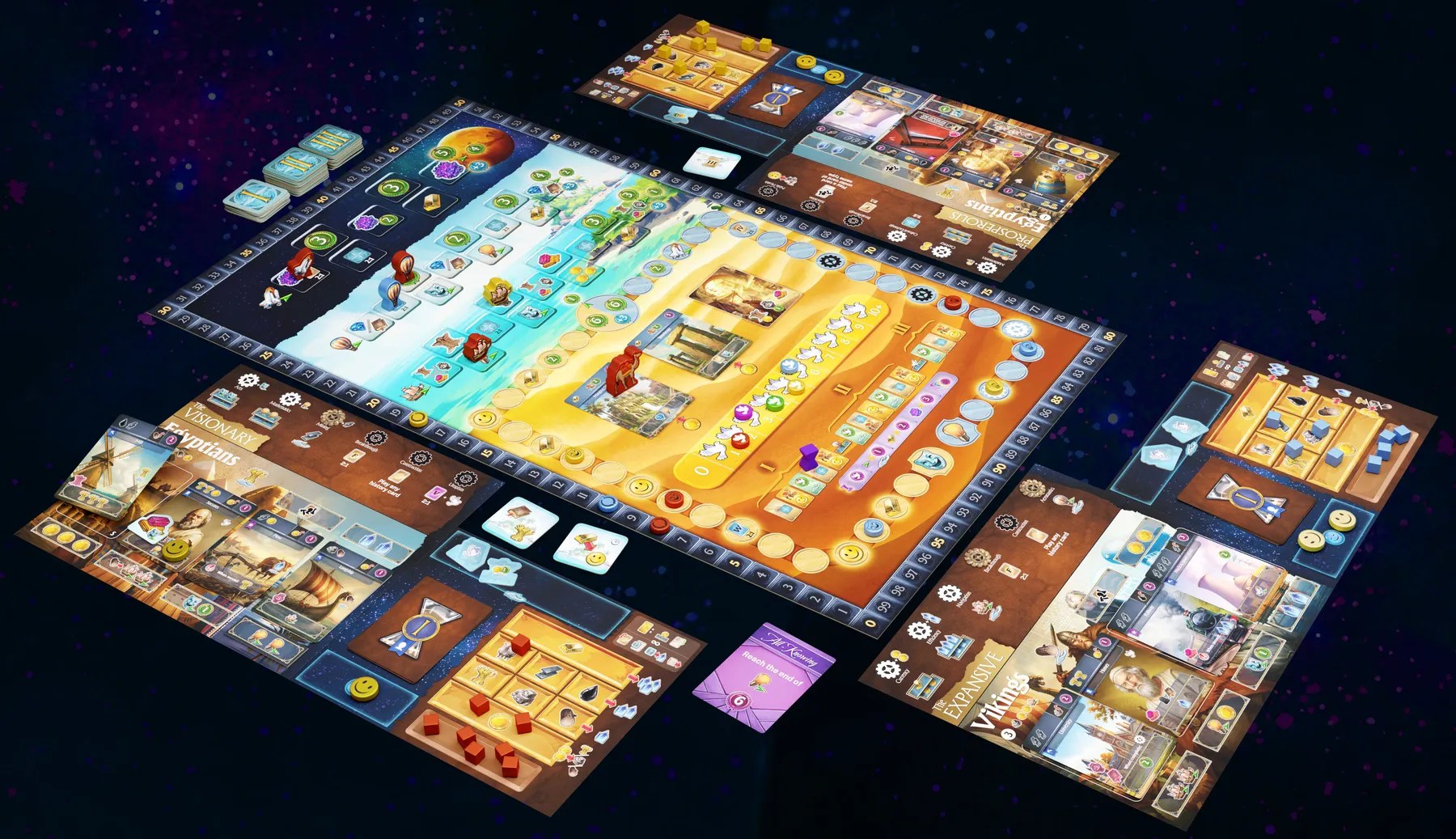
To set up, the board is placed on the table – if you have a small table, you can actually fold up the board and use a mini-board on the back – this is really neat! Players place a marker at the start of each of the tech tracks. 2 Wonders are dealt face up next to the board as the neutral wonders.

Each player gets a civ board and a technology board – each is unique with different action spaces, starting resources, etc. Players get 8 resource cubes and they place cubes on their inventory area to match their starting stuff. The resource track has four levels, and you can convert resources (both upward and downward) through actions in the game.
Players place their three starting cards as directed on their timeline. Players start with 3 workers and leave the rest in the supply. Players get a starting hand of 1 wonder card. Players also choose a vision card to place between themselves and their neighbor, this is a shared end game bonus card for them.
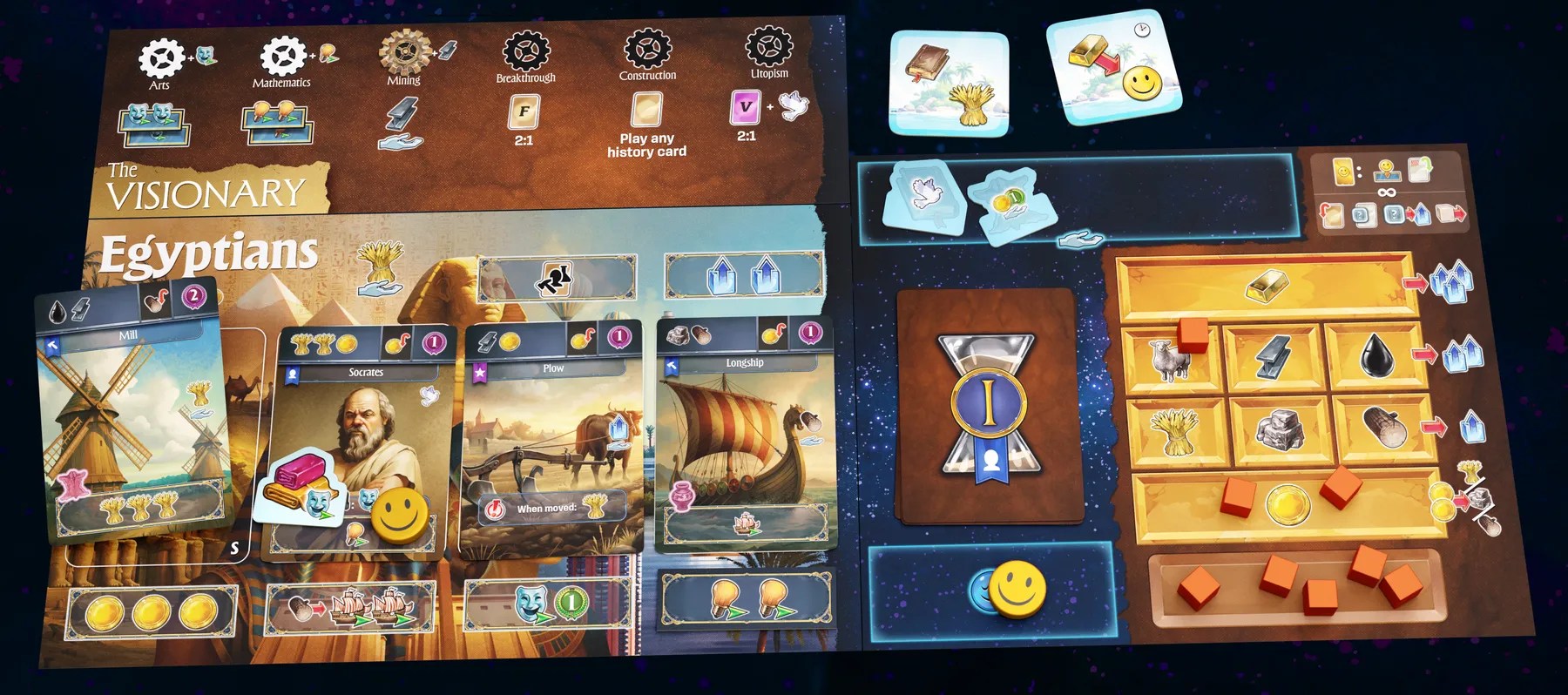
The game is played over 5 rounds. Each round consists of an income phase, a camel moving phase, an exploration phase and an action phase.
Players take income each round (other than the first) for income effects seen on their board, timeline, luxury tiles and technologies. Players then count up their number of peace symbols and place their markers accordingly on the Peace track. Ties are broken in favor if the lower number printed on the civilization board.

In the exploration phase, players take turns (in order of their positions on the Peace track) to draft cards and discovery tiles from the current age. There are N+1 sets, each consisting of a face up discovery tile (mostly granting immediate one-time benefits), a face up history card, and a face down history card. Cards are useful as they can be played to your timeline to give possible actions, but most cards can also be discarded to provide resources.
Then, players move their camels, possibly visiting the other players’ wonders for various effects and rewards. You must move your camel to a new wonder – and you can never move to your own. If you use an opponent’s wonder, they get 2VP. If you use a neutral wonder, you must pay a coin to the supply. You get the benefit of whichever wonder you choose. Alternatively, you can freely go to the marketplace to get resources/tiles.
Then follows the action phase, which is played simultaneously by all players:
Each player has a civilization board with a timeline, where they can play up to 4 cards. As new cards are played, older cards are pushed out of the timeline, and go into the player’s graveyard. Cards are always played in at the left side, pushing out a card on the right. The cost to play a card is in the upper left. Players should also not forget that many cards can be discarded to generate resources.
Players use their workers to activate cards in their timeline, as well as action boxes on their civilization boards and their own wonders. Some cards may activate the box which is underneath it (and this will change as the card moves down the timeline).

All activations provide various rewards such as resources or advancements on the culture track (to gain wonders and new workers), on the science track (to unlock technologies on the player’s technology board), or on the ship track, the flight track or even the space track (giving access to various rare luxury resources). Luxuries can be used to upgrade your cards’ effects, and when luxuries are moved into your graveyard, they continue to provide permanent passive income or end game VPs.
You can only use an action space once, and you are limited to one action per worker you have available. As you progress along the culture track, you can unlock more workers.
At the end of the second and fourth round, a new age begins, and new cards and discovery tiles are introduced to the players. Players also get a new tile to place on their board to unlock movement on the next era’s technology (hot air balloons in Age 2, and the space shuttle in Age 4).
After the fifth action round, the game ends. Players calculate their scores:
- 1 VP per space on the Peace track
- 1 VP per track bump taken in final income
- 2 VP per gold in storage (you are allowed to convert resources as normal)
- 3VP per Umulium luxury tile
- VP per completed Vision card placed during initial setup
The player with the most points wins, ties broken in favor of further ahead on the peace track.
My thoughts on the game
Man, so this is a review/first impressions after just 2.5 plays. That’s maybe two fewer than I’d normally like for a game like this, but I’d really like to write something about it while the fair is going on – and frankly, I’m already pretty sure of my opinion on the game.
This year is apparently the year of the civilization themed game for me – many of my favorite games this fall have fallen into this genre (see Ashes & Amber) – though each has approached it a little differently. To be fair, it’s possible that I might never voluntarily play a 4X game again, they’re not my jam. But I am attracted to these sorts of games that allow you to try to build or craft a society/civilization. Heck, under this loose definition, 7 Wonders might even be able to sneak in the category.

Here, it is not quite simultaneous solitaire, though blissfully there is a lot of simultaneous going on. Players will interact a bit with competition on the Peace track which leads to drafting order, with racing on the tech tracks for bonuses, and through the choices of Wonder cards played – as each wonder card can be used by other players during the Camel moving phase. However, for the bulk of the turn, in the Action phase, you’re just placing workers on your own and doing your thing.
This simultaneous action does help the game move along, probably halving the time it takes to play opposed to a world where you just watched everyone else do their thing. While I can see a few edge cases for why you would want to know what an opponent is doing (i.e. the race to get to the end of a tech track first) – the bulk of the action is taken on your own cards and boards; and no one can prevent you from doing anything. Also, even if I would watch someone else do their actions, I can’t take them, so just let me know what the end result is…
As there has always been at least one newbie in my games, I was taught with a system that worked well. For the first two action phases, each player took their turn individually, getting a chance to ask questions and possibly re-do things if they didn’t work out. By the third, everyone should have the hang of the game (because it is quite intuitive), and people can pretty much do everything on their own and should not require any supervision. Sure, there is always the chance that someone could (un)intentionally make illegal plays as everyone is doing their own thing, but man, if that bothers you, I’d just tell you this isn’t going to be the game for you (or you need to find gaming friends who don’t cheat).
I like the Timeline mechanism, giving you some time to play and use cards, but oftentimes trying to get a luxury tile on the and move them to your graveyard for those benefits. Some cards and civilizations offer action spaces that trigger other things based on position, and that’s interesting too. There is a nice push-pull with the playing of cards. If you have an action you like, you don’t necessarily want it to go to the Graveyard, but you’ll need to continue playing cards to keep things moving forward. Also, as you would expect, the cards in the more modern areas tend to have more power than the earlier ones.

The cards themselves are great, and the college history major in me appreciates the time and thoughtfulness put into the people and events on the cards. The actions on the cards make sense. If you play Cannons, you lose Peace. When you play Rosa Parks, she sits in your timeline and then refuses to ever move again. Nothing is moving her out of her seat on your Timeline bus. So clever!

Timespan also scratches a bit of my roll-and-write combo itch. Plenty of actions, especially track bumps, can lead to cascades of actions on a turn. There are plenty of ways to generate actions in the game, so you will definitely have to do a bit of forward planning when starting your Action phase.

Each game will likely set up differently as you have 36 different ways to pair the Governments with the Civilizations. The action spaces are all a little different on the Civ board, and the Governments have unique gear actions – three white and three dark – and you can only ever use max 2 of each type, should you get far enough forward on the science track. The whole tiebreaker system seemed a bit harsh, but I’m trusting that the designers have given enough other benefits to the highly numbered Civ boards to compensate for them losing every tie.

I also very much like the resource inventory system. You can only ever have 8 things, and you can use upgrades and downgrades to manipulate what you have. If I recall correctly, a very similar system was used in Saltfjord – but it’s cleaner in implementation here. You can also see the luxury tiles as a sort of inventory game as well – you’re trying to pair up tiles to play on cards that want specific types; as this improves the action while on the timeline and then provides persistent bonuses if they get moved to the Graveyard.
The art on the cards and boards is fantastic; the illustrations really do add to the feel and lushness of the game. One part of the game I haven’t quite figured out is why the workers are smiley faced on one side and frowny faced on the other. I tend to place mine frowny side up because, after all, no one really likes being at work.

Overall, I have loved my two full plays of the game. Trying to figure out how to make my combos work as I build my civilization up is the heart of the game. I feel true to my Eurogamer roots, and I’m not sad that there is no military aspect (like 7W on the lighter end, and Through the Ages at the other). Nothing is gonna knock down what I’ve built; I just have to build more/better than you. That’s “Civilization building” that suits me just fine, and I’m ready to play it again right now… well, maybe when I get home and catch more than 4 hours of sleep a night!
If you’re at Essen, you can check out the game at the Alion booth, 3F-110.
Ratings from the Opinionated Gamers
- I love it! Dale Y
- I like it.
- Neutral.
- Not for me…
Amazon affiliate link:


