
Essen Friday was as busy as yesterday and by now I am used to once again the Essen shuffle through the aisles and the huge number of small steps taken – I think I walked 5 miles today! Anyway, not all of it was walking around, but I did enjoy wandering through the art gallery, buying some components at Spielmaterial, who always have an excellent selection at Spiel, and walking oast the enormous queues for Lorcana, the Asmodée store, Gaudi from Devir, the queues for Queen Alice by Combo games which is this year’s hottest game (I don’t know if that is justified….let’ see), and the various other madnesses of Essen such as queuing for lunch food (which is definitely getting better these days). There was also a break in the rain and wind for a bit of sunshine which was pleasant when you are walking outside to avoid the, well, long Essen shuffle down Hall 3.

I started the day off with a play of Medico, the latest Stefan Feld game from H@ll games. It was a delight to be taught by publisher and developer Ralph Bruhn who patiently talked us through what looked like a complex game but which was actually very easy to understand thanks to the brilliant look, feel, iconography, and general design of the game board and components. I am not always a fan of Feld games – some miss the mark for me, others I absolutely adore (Civolution, I’m looking at you, but many others too). Medico felt like the roughly same weight as Merlin, and I definitely enjoyed it.,
The game is designed around the history of medieval medicine, where players play travelling barbers trying to learn basic medical skills from Medico, a mythical founder of medicine. To do so, they will need to pay visits to the Medico who moves clockwise around a board made up of 7 seven segments., By paying Medico a small fee he will impart wisdom, represented by gorgeous golden owl pieces that you place on selected spots on your player board to gain a bonus ability. Apart from meeting him, you may want to travel around the board too, from district to district, and as you do so you pick up resources such as leeches and rose quartz to help you in your healings. Some resources will be placed on recipes from books you accumulate – once you get the ingredients you can cook them, and this earns you end game points as does the of delivery certain supplies that are in demand in the different regions, You may also want to deliver letters from one region to another on your travels, for which you also earn rewards.
The game board tracks not only your Victory points, of which you score very few in the game, but also your prestige. When travelling, all players select their destinations secretly and reveal them only on their turn. If after everyone has moved and taken actions, you find yourself in a region with the Medico or another player, the player (or the Medico) with the most prestige earned will “win” a bonus action. Having more prestige than the Medico is very difficult, but it is worth building up prestige compared to other players.
The other resource tracked is money, which like in many good games can be hard to get hold of and worth having. With money you can pay the Medico, buy recipes, install an apprentice in a region, and buy tools that can score significant points and prestige. The tools depicted are I’m sure as basic as the ones actually used by these amateur medical men!

The game is played in 7 rounds in which you will find yourself unable to do everything you want to. Objectives (in fact, golden and silver medical serpent Hippocrates symbols) for “first player to do something” help guide you through the game, and earn you points. At the end of each turn you make you will be able to do one of 4 fixed actions – two of which are free (take 2 coins, take a card), and two of which cost money (install an Apprentice, buy tools). The only action I haven’t already mentioned is the possibility to collect a card to use later as a one-off use – all the cards are different and brings interesting benefits.
If any of this sounds confusing, during the game play it really isn’t, because the flow of the game guides you quickly and easily through your different options in the form of a path which you must walk along when you move from one region to another, showing symbols for the various actions you can choose to take. It really is beautifully arranged to allow you to quickly learn the game.
Overall, if you haven’t already noticed, I was very taken with the game and am looking forward to playing again.

Next up, I wanted to look at a couple of Japanese, gorgeous looking games from Huch: Ikebana and Sensu, because I am planning a holiday to Japan next year, Both games use gold embossing in their production and are visually stunning. Ikebana was sold out unfortunately, except for a few copies held back for a Saturday event, but I did see a demo copy from a distance and it certainly looked like a very pretty set collection game. Sensu is a 2023 game from DV Games which has been republished with advanced rules. This original game has a few twists on a typical set collection game, because you carefully play sets of cards whose numbers add up to 15 and then “rescue” at least one card to start to make a Japanese fan (all the cards have beautiful illustrations of fan segments on them). If while playing you make a combination – either by having at least three cards of the same suit , or by having at least 2 cards with the same number on them, you may rescue more of your played cards to use to build the fan. Each fan you construct will be made up of 7 “sticks” – segments of the fan which must all match in colour – and when one player has built 3 fans the game ends, but you must be clever in how you play your cards to maximise the number of sticks you rescue from each card you lay down. The updated version contains several options for advanced play which look interesting too. Definitely worth checking out.
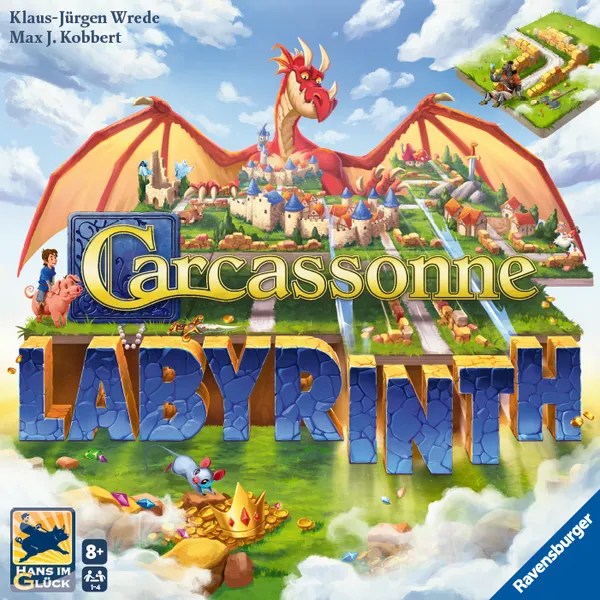
Next up was a well-needed sit down after a further wander around the halls, to play Carcassonne Labyrinth. This game is a crossover cooperation between Hans im Glück and Ravensburger – and seemed intriguing since these games are giants and real classics.
Unfortunately…this game turned out to be a disastrous experience for me. Mashing together labyrinth, in which you use a tile to push out a tile you want from the central board, and then Carcassonne, in which you play the tile you pushed out, which is a carcassonne tile into a personal play area to construct castles and roads, may seem alright on paper; but what ruined the game for me was the use of treasure tiles. Each player has a stack of these and each tile looks like a normal Carcassonne tile with a treasure symbol on it. To be able t play that tile onto your personal carcassonne map, you have to first move your meeple, which starts off in the centre of the labyrinth board, to one of the 9 edge spaces containing the treasure symbol, by using the roads on the carcassonne tiles which are in the labyrinth. This is totally chaotic and very luck-driven, and in our game all three of us found it extremely frustrating. The icing on the disaster came when we used the recommended method of seeing who wins by piling up tiles, shields and treasures won either by closing off castles or roads, and finally adding on the top of the pile your meeple or, if you have won the challenge condition (selected card for that game, to give replayability there are several game bonusses and game quest cards that can be played with) a slightly larger crown. WHile this seemed neat, since our scores were very close it was difficult to tell who the winner was. Overall, the game was a pretty horrible experience and not to be repeated – other’s mileage may of course, vary!
– Simon W


