
Wild World
- Designers: Eilif Svensson, Åsmund Svensson, Viljar Opdal Svensson
- Publisher: Chilifox
- Players: 1-4
- Age: 14+
- Time: 45-90 minutes
- Played with review copy provided by publisher
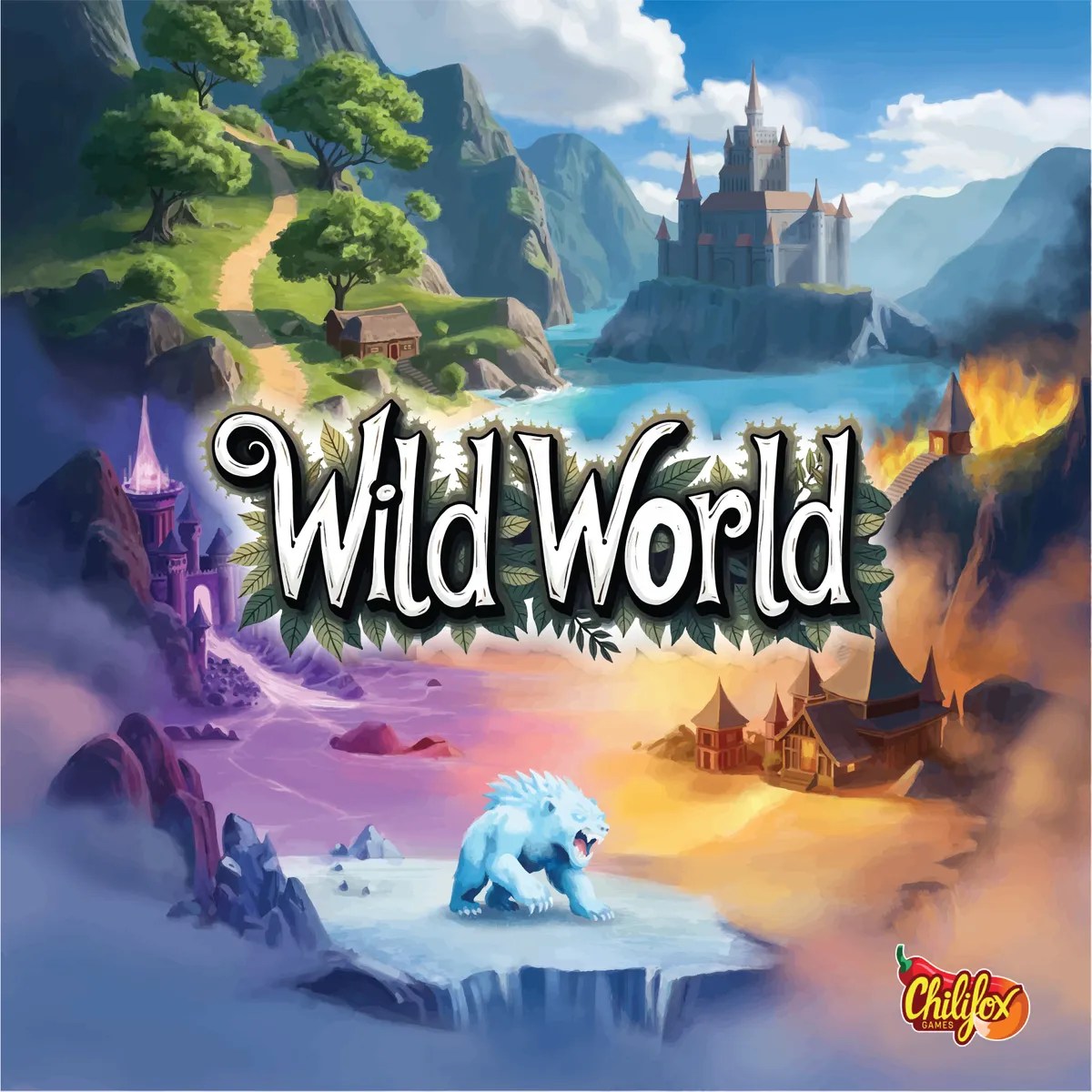
Wild World is a dynamic 1–4 player strategy game that blends worker placement, multi-use cards, engine-building, and tactical monster combat into one seamless, combo-driven experience. Set across five elemental realms — Forest, Ocean, Fire, Frost, and Magic — players gather fantastical creatures, explore vivid regions, evolve their champions, and brew powerful potions as they race to score the most points over three rounds.
What makes Wild World stand out is the freedom and flexibility baked into every turn. You may perform a number of different free actions — placing cards to strengthen your engine, traveling through realms for rewards and prestige, or discarding for resources — allowing each turn to unfold as a meaningful puzzle. Every card has multiple uses, and clever sequencing often triggers reward chains that lead to explosive, satisfying combos.
At the heart of the game are the mighty monsters guarding the world. Defeating them will give you permanent abilities, immediate bonuses, scoring conditions, new workers, and prestige, but reaching them requires smart planning: evolving creatures, upgrading your potion-brewing, unlocking stronger foes, and assembling the perfect moment to strike.
With multiple strategic paths, escalating tension, and thrilling bursts of synergy, Wild World offers a richly re-playable adventure in which every decision matters — and every turn can become something special.

To setup, place the board on the table and then place the pentagonal alternative action board in the center. Each player gets a player board and a starting hand of cards as dictated by their board. Players also get an ability card, an instant bonus card and 2 scoring cards that match their player board which are then flipped over to be placed on the Monster Cards area of the player board (in addition to the monster pre-printed onto the board). Players place a crystal on top of each of the six lock icons on their board. Each color of creature deck is shuffled separately. Players start with 3 workers.

As mentioned above, each player starts with 5 creature cards. These cards are the heart of the game, and each card can be used in four different ways:
- Play it next to your player board (home section) to build your engine to buy stronger cards.
- Play it to the bottom of your player board (travel regions) for end-game points and bonuses (preprinted on the board).
- Play it above your player board to defeat monsters to gain abilities, bonuses, and points.
- Discard it to gain its gold value. This flexibility creates meaningful decisions throughout the game.
The game is played over three rounds with players taking turns in order. On a turn, each player must choose one of three action options in addition to any free actions:
1] Place Worker onto a vacant worker space, paying gold if other workers are in the region. Then either perform the main action in that region or pay 1 gold to take the action shown on the Alternative Action Pentagon for the region. Actions include: Draw a card from any deck, gain an Evolve token, gain 7 gold, unlock one crystal from your board, gain 2 tokens.

Finally, you may buy the card that is in your portion of the region – it has both a gold cost as well as a strength cost. To meet the strength requirement, you count up the needed icons in your home area (to the right of your player board) from cards played there. You can always use crystals as icons. If you buy a card, you also get to take advantage of the bonus spot underneath the card as well.

2] Defeat Monster – choose an unlocked monster on your board then play a card from your hand that is of one of the two colors the monster is vulnerable to. Starting with the value of the card, you can also add Evolve tokens, potions and crystals until you generate enough strength to defeat the monster. Flip the creature card face down under the player board, and then take any instant bonuses shown on the defeated monster. You now move your potion marker as far left as you can (until it is adjacent to the cauldron marker)

3] Move and Rest Worker – Move an already placed worker from an action space to a vacant space on the resting island. You take the bonus next to the space you fill. Workers on the island can not be moved again. If there is now at least one worker of each player color on the island, the round ends.
The free actions include:
- Play a card to your home section – overlapping them to the right so that you can see the icons on the left side of each card
- Play a card to your travel regions – must be a single color per column, going bottommost to top, gaining bonuses as you cover icons
- Discard a card to gain gold
After the end of the first two rounds, players take their workers back and the alternative action board is rotated one position clockwise. The starting player for the next round is the player who placed first on the highest occupied line on the island.
The game is played for three rounds, and at the end, points are calculated:
- Points from defeated monsters, seen in upper left corner
- Bonus scoring from defeated Scoring Monster cards
- Points based on the position of your Cauldron and Potion marker
- Points per card played to a travel region on your board
- Points equal to the rank of each card played to the home region
- 1 point for each unused Evolve token
- 1 point for every 5 gold/crystals

The player with the most points wins, ties broken in favor of what turn order would be in the next round.

My thoughts on the game
Wild World is an intriguing game that I’ve now had a chance to play a few times both before Spiel and then now during the fair at night. I really like the flexibility that players get with the multiple ways to use each card. There are a number of currencies in the game (gold, potions, cards) and each requires its own management.
Early on, you will need to play a few cards to your home area in order to build up enough icons to purchase cards when you take actions. You may also need to even discard some for gold to pay the cost. Once you get a little card acquisition engine going, then you will have even more considerations.

There can be a little bit of an engine building aspect as you progress in the game. One of your monsters gives an ongoing bonus and another gives an instant bonus. These change each game, and I would definitely recommend considering how these two bonuses might work together before you take your first turn. Alternatively, you could also focus on the two monsters that provide bonus scoring opportunities and then plan accordingly to maximize those bonus criteria.
Also, once you have a bit more flexibility, you can look to maximize each worker placement by making sure that you can buy a card after the main action; in this case you not only get a card (which can again be used in any number of ways) but also then an extra action from the bonus spot under the card. Of course, it can be a difficult decision then where to take the action, but that’s the fun part of the puzzle for me.
In my first game, I didn’t get nearly as much done as I wanted to. The three rounds can end quicker than you think. At a minimum, you’ll have 12 worker placements – 3 initial placements and at least one movement to the island. Thus, this does put a bit of a premium to defeating the scoring monsters on your board – as each of those confers an extra worker immediately.
While you’re doing this, you’ll likely need to spend some actions to get Evolve tokens and potions – as you’re going to need to be able to boost for attack strength. If you have also managed to move your cauldron, you will reset your potions to a higher baseline each time to you defeat a monster.
The goal of the game LOOKS like it should be defeating all the monsters, but interestingly, I’ve seen players do quite well by focusing on other things. If you unlock the rightmost travel areas, you can score 4 and 5 VP per card placed in those columns… you also score points equal to the rank of each card played to the home area – and trust me, that can really add up. I would say that defeating all the monsters is NOT mandatory to win.
In the end, the game is about getting the most for each action, especially generating a steady stream of cards which you can then use to build your engine and score points however you like. I’m obviously too much of a newbie to have a good feel for what an optimal strategy would be, but I do like the fact that my initial games have shown that a number of different approaches have been competitive, and it makes me want to play it more.
If you’re at SPIEL, you can check it out at 3F-120.
Ratings from the Opinionated Gamers
- I love it!
- I like it. Dale Y
- Neutral.
- Not for me…


