
…My first day without appointments, and a chance to play more games and wander round the smaller publishers too…here’s what I found.

The day started off with a play of Cardia Tide and Storm, the new standalone expansion for Duel for Cardia, – for which I had the honour of presenting the International Gamers Award for best two-player game 2025. Tide and Storm consists of 2 new decks to play with – an Island deck and a Storm deck! These decks can be played standalone or mixed with the original game, and I gather involved a lot of work to ensure that the game still functions well with the different cards played. As with the original game, each player simultaneously reveals their played card; the higher card wins a victory point while the lower card can enact its action – which can lead to all kinds of interesting effects on the opponent, on cards already played in previous rounds, etc. One feature of the new game is the increase of the number of points needed to win from 5 to 6. In the Island decks, the game features 3 island cards and 3 ships which may be moved by players. Should you move a ship onto the island nearest you, you will gain a VP – if the ship stays there! Moving onto the middle island forces a player to lose a card from they deck or allows you to draw an extra card. Indeed the deck features a number of cards which move the ships and which invite you to reduce your hand size for a benefit or occasionally to increase your hand size. Plenty to think about here! The second deck uses a new resource called “Phials” and involves abilities in which you place the phials onto cards to trigger their abilities. Such abilities can modify the value of other cards already played, for example, to switch around who actually won a previous round. The deck is more complex and requires more planning than the Island deck. I really enjoyed playing the new expansion and I’m excited to get it back to the table soon; and really admire the depth of development and the ideas that I saw in the game!
Next up was a playthrough of “Which Witch” the first game from small publisher Curious Lynx Games. The game caught my eye because of the gorgeous artwork (some of which was done by the author) – and the gameplay proved to live up to the same standard, The game consists of 13 witches of which 7 are used in teh game. Each witch has a number and is placed in numerical order in a circle around two witchy familiars – a crow and a cat. Each player plays from a deck of identical cards, and may have to play a witch to pick up their played cards again at some point. Each player is trying to make 5 potions in the same color – there are 6 colors in the game, one per player, but only one is used per player in the game. Each round all players simultaneously choose a witch, and then a stone moves clockwise around the circle and each player must reveal their witch when the stone is on the witch they played. Should more than one player have played the same witch, the player with the cat, if any, gets to enact the action on their witch card. Otherwise the witch action is taken; and then the stone moves on. The cards are cleverly designed to align with the order in which each is revealed, to encourage a highly interactive game in which players will be creating the potions they need, preventing other players from creating theirs, stealing and swapping potions, guessing the card another player is playing, etc. With 13 witches to put into the game the variety is good! I really enjoyed this one. The KS campaign has been successful but the KS is still open, so have a look and support it if you like good interactive card games: https://www.

When Viking Raiders came out in 2023, it got a lot of attention, including best card game and People’s choice wins, at the UK games expo – and now Neowulf games is back with an expansion and more chaos in Loki’s mischief. It’s the first time I’ve seen the original game, which is well worth checking out as a highly interactive slugfest. Players will be seeking to take cards from a market by paying resources, and then collecting 5 points in each of three colors in order to win (more points if you play a longer game). There are plenty of good ideas in the game including viking raids – try to steal cards from your opponents with a straight 50% chance of instead meeting their defences; event cards which cause chaos or some resetting of the game, and so on. Quite “stab in the back” gameplay and lots of fun in a small and relatively short package. I watched part of a game and I can see why it was getting accolades. Loki’s mischief adds a bunch of extra cards and a card holder – some being event cards that mess with the rules, others just being cards that mess with other players. The game looks like a lot of fun.
Next up was a playthrough of Concordia: Mare Nostrum, the latest Concordia expansion from Mac Gerdts. One of the many things I love about these expansions is they are very reasonably priced, this one being simply a map and some rules – and yet Mac has put a LOT of thought into the game. Mare Nostrum turns Concordia on it’s head – in this game you only travel around a map with ships, and can only build your cities on coastal regions. Now, instead of going inland with your colonists, each colonist are placed on one of three action spaces on the board. Each action space consists of 4 actions, and when you move your colonist around them, 1 movement point gets you a move onto any of the 3 action spaces you weren’t already on. These actions give you resources, allow you to buy a card or sell a resource for slightly more than usual, buy two resources for the price of one, etc, There are 4 actions on each of the three action spaces so with 3 colonists you can get 3 juicy optional bonuses to take – very nice! Otherwise, the game uses the same principles and cards etc of the original game. Overall, I really loved this version of Concordia because the new action spaces being new tactics, you feel slightly less constrained and yet you must still do your best to optimize every turn, just like traditional Concordia, but in a wholly different way. Wow.
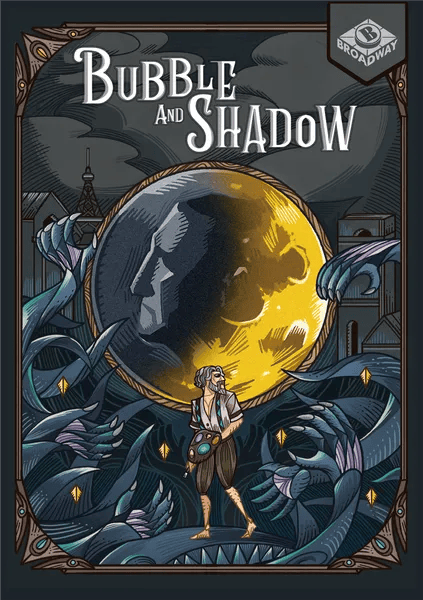
Bubble and Shadow by Broadway Toys is an intriguing game of trading resources. There are three resources in the game, bubbles, silver and moons – and players start with a random draw from a bag of 11 each of these. Then, on your turn you must play one of your 7 cards and offer a pact to your fellow magician. The cards are beautifully illustrated and picked out with gold embossing. Anyway, when you offer a pact, you simply are offering to trade a number of resources with one opponent. The opponent can accept your pact and trade, or reverse the trade instead. So for example I could say: let’s trade 2 silver for 3 gold. If you can pay either 2 silver or 3 gold moons, you can choose which way the trade goes. If however. you can only pay the silver then you must pay silver and get gold. If you cannot fully pay either, you can choose which way round to do the trade and pay all you are able to. Therefore it’s important to track an opponent’s resources, to force them to trade the direction you want – but the initial hand of 11 resources is hidden, only resources gained in trades are public. As the game goes on, more information comes to light and – here is the main twist, you must work towards several goals. Firstly, the player with the most purple bubbles will lose the game. Secondly, the player with least Silver will lose the game. Finally, after these two other tests, the remaining player with the most gold moons will win the game. At each of these three test stages, players remaining in receive a crystal. the player who reaches 5 crystals first, which will take more than one game, will win. This was an interesting quirky design which almost felt like it was not a game initially – but nevertheless as it went on, I started to appreciate that the game was rather clever. Definitely one to check out!
Songbirds by 圆啾会议 and recently published in English by Daily Magic games is apparently a 2016 game which caught my eye in the halls due to it’s pretty illustrations. Expecting a game about singing or something, I watched a round being played: in the game a grid of 5 by 5 cards will be played out by players with enough starting cards in hand that they are each left with one card. At the ends of rows and columns of the grid are randomised point counters, and the birds are in 5 different-colored suits. When a row or column is completed, the color of bird with the most points on cards in that row or column will win the token associated. If there is a tie no bird will win it. Once all 25 cards are played, the player’s reveal their last card and score the points on the matching bird. Should two players have kept the same coloured last card, teh player with the highest bird wins the points. It’s a simple and fun game which takes perhaps 10 minutes to play, and looks great for families.

Next up was a quick look at Asterix games’ expansion “Landmarks of the Lost Atlas” for Railways of the Lost Atlas – a 2024 game I haven’t played yet, so I was intrigued to see both the game and the expansion. This is an 18XX in which you build your own map to start with, which is heavy on network building with some interesting twists – eg no private companies but minor companies with special abilities – and the expansion includes new map tiles with special abilities built into them for players who first build there, as well as lots of other new material such as new minor and major companies, a neutral company, etc. The game looked pretty full of options and extras and although I only saw it and didn’t play it, I am sure 18XX fans everywhere will be attracted to it, and the base game is highly rated. It had me drooling!
Lastly, I took a look at Circadia by Synapsis games, a Hisashi Hayashi card game in which players play cards in ascending order and 3 different suits. When a column of one color gets long enough, you may capture point cards from the centre of the table – the cost being the number of cards in the column. You may then discard the entire column and draw that many new cards from a display into your hand, A further twist is that the point cards are either night or day cards, and you must alternate which ones you collect. The winner is the player collecting cards worth 15 poiints,. Although I didn’t get to play, the game looked decent and takes around 30 mins.
One more day to go…. Simon W


