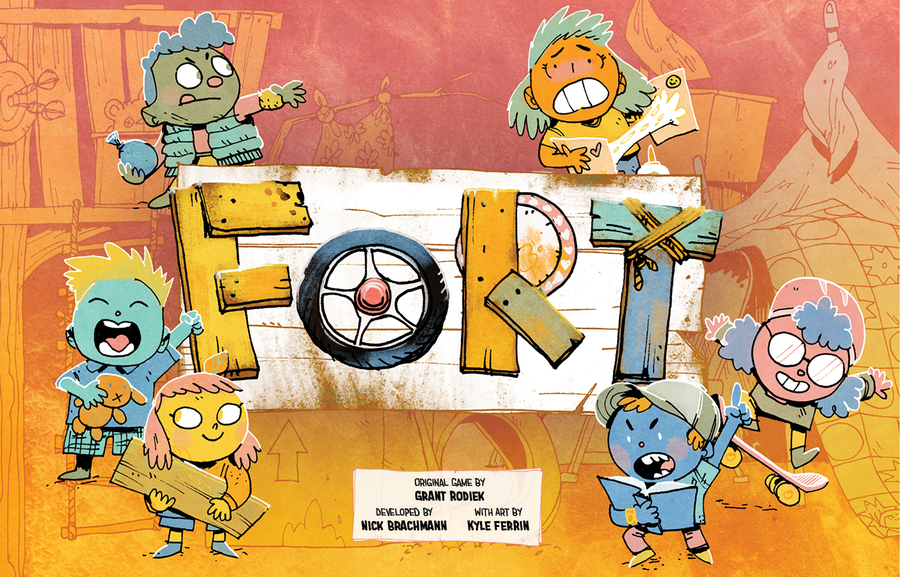
Deck-building games have come a long way since the days where the only choice was Dominion. Most of the time though, even today among those myriad of choices, I’ll still take Dominion over any other deck-building game. Nowadays it seems that you need to integrate your deck-building into games with other mechanisms. I honestly don’t think that a pure deck-building game will ever come along again like Dominion and even if it did, it wouldn’t be nearly as successful. So many challengers try to step up and knock the king from its throne, and one by one, they all fail to get that top spot. Enter a new challenger, Fort, from Leder Games, who are better known for their asymmetric lineup of games with cute and cuddly art from Kyle Ferrin, and designer Grant Rodiek, better known for his corgi, Peaches and his ability to just keep talking, along with game designs like Cry Havoc and Hocus.
As the summer comes to a close, along with the board game industry award season, and as we ramp up for a new year in gaming that begins with the slew of new releases timed to the Essen game fair in October, I thought it would a good time to take a moment and look back at games played, games loved, and games loathed. Rather than a crown a single champion though, I’d like to acknowledge a variety of games in different categories. Of the 249 different games played over the past year, these are the handful of games that I’ve played that merit special recognition.
Most Played Game: Railroad Ink | Runner Up: First Monday in October
My most played game is Railroad Ink, but a close second is the prototype for the game that I’ve been designing called First Monday in October. These games could not be more different, but I’ve been enjoying both immensely in different ways. While I was initially skeptical of the roll-and-write and flip-and-write genre, I think what I actually disliked was the numeric focus of many early games in the genre, epitomized by Ganz Schon Clever and later compatriots like Dizzle and Metro X. In practice, I’ve turned out to be a huge fan of certain games in the genre, such as Railroad Ink and Cartographers, which allow players to relax, draw, and plot out their area — trying to simultaneously plan ahead and adapt to unpredictable circumstances. The combination of variability and predictability in Railroad Ink, along with the ratio of its duration to its luck, make this a perfect package for me. I love that the game works so well in its base version, but that it comes with additional dice and rules to mix things up and keep it fresh. Railroad Ink feels like a game that really rewards playing it dozens of times, but at the same time manages to be accessible and rather non-intimidating to teach or learn. With several hundred possible games on my shelf, Railroad Ink has proven to be such an easy one to pull out over and over again when feeling undecided or tired at the end of a weekday.
First Monday in October is a close second (although beloved Root is second if you don’t count my own prototype). I’ve already spilled plenty of metaphorical ink about First Monday, but for anyone that missed it, I’d encourage you to check out my initial designer diary about the gradual years long development process and many different gaming influences, along with my subsequent detailed write-up on one of my favorite aspects of the game, or there’s the GeekList format about the game’s inspirations if that’s more your speed (which includes some recent late-breaking additions). Given how much the game has evolved over the past year, it’s hard to say if all of the plays could reasonably be counted as the same game. But as daunting as it is to say, the game is now done, and in the hands of the wonderful publisher and artist to eventually reach anyone that happens to be interested in checking it out.
Best New Game: Q.E. | Runners Up: Mandala, Silver & Gold, Fox in the Forest Duet
I think the best new game from the past year is an easy call for Q.E. I know it had a 2017 version and all, but I was not introduced to the new version until December 2019. Having played it five more times in 2020, I’m confident in saying this game is a masterpiece. Having even played it with a researcher at the World Bank, and hearing that the game is scarily realistic, just makes the game all the more compelling! I’ve long adored auction games like Ra, Princes of Florence, and Keyflower, and now Q.E. joins that pantheon as a remarkably fresh take on the concept. The idea behind Q.E. is so radical that you think it’s a joke when the game is being taught to you. An auction game where you have infinite money and can bid any integer that you can think of? Yeah, okay, sure. But it doesn’t just work, it truly sings. It is a psychological thriller in a box, and a game where you are really playing the other players in one of the most tense board games out there. I would never want to confine this game to a cloistered game group (although that might be fascinating in its own right to see the group think that could develop over time) because I think it shines brightest when you bring it to a meetup and see its utterly topsy-turvy nature at its finest. Back-to-back plays are even better if you have time because of the added layer of psychological uncertainty that becomes more poignant in that second play.
Designers: Molly Johnson, Shawn Stankewich, Robert Melvin
Publisher: AEG
Players: 2-4
Age: 14+
Times played: 3, with review copy provided by AEG (and played while eating chocolate truffles also provided by AEG)
In Truffle Shuffle, players compete with each other to make the most valuable collections of chocolates to sell. The players will draft cards from a smooshed pyramid of cards. The top of the pyramid is 4 cards (all faceup) covered by the row below having one more card but face down, and continuing onward until there are 9 face down cards at the bottom. Some bonus coins are put at the bottom, the number of which is based on player count.Continue reading →
Trick taking is a favorite mechanic of ours here at The Opinionated Gamers. Though we never finished our Tricks and Trumps series, we do cover a lot of the games on this site.
And over on BGG, I run the Trick Taking Guild, which recently inducted its inaugural “Hall of Fame” for trick taking games released before 2010.
Today’s article is part of our “10 Great” series that features 10 great games in a given subcategory. I pick a mechanic, theme, publisher, etc. In this case, I picked a mechanic. We here at the Opinionated Gamers then all vote behind the scenes to create a list of 10 great games that meet the criteria.
Summoner Wars has been going strong for over ten years, and the Alliances Master Set is the pinnacle of the series. For those of you that haven’t been paying much attention to this incredible game, I’m going to start with a brief overview and extol its virtues. Then I’ll dive into ranking and discussing many of the 40 unique faction decks that have been released, which make for over 1,000 different thrilling match-ups to try (and that’s without any deck construction).
The journey started in 2009 with the release of two simple, unassuming base sets. Each came with 2 faction decks, a plain paper mat, dice, and wound markers — everything you need to play. The game is a two-player card-based combat game where your goal is to eliminate your opponent’s leader using your faction deck’s unique unit and event cards. The original base sets featured Prince Elien of the Phoenix Elves squaring off against Grognack of the Tundra Orcs, and Oldin of the Guild Dwarves lined up against Sneeks of the Cave Goblins. Many of you probably played the game back then and never gave it a second thought. The game has come a long way since then, in both intricate mechanisms and quality components, so it very much deserves a second look.
The game was first expanded through a series of faction decks in 2010 and 2011. These decks required a base set to play the game, but could be matched up against each other or any of the earlier factions in any combination. This is when we were introduced to Ret-Talus of the Fallen Kingdom, Sera Eldwyn of the Vanguards, Vlox of the Cloaks, and Abua Shi of the Jungle Elves. These were not my favorite decks as I’ll discuss later, but they do contribute nicely to the incredible variety of the possible match-ups.
Summoner Wars really hit its stride in 2011 when the Master Set was released. The game finally got the beautiful (and still very functional) mounted board that it always deserved, but more importantly, the designer Colby Dauch worked up six great new factions and put them all in this set. It’s a fantastic entry point for the series despite its somewhat misleading name. The Master Set included Selundar of the Shadow Elves, Tacullu of the Benders, Sunderved of the Mountain Vargath, Krusk of the Sand Goblins, Tundle of the Deep Dwarves, and Mugglug of the Swamp Orcs. I love how the descriptor in the faction name is not just window dressing. There are three distinct kinds of elves (Phoenix, Jungle, and Shadow) each with their own feel and style, and the same goes for orcs (Tundra and Swamp), dwarves (Guild and Deep), and goblins (Cave and Sand).
At its essence, Summoner Wars is essentially what would happen if the classic 1940s board game Stratego grew up in a post-D&D, post-Magic world. I loved Stratego as a kid, and I enjoy games with a lot of setup variability, so it’s no surprise that I see Summoner Wars as a huge achievement in game design. The precision of the wording on the cards, the functional nature of the thematic ability descriptions, and the even-handedness of the diverse matchups make for a game that showcases the designer’s incredible attention to detail in a way that makes playing the game even easier and more enjoyable than almost anything comparable out there.
Times played: 3, with review copy provided by HABA USA
5er Finden is HABA’s most recent foray into the roll and write genre. In this game, each player gets a board with a 10×10 grid of 6 different colored squares. There are 12 polyominoes that are placed in the center of the table; these represent the 12 different possible shapes that can be made with 5 squares. They are valued from 1 to 4 points – this is printed on the polyomino itself.



10 Great Trick Taking Games (Article by Chris Wray)
Trick taking is a favorite mechanic of ours here at The Opinionated Gamers. Though we never finished our Tricks and Trumps series, we do cover a lot of the games on this site.
And over on BGG, I run the Trick Taking Guild, which recently inducted its inaugural “Hall of Fame” for trick taking games released before 2010.
Today’s article is part of our “10 Great” series that features 10 great games in a given subcategory. I pick a mechanic, theme, publisher, etc. In this case, I picked a mechanic. We here at the Opinionated Gamers then all vote behind the scenes to create a list of 10 great games that meet the criteria.
Continue reading →Share this:
Like this: