Unheralded Games of the Past Decade: 2018 & 2019

OG Unheralded Games of the Decade 2018 & 2019

It’s that time of year again, when we take a look back and do lots of Top game lists, but this year’s end is a bit special, it’s the end of a decade. A decade that started with 7 Wonders, Hanabi & Forbidden Island, and is ending with the likes of Die Crew, Wingspan & Res Arcana. There were lots of hits, even more misses and a lot of games over the decade that got lost in the continuous shuffle. So while a lot of outlets are going to give you their favorites of each year of the decade, we thought it may be a fun idea/experiment to take a look at some titles that have held the interest of folks here in The Opinionated Gamers. So for the next few weeks we’re going to take a look at these games and share our love of some of these off the radar titles. Feel free to participate in the comments and share your thoughts on games that we’ve overlooked.

2010 & 2011

2012 & 2013

2014 & 2015

2016 & 2017

Continue reading
Posted in Commentary, Reviews | Tagged , , , , , , , , , , , , | 4 Comments

Robin of Locksley

DESIGNER: Uwe Rosenberg

PUBLISHER: Wyrmwood/Rio Grande Games

NUMBER OF PLAYERS: 2

AGES: 14 +

TIMES PLAYED: 3, with a copy I purchased

I am a fan of Uwe Rosenberg games, so when a new one comes out, it is pretty much an automatic buy for me. Sure, I’ve been burned a couple of times in the past (I’m looking at you, Reykholt), but more often than not I enjoy them.  One of the many things I like about them is that they usually work very well as 2-player games; since more than half of my gaming is 2-player, it is a definite plus. Robin of Locksley is specifically a 2-player game, so I was especially interested.

There are 60 loot tiles. 25 of them are laid out in a 5 x 5 grid. The rest are put face down nearby to serve as a draw pile. 

There are 8 corner-shaped fame tiles. Two of them – The Beginning (start) and Long Love the King (end) are always used and are put together on one corner. The rest are shuffled; you draw three and put those on the other corners, and put the other three back in the box. There are 16 smaller fame tiles; you draw 12 and place three on each side of the board; the rest are returned to the box. Some of the pieces are labelled as day (easy) or night (harder), and you can choose to use the day pieces to make the game easier.

The game contains 2 pieces per player – one Robin, which is used to move on the tiles, and one Bard, which is  used to move on the fame tiles.

Before the start of the game each player chooses a tile from the corner of the board and then places their Robin in the now-empty spot. The tile is placed face-up in front of the player, in their personal supply. 

On your turn you move your Robin in a knight’s move as in chess – the shape of an L. You take the tile you landed on and place it into your personal supply, and draw a tile to replace the one you took. Sold Loot collections are discarded to form a discard pile that is shuffled and re-used when needed (more on selling loot collections in a minute). 
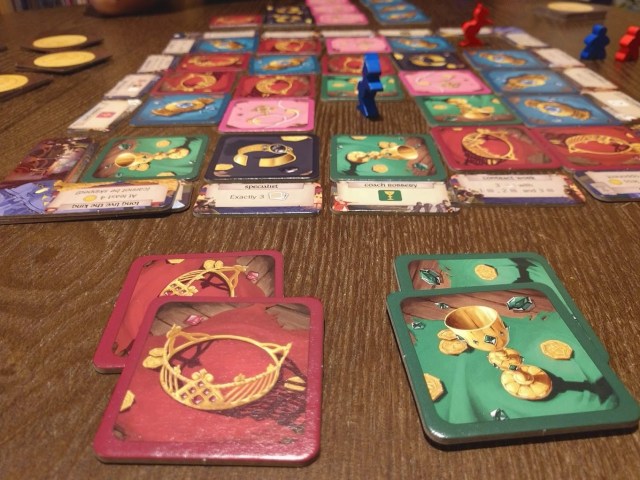
After you move your Robin you have the choice to move your Bard on the Race Track, which is made up of the Fame tiles. Each Fame tile has a task on it; if you have fulfilled that task you may move onto that tile. Most of the “tasks” relate to your personal supply – have 2 collections, have at least one tile of a particular color etc.  If you cannot meet that task you may also spend 1 gold coin per space to move.

How do you get gold coins? Well, all the tiles are double-sided. Any time during your turn you can sell a Loot collection that has three or more tiles of the same type. Two of these tiles are discarded to the discard pile and the remaining tiles are flipped to their gold side and remain in your supply as gold (much like in Bohnanza).  However, unlike Bohnanza these gold coins are not victory points; they are currency that is used to travel the Fame track.

The game ends in one of two ways – if one player laps the other player (meaning they pass their bard a second time), that player wins immediately. Otherwise the player to complete two laps and fulfill the task on the end tile wins.

MY THOUGHTS ON THE GAME

The components are of good quality. The icons are distinct and the text is clear. It can be a little hard to read the text on the fame tiles from across the table, which requires asking the other play to remind you what they are, which is not ideal. It does get easier to remember with repeated plays, but there is still a lot of asking “what’s that next tile say?”. All information is public, so you aren’t giving anything away; it’s just annoying.

The rules are clear and provide some good examples.

The box is double the size it needs to be; aside from space concerns, this means that the tiles fall all over the box every time you move them, and you have to reorganize everything each time you open the box. I have now bagged everything, even though a better, smaller box would negate the need for that.

I enjoy the game play. Using the knight move from chess adds to the puzzle of trying to plan your move to maximize your collections. You also need to be thinking about how that positions you for future moves, which makes it more challenging.

Gold not counting  as victory points is a nice twist. It is essential in helping you move around the board and possibly prevent the other player from moving too far ahead of you; you have to find the balance of not spending it carelessly and not hoarding it too much, and that can change from game to game based on the fame tiles that come out and the layout of the loot. You also have to monitor the other player to see if they are about to rabbit ahead and end the game.

I do not anticipate ever needing to make it easier by using the “easy” tiles, as the goals are pretty straightforward, but it could be useful with a younger player or less experienced gamer. I think this could easily be played by children much younger than 14.

Overall, I enjoy the game. There is a lot of strategy built into this game that is not obvious on the first read-through of the rules. If this game had a smaller box it would likely see more play, since it would be more easily portable. However, with a play time of 20ish minutes on average it likely will get pulled out often at home when we want a quick game. 

THOUGHTS OF OTHER OPINIONATED GAMERS

Mark Jackson (1 play): My only complaint is mentioned by Tery… the size of the fame tiles (especially since the box is large enough for bigger fame tiles). Otherwise, I enjoyed my one play immensely and am looking forward to adding it to my collection.

RATINGS

I love it!:

I like it: Tery, Mark

Neutral:

Not for Me:

Posted in Reviews | 4 Comments

Best New (To Me!) Games of 2019

For the last decade or so, I’ve intermittently published my Best New (to me!) Games list each year… and, when I missed a year or two, added the missing lists to the most recent post.

This year is no different – we’ll start with the lists (without extra comments) from 2017 and 2018… then proceed to the main event. (This is SUPPOSED to be a yearly post… but you can see just how well that’s been working.)

Continue reading
Posted in Best Of, Reviews | Tagged | 10 Comments

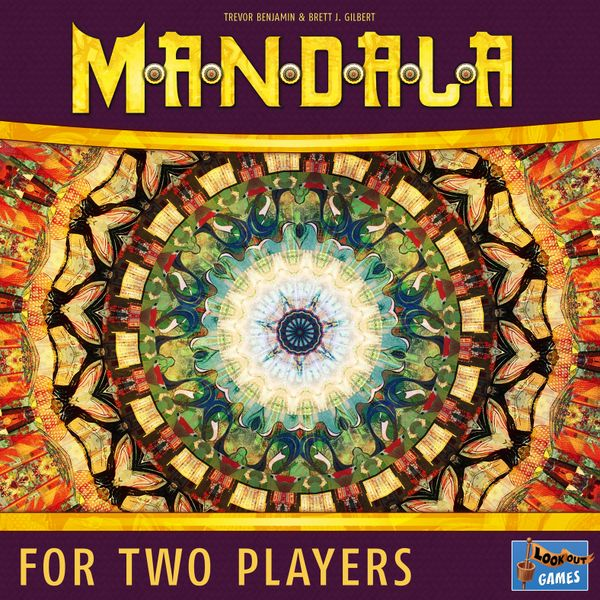
Mandala (Game Review by Brandon Kempf)

  • Designers: Trevor Benjamin & Brett J. Gilbert
  • Artist: Klemens Franz
  • Publisher: Lookout Games
  • Players: 2 players
  • Time: 30 Minutes
  • Game Mechanisms: Hand Management
  • Times Played: 7

Two-player games are an important market in the board game industry. Seemingly, no company has embraced this as much currently as Lookout Games has with their “Fur Zwei Spieler” series of games. The newest title I’ve had the pleasure of playing from this line is Mandala from Trevor Benjamin and Brett J. Gilbert. Mandala is a hand management game where the two competitors are attempting to create the highest scoring pile of cards. 

Continue reading
Posted in Reviews | Tagged , , , , | 7 Comments

ORLEANS STORIES

DESIGNER: Reiner Stockhausen

PUBLISHER: dlp games, TMG

PLAYERS: 2-4

AGES: 12 and up

TIME: 60 -180 minutes, depending on the scenario

TIMES PLAYED: 2, once through each scenario, with a copy I purchased

(note: This review is spoiler-free; I am not discussing any details of the stories.)

Orleans is one of those games that I played a couple of times at cons and enjoyed, but never played because I didn’t own it and no one I play with regularly does either. I always meant to pick it up, but then I got Altiplano , which filled the bag builder niche for me quite nicely, and I forgot all about Orleans.  When I saw Orleans Stories I was intrigued by the concept of the stories, and decided to give it a try.

You first need to know that this is not a legacy game, which seems to be a common misconception about it. It is a scenario-based game. The game includes two scenarios, both of which could easily be played many times. You don’t destroy anything, and while you’d know the elements of the scenario story on repeated plays,the game play would likely be different and  the game would still be enjoyable to play.

It comes in a fairly large box. Inside the box is a tray that holds many of the resources and workers and some of the components. There are also various modular boards, some of which are used in both scenarios and some of which are used only in one. Each scenario has its own small book, with one copy for each player, that takes you through the scenario and lets you know what gets added or what happens at particular points during the game.

The game board

The game board is the same in both scenarios, and is set up with terrain based on the number of players. 

Common supply board and market

There is a common supply board that is filled and re-filled based on the story you are playing.

There is a supply of buildings that are divided by number; the buildings enter play based on the scenario you are playing.

Player board

Each player has a personal board and a personal supply of buildings as well as player markers in their color that indicate control and fortresses.

The rule book provides a basic overview of the Orleans bag-building system for those who are not familiar with it. It also covers the basic set-up and rules that are true for both scenarios, and then goes into the scenario-specific set-up.  At that point, you use the book for that scenario to begin. The book will tell you what goal(s) you have to obtain to move to the next section.  There is a copy of the book for each player.

The game play in both scenarios has many similarities to Orleans; you and the other players simultaneously draw a number of followers from your bag based on the scenario, and then assign those followers to the spaces on your player board or to the buildings you acquire over the course of the game or banish them to beneficial deeds, where you will get a bonus but lose that follower.   In player order each player does one action based on how they assigned their followers; this continues until all players have passed. 

What you are doing with those actions is similar to Orleans, and contains many of the same elements. You have the same followers, and there are still technologies, goods and beneficial deeds. Your objectives to win the game are different, though, based on the scenario, so some things will work a little differently or have a slight twist them.

The game continues to the end point specified in the scenario that you are playing and victory is assessed on that specific scenario.

The scenarios included in the box – The First Kingdom and the King’s Favor – are both very different. Both give you a story to follow and additional actions and rules that are included. Each has a very different feel, despite the fact that they are using the same basic gameplay.

That’s about as much as I can say without giving anything away.

MY THOUGHTS ON THE GAME

The box is large, but it needs to be to hold the included components. The tray that holds the resources is nice, but has a few empty spaces that I assume are meant for future components.  The components are all of good quality. It’s a bit confusing to set up because you have to figure out which boards and components go with which scenario, but the rule book and the scenario books help with that and it was much better on the second go, after I invested the time to sort and bag a little differently.

The stories are very interesting and add to the experience of the game. The two that are currently included play out VERY differently; one is much more forgiving than the other. I liked that the experience was completely different.  I would recommend starting with The First Kingdom if you are not an experienced Orleans player. First Kingdom takes longer to play, but is more flexible and forgiving, while The King’s Favor is more prescriptive and very unforgiving .

I think it will be harder to play this if you don’t have any experience with Orleans or at least a bag-builder. Even though the rules has a section that covers the basics, we had one rules question about a building that wasn’t explicitly covered in the Orleans Stories rules, but that we did figure out by reading the rules to Orleans and Orleans Invasion. It was minor, and our instinct about it was correct; I suspect someone with more experience with the original games would have known it.   I don’t think it is impossible, though, as long as you are prepared for the learning curve. I would suggest reading through the bag-building section of the rules very carefully. I would also suggest you start with The First Kingdom in this case.

Each scenario is definitely replayable. It was fun the first time through when we didn’t know what would be revealed or happening in the next section, but the gameplay is still interesting regardless. I think one of the scenarios is especially replayable as there are more paths to victory; the other I suspect may have a clearer path that would reward a more experienced player. I do think eventually the stories will feel tired, though, so I hope there will be addiitonal ones released.

I like the game; I am looking forward to playing it again, and I hope that there are more scenarios being released in the future. It will not replace Altiplano as my favorite bag-builder, but the story arc is enough to keep me interested.

THOUGHTS OF OTHER OPINIONATED GAMERS

Doug G: Shelley and I really like Orleans and probably enjoy Altiplano, its follow up, even more. The bag-building mechanism works very well, though Altiplano’s greater control since you don’t put used items back until the bag is empty makes it better IMO. That said, we have gone back to Orleans numerous times, especially with the additions of new expansions and scenarios.

All of that needs to be said because we were both looking forward to Orleans Stories more than most of the titles we brought back from Essen. However, I’m sad to report that this one went over like a lead balloon. The HUGE box (at least twice the size of the original) was initially off-putting for a luggage-limited traveler, but we made do…but then I read through the race-game-focused rules and the LOOONG playing time of the first scenario and I began to get worried. Unfortunately, those worries were realized as we plowed through that scenario, finding ourselves manipulated into playing a particular way due to the end-game conditions, and just hated the experience.

I wonder if flipping the two scenarios would help, especially for more experienced Orleans players like Tery alludes to, as the second one is supposed to play a LOT more quickly. That said, we just couldn’t stomach another go at this one – it made it to the ‘to sell’ table and has found its way into someone else’s hands who will hopefully get more enjoyment out of it. Shel doesn’t want to play Orleans for awhile (nor do I) because of the bad taste Orleans Stories left. We’ll be talking about the game more extensively on an upcoming Garrett’s Games podcast.

I loved it!:

I like it: Tery

Neutral:

Not for Me: Doug G.

Posted in Reviews | 4 Comments

T6 (a trick-taking party)

On a recent weekend, I again invited a number of my friends to town for a weekend of playing trick-taking games. Around 33 people participated, and, if I’ve counted correctly, I played 68 different games, almost all of which were trick-takers.

Now I’ve done it already –two sentences in and I’ve reverted to my style of communicating through a recitation of statistics. Let’s push more in the emotional direction.

Here’s a photo of my grandfather. My great-grandmother, who I never met, held on to things that would become keepsakes in the same way that I communicate through numbers of things. He gave her a rock once. We still have it; there’s a note “this is a rock that Jimmy gave me.” I think it’s dated. Slips of paper recording this event and that. Elementary school report cards. I read many of his elementary school papers on the drive to Yellowstone last year. His puppy died and it made the local paper.

Yet, if I have the story correct, this is the only photo that was ever on display in her home.

But we’ll come back to him.

(Also, this is going to be a long one. Get comfortable.)

Continue reading
Posted in Convention Report | Tagged | 16 Comments