
First Impressions of Space Race

Space Race

  • Designers: Jan Soukal, Michal Mikes, Marek Loskot
  • Publisher: Boardcubator
  • Players: 1-5
  • Ages: 13+
  • Time: 60-90 minutes
  • Played on preview/prototype copy provided by Boardcubator

Space Race is a game where players fight against each other to have the most successful space exploration program.  Over the course of seven turns, each corresponding to a decade of development, your faction will work to make the most breakthroughs, finish the most projects, and have the coolest rockets…  This version of the game is a reimplementation of Space Race: The Card Game – a game which initially came out in 2017. While I normally don’t look at KS games (this game is actually currently running on KS – see https://www.kickstarter.com/projects/boardcubator/space-race-0/description) – I had enough good things about the card game version to want to look at their new take on things.  The new version adds a number of more complex mechanisms as well as giving a board to help organize play – providing areas to organize cards, keep track of score and breakthru progress, etc.    Rather than re-invent the wheel – I will just point you here to a BGG thread written by one of the designers that outlines that progression from the simple card game to the more complex board game:  https://www.boardgamegeek.com/article/30853050

The board looks like a giant blueprint of a rocket.  This rocket ship space is in fact used to track the progress of the game.  There is room on the board for the “Universe” – that is the selection of cards which players can add to their hand.  There is also a breakthrough tracker where players can mark their achievements in the four different areas:

Continue reading
Posted in First Impressions, Preview | 1 Comment

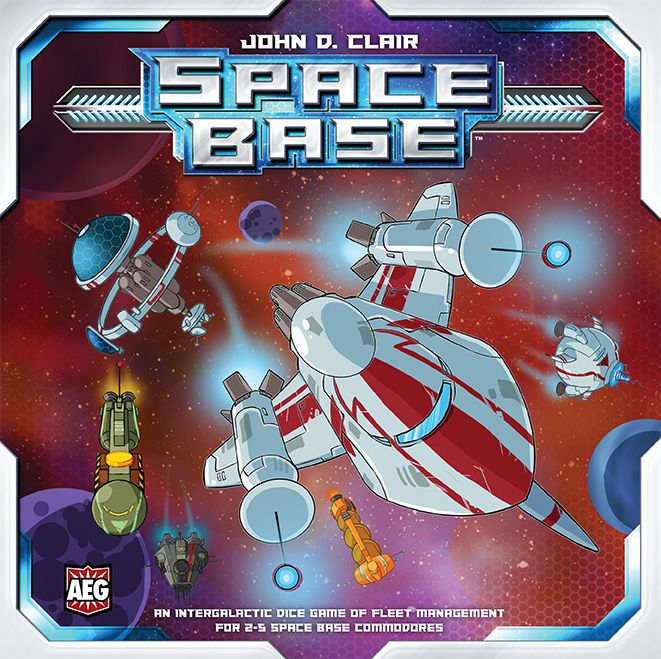
Space Base (Game Review by Brandon Kempf)

  • Designer: John D. Clair
  • Artists: Chris Walton
  • Publisher: AEG
  • Players: 2-5 Players
  • Time: 60 Minutes
  • Times Played: 3

“I swear, if I roll another damn three combination, I am chucking these dice into space.”-Brandon Kempf April 2019

In space, no one can hear you scream, but when playing Space Base, your friends definitely will.

Space Base sees the players lead a small fleet of ships out in the vast universe to engage in trade & commerce, mining and even a bit of influence spreading via your giant spaceships. In reality, on the table, the players are building a tableau of spaceship cards and rolling dice hoping to activate ships to gain the benefits of the given ships.

Continue reading
Posted in Reviews | Tagged , | 7 Comments

Chris Wray: What I Enjoyed Playing in April 2019

This is the April entry for my series where I post five games I enjoyed playing in the past month that I didn’t have time to do full reviews of.  As always, I limit it to five titles, of which there’s a combination of old and new games. My apologies for being a few days later than normal with the entry.

By the numbers, April 2019 was the highest number of logged plays I’ve ever recorded in a month, with 165. I’m terrible about logging plays, especially at conventions, so the real total was likely a bit higher. My most played game was Ultimate Werewolf — a common theme when I’m at conventions — but the games below also had a decent number of plays each.

Continue reading
Posted in Commentary, Reviews | Tagged , , , , , | Leave a comment

UNDERWATER CITIES – A COMPARATIVE REVIEW BY SIMMY PEERUTIN

I own 3 Vladimir Suchy games – Shipyards, Pulsar 2849 and Underwater Cities. They have one thing in common; They are almost always not my first choice to bring to the table and yet, afterwards, I almost always remark on how much I enjoyed the experience and wish we played them more often.

What I think is so special about his games is that each one has a unique central mechanic that introduces a delicious tension to every decision and keeps players’ attention even when it is not their turn. On the other hand, the decision-making in his games is on the complex side and that can lead to analysis paralysis.

Continue reading
Posted in Reviews | 3 Comments

Dale Yu: Review of The Boldest

The Boldest

  • Designer: Sophia Wagner
  • Publisher: Edition Spielwiese / Stronghold Games
  • Players: 2-5
  • Age: 10+
  • Time: 60-90 minutes
  • Times played: 5, with review copy provided by Edition Spielwiese

The Boldest is set is some sort of futuristic/dystopian or fantasy setting.  You are in a kingdom that has multiple competing army factions, each seeking to be labeled the Boldest for their exploits.  Many of the creatures that you fight appear to be mechanical hybrids, and things are so weird in your land that new recruits are not swayed by high wages but apparently more by tastier stews.

Continue reading
Posted in Essen 2018, Reviews | 1 Comment

Mystic Vale

Design by John D. Clair
Published by AEG
2 – 4 Players, 45 minutes – 1 hour
Review by Greg J. Schloesser

I appreciate originality in game design.  Most games will use existing mechanisms and combine them in various fashions in order to produce a game that hopefully feels somewhat fresh. Sometimes, a designer will tinker with an existing mechanism, giving it a new twist or facet that can also make the overall game feel a bit different from its predecessors.  It is a true rarity when a designer invents something brand new, as this is usually a breath of fresh air. Of course, this new mechanism cannot stand on its own; it must be surrounded by a fun and entertaining game.

Fortunately, that is the case with John D. Clair’s Mystic Vale.

So what is this clever new mechanism?  It is known as the “Card Crafting System” and allows cards to be physically changed by adding new features and advancements to them.  It is a dramatic addition to the familiar deck building genre.

In Mystic Vale, the tall cards are inserted into card sleeves.  The basic cards have their powers printed on one-third of the card (top, middle or bottom).  Card advancements are printed cards of the same size, but these new cards have a transparent background.  As with the basic starting cards, a small portion of this transparent card depicts the advancement, which is also depicted on only one-third of the card.  These advancement cards are inserted into the card sleeves over the basic card.  However, any previous advancement—including those on the basic card—cannot be obscured.  In this fashion, a card can be upgraded two times (three if originally empty) if cards are acquired that have the advancements printed in the proper places.  With nearly one hundred different advancement cards available—more with expansions—this makes for a seemingly infinite number of ways to construct a card. Brilliant.

Before describing the game, a word about the theme is in order.  As one could surmise from the name, the game has a fantasy setting wherein players assume the roles of “druidic clans attempting to restore the cursed lands to their former vitality.”  Card advancements represent new life and vitality for the land, which is helpful in the restoration process. The goal is to acquire and properly assemble these advancements, with the acquisition of even more powerful “Vale” cards adding to the restoration.

Continue reading
Posted in Reviews | 3 Comments