I never set out to make so many tile-laying games, but I always find something new to explore.
-Jeff Allers
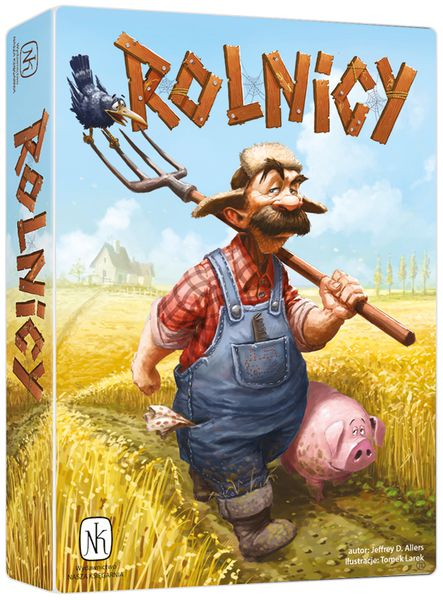
Taking a look back through my Top 25 list of games, it’s very apparent that I am drawn to tile laying games, or games with a tile laying mechanism as part of it. Ten of my top twenty five feature it in the game. It seems that if you physically have to build something in a game, I am the target market. Right now, in this design portion of the hobby, no one is doing as much work in revitalizing and refreshing tile laying than, Jeffrey D. Allers. In 2018 alone we were given Pandoria, Gunkimono, and the subject of this review, Rolnicy. Currently Rolnicy is available only via Polish publisher Nasza Księgarnia, but for folks here in the North American market, I hope that changes, and after reading this review, you may as well.
Designer: 与儀新一 (Shinichi Yogi) Publisher: 77spiele Players: 2-4 Ages: 10+ Time: 20-40 minutes Times Played: 4 times with purchased copy Availability Note: The copy I have was acquired by a friend at the 2018 fall Game Market, but at the time of this review, copies are available from booth.pm (transship service such as Tenso required),
Tenka Meidou is probably the first game I’ve purchased that comes in a box, but not a box for which it is intended to be stored. The version I have came in a shoe-box type container, but this allows neither the rules nor the cardstock board to lay flat, and neither are designed to be folded. It comes with a sheet of stickers, including one which has the title of the game and its vital statistics (e.g. player count, game length, etc.) — the shoe-box itself is unlabeled. (As I write this, the game is available on booth.pm, and while it still comes in a container that is not its intended permanent storage, it is no longer the shoe-box.)
TM was first released in the fall of 2017, but a new version, with the same rules, was released at the fall Game Market in 2018. TM won the Game of the Year award at the fall Game Market, and one of the jurors noted that the components (and I imagine the box) were sourced from 100-yen stores.
Tenka Meidou is an area-majority game. The board shows a map of Japan divided into 11 areas. (The map is two sided, blue and yellow, but the maps are otherwise identical.) During setup, tokens with numbers 2 through 12 are randomly assigned to the 11 areas. Each of these areas will be worth an amount of points equal to the value it has been assigned, and half-points will be available for 2nd place in 3 and 4 player games.
Times Played: 4 times with someone else’s copy (mine is on pre-order), plus several times online
I have always enjoyed city building as a theme for many things, from wooden blocks and Legos to playing SimCity on my Mac Classic, so it’s generally something I enjoy in my board games. I also can’t resist a good tile-laying game, so I was very curious to check out NEOM.
The goal of Neom is to build a city using tiles that provide you with housing, resources, industry and income, building up over three rounds. You earn victory points for building particular structures and having certain buildings in certain combinations or particular locations, and to no one’s surprise the player with the most victory points wins.
There are 150 tiles, divided into 3 eras, as well as 30 cornerstone tiles (tiles that give you objectives and bonuses), cardboard coins and resource tiles.
Setup is fairly easy. Resource tiles and coins are sorted near the board, and the cornerstone tiles are shuffles and stacked face down. Era tiles are divided by era (with some potentially removed depending on the number of players).
S
Each player gets a random player board; all boards are the same except for the starting resource printed in the middle of the board. Players also get $6.
Before the game begins each player is dealt a hand of four cornerstone tiles (the rest of these tiles are removed from the game). Each player chooses one tile to keep and passes the other three to the player on their left; repeat until all players have three and then discard the remaining tile.
At the start of each era players are dealt a hand of eight tiles. Each player selects a tile they want to play and passes the other tiles to the left. Players simultaneously reveal their selected tiles and take an action.
Tiles come in several different flavors:
Green Residential Tiles have no effect other than giving you VPs. If you do not have at least two green tiles on your board at the end of the game you will lose VPs. In addition to the VP value of the tile in the upper right corner residential tiles you score for the number of tiles in each grouping/neighborhood of connected green tiles – the bigger the better.
Blue Commercial Tiles give you income; some give you immediate one-time cash, some give you income at the end of each era and some give you both.
Grey Resource Tiles produce raw goods, which are used to build other tiles.
Yellow Industrial Tiles produce either processed or luxury goods, but they can also give you negative points if placed adjacent to a residential tile, since they cause pollution.
Orange Public Tiles give you victory points for meeting certain conditions at the end of the game or give you an advantage or protection during the game. Cornerstone tiles are mostly, but not all, orange public tiles.
You can:
Place the tile:
Play the tile on your city board. The cost, if any, is printed on the upper left of the tile. If it has a cost in coins, you spend the coins. If it is has a cost in resources you just have to be able to produce that resource; you don’t actually “spend” it. If you don’t have that resource you can buy it from another player at the base cost plus $1 for every step between you and that player – so buying a raw good from a player next to you would cost you just the base cost of $2, but buying it from the player one person away would cost you $3. If you’ve managed to connect the middle pre-printed tile to the road printed on the edge of the board your cost is reduced by $1 in that direction, since you have developed a trade route.
The tile has to be played on an empty space or you have to replace a previously-played tile, and it cannot be rotated. While not all roads have to match up with other roads, you must be able to trace a path back to the pre-printed center tile on your board.
Discard the Tile to Place a Cornerstone
Discard one tile from your hand and instead place one of your cornerstone tiles; the number of times you can do this is equal to the era number, so you could do this once in Era One or, if you haven’t played any yet, three in Era Three.
Discard the Tile to get $5
If you can’t or don’t want to place a tile you can discard one to get $5.
Disaster Strikes!
There are also three disaster tiles in the game – a flood in the first round, a fire in the second round and a crime spree in the third round. If you choose to play a disaster it doesn’t affect you (other than it being your only play that turn) but does affect all other players, who must pay the associated cost or discard tiles. The cost is $1 per residential, commercial or industrial tile in the first two eras and $2 for each of those tiles in the last era or you must sacrifice the specified number and type of tiles.
After all play is resolved you pick up the tiles passed to you and lather, rinse and repeat for a total of seven turns. At the end of Eras One and Two you collect income and then deal out the tiles for the next round. At the end of Era Three you collect income and then calculate VPs.
You get VPs for the following:
VP values printed on tiles, both straight values and condition-based
VPs based on the sizes of your neighborhoods – one tile gets you 1 point, two tiles gets you three points etc.
VPs based on the types of goods you produce – 1 for each type of raw good, 2 for each type of processed good and 10 for each type of luxury good.
1 VP for every $2
-2VPs for each orthogonally adjacent and -1VP for each diagonally adjacent residential tile next to a tile with pollution.
-10 VPs for no residential tiles and -4VPs if you only have one
5 VPs if you do not have any tiles with the power symbol on them
The player with the most points wins; there is no tiebreaker, so if there is a tie the victory is shared.
The rules are slightly different for the 2 player game in that the era tiles are distributed in stacks; each player takes a stack, picks a tile and discards the rest. Also, goods can be bought from the bank as well as the other player. The game includes a solo variant as well, but I have not yet tried that.
MY THOUGHTS ON THE GAME
The game gets compared to 7 Wonders due to the draft mechanism. While the drafting of tiles is quite similar to the drafting of cards, it just doesn’t have the same feel to me. While you will be passing tiles to the player on your left you are less concerned about what you are passing them and more concerned about maximizing your own board, at least most of the time. One could argue that the goods and the color combos are also similar, but those are elements in many games and without the drafting no one would think twice about it. I am not a big fan of 7 Wonders and I do like NEOM, so that may color my opinion that they are not that similar.
The components and the box are all of good quality. The graphics are generally clear, albeit very small in some cases. The different symbols were a little confusing at the start of the first play, but by the end of the game everyone had picked up on them.
I enjoy the gameplay. The tension of not knowing what tiles you are going to have to choose from and trying to decide to whether to keep something or hope for something better continues to be interesting to me in every replay, in part because you always have different objectives. It bothers my OCD side to not have all road tiles match up, but it is actually a good feature here, since it doesn’t limit you so much when you have fewer tiles to choose from.
The disaster tiles are also an interesting mechanic. You know what the disaster is going to be and what the potential penalties will be be, so it’s possible to plan for it, especially if you have a public building that gives you some protection. When you have a disaster tile do you play it, earning the enmity of the other players who really have no way to exact revenge, or do you pass it along, hoping no one will play it? You don’t get to play a tile when you play a disaster, so you are affecting your score, but the tile might hurt you more if someone else plays it.
The game does play in the given time frame, and once you are familiar with the game it can move really quickly, but there is the possibility for analysis paralysis.
My final thought is that I am anxiously awaiting my very own copy which has been on preorder for quite some time – expected US release is now February 2019.
THOUGHTS OF OTHER OPINIONATED GAMERS
Dan Blum (1 play): I agree that it’s not really all that similar in feel to 7 Wonders, which is good in general (nothing against 7 Wonders but I don’t think we need minor variations on it). I liked NEOM fairly well, but with some reservations. The resource production is interesting – I like that you get points for producing things in addition to being able to use them – but after the first few turns there didn’t seem to be a lot of tension around resources. This is a case where NEOM definitely feels different from 7 Wonders, in which resources are often an issue all game, but I am not sure that NEOM benefits from the comparison. My bigger reservation is the way the disaster tiles work – they seem really devastating, particularly the one in the third era, and while you can in theory plan for them if you don’t get the right tiles there’s not much you can do. Losing points is one thing but losing tiles is another.
That all being said I’d definitely be willing to play again, but I am not sure how many times.
Craig M (1 play): The first thing I should say is that I can’t believe I have only played this game once. It is way better than a single play. The comparison to 7 Wonders is apt, but like Tery said, it doesn’t have the same feel. You are really focused on your board and my one play found me paying very little attention to what my neighbors are doing. I agree with Dan that the resources in seem much tighter in 7 Wonders than NEOM which makes the latter feel less tense. Also like Dan, this is probably a negative. The game adds tension back in with the disaster tiles. You can try to plan, but there is a fair amount of uncertainty. I disagree with Dan that they are devastating to the point of ruining the experience. The game hums along and is short enough to play a second time.
Joe Huber (1 play): While I’m not a fan of 7 Wonders, I had hope for Neom, but was left rather flat by it in the end. The actions of each tile are tricky to sort out, getting a little easier as the game goes on – but still requiring a lot of lookup. This slows the game down – and is likely to be an issue whenever playing with new players. As Dan mentioned, the disasters can be devastating – but more critically, they have a wide range of impacts, and they just aren’t fun. It’s still not a bad game – I’d consider playing it again, but I haven’t sought a second play, and don’t expect to.
Gugong deserves better than its BGG ranking at number 493 as at the time of writing. It is a great Euro, simple to explain but with seemingly many viable strategies for achieving victory, and in my opinion it is Andreas Steding’s second best design, after Hansa Teutonica.
I am a Steding fan, owning all of his games except Norenberc, and I believe the Staufer Dynasty, with its clever ‘action queue’ mechanic is highly underrated, so Gugong was on my ‘almost definitely buy’ list and was one of the first games we tried at Essen 2018. It was an instant hit for me, marrying highly thematic gameplay with a wonderfully tense action selection mechanism.
Played with review copy provided by Horrible Games
Alone is a new one vs all game from Horrible Games. I received a review copy a few months ago, and I’ve had it on the table a few times now. It has been a hit as there is now a second KS campaign about to launch as the demand for the game has been high.
The game is a bit of a departure from the usual Horrible Games fare as it is a non-Euro game – really more of a dungeon crawler. The game thematically is different than most in the genre because in Alone, the solo player is the Hero or good character and the group is made up of Evil masterminds. Furthermore, the game box is chock full with sculpted miniature figures, boards, cards, etc.
Designer: ましう(Mashiu) Publisher: 倦怠期(Kentaiki) Players: 2-4 Ages: 7+ Time: 20 minutes Times Played: 3 times with copy gifted from a friend Availability Note: At the time of this review, copies are available from Sugorokuya
I’m currently reading John McPhee’s Draft No. 4, and just seven pages in, was struck by the following passage, where he is discussing choosing topics to write about:
[a] general question about any choice of subject is, Why choose that one over all other concurrent possibilities?…For nonfiction projects, ideas are everywhere. They just go by in a ceaseless stream.
Today I’m choosing Meteor Recovery Corp. (in BGG as Meteo Inc, as that is how bodoge.hoobby has the English name). I usually choose to write about the games that I “love”. Sometimes the games that I “like”. Sometimes I have a story I want to tell or an experience from a game that I want to relate. But I think this time is something different.
There’s a certain amount of whimsy to Meteor Recovery Corp. that makes it feel special – even if the game play is not stellar.