Dale Yu: Review of Sherlock Holmes Consulting Detective: Jack the Ripper & West End Adventures


Sherlock Holmes Consulting Detective: Jack the Ripper & West End Adventures

  • Designers: Suzanne Goldberg, Gary Grady, Jerome Ropert
  • Publisher: Space Cowboys / Asmodee
  • Players: 1-8
  • Time: 60-120 mins
  • Ages: 10+
  • Times played: 6 cases so far, with review copy provided by Asmodee

Sherlock Holmes Consulting Detective was perhaps the first Spiel des Jahres winner that I owned – either that or Rummikub.  Of course, at the time, I didn’t know what the Spiel des Jahres was, and I’m certain that neither of my English language versions of those games made any mention of this German award. My original Sherlock Holmes Consulting Detective was a brown binder with pages and pages of text.  I remember playing through the cases on my own as a youngster.

Ye old school SHCD

The series has been redone by Ystari/Asterion/Space Cowboys in the past decade.  Many of the cases are taken from the original game and its expansions, but there have also been new cases developed for the updated releases.   Continue reading

Posted in Reviews | 3 Comments

Dale Yu: Review of Emergents: Genesis


Emergents: Genesis

  • Designers: Anthony Conta, Kyle Gallagher, Matt Ferrando, Miles Rodriguez
  • Publisher: Urban Island Games
  • Players: 2-4
  • Ages: 10+
  • Time: 30-45 minutes
  • Times played: 3, with review copy provided by Urban Island Games

Emergents: Genesis is a superhero/comic themed game set in a unique universe created by Brian David-Marshall.  In this world, Emergents are budding superheroes that have decided to fight each other.  That battle is what takes place in this game.

The game is a PvP deckbuilding battle royale.  For those of you who are familiar with the deckbuilding genre (Dominion, Thunderstone, etc.), many of the concepts will feel very similar.  Each player starts the game with an Emergent Avatar card – this gives you your identity as well as your special power in the game.  There are four different classes of Emergents in this world, and each has a different way they can take advantage of the game rules. Continue reading

Posted in Reviews | Leave a comment

Bohemian Villages

Design by Reiner Stockhausen
Published by dlp games
2 – 5 players, 45 minutes
Review by Greg J. Schloesser

bohemian-villages-cover

I enjoy when boardgames teach me something new.  I grew-up in the hobby playing wargames, and remember the thrill I would get from reading the often extensive “Historical Notes” booklets included in many Avalon Hill and SPI games.  I often enjoyed those history lessons more than the game itself!  I recently learned something new from Bohemian Villages, the new dice-rolling game from Reiner Stockhausen.  This new tidbit of information is that there is a German saying: “This is like Bohemian villages to me.”  The background of this saying is provided in the introduction to the rules and harkens back to the days of the Thirty Year’s War when German troops encountered a foreign speaking population living in Bohemian towns with confusing names.  The resulting confusion led to the “Bohemian villages” term, which is the equivalent of the English saying, “It is all Greek to me!”

This interesting little bit of information likely served as a bit of inspiration for the theme and title of this latest Stockhausen design.  Players roll dice and attempt to inhabit various businesses and buildings in villages in hopes of achieving wealth and riches.  Each of the nine village boards depicts various buildings upon which players can place their dice, effectively inhabiting those buildings and deriving any benefits they may confer.  The objective is to generate the greatest wealth through a variety of building occupations.

A player’s turn consists of rolling the four dice and arranging them to create one or two totals.  In order to be valid, a combination must include at least two dice; a single die is not considered a combination and a player cannot use it to place a figure onto a building.  Once the player forms these combinations, he may place figures onto buildings that have the corresponding value.  For example, if a player forms a “9” and a “5”, he may place figures on an inn (value 9) and a tailor shop (value 5).  He may choose any unoccupied building in any village, splitting the two placements as he sees fit.  It is then the next player’s turn, who repeats this process.

Continue reading

Posted in Reviews | Tagged , , | 1 Comment

Aurimentic

Design by Nikolaus R. Friedrich
Published by Nikamundus
2 – 4 Players, 1 ½ hours
Review by Greg J. Schloesser

aurimentic-cover

“Beware the Weather” is sage advice, not only in real life, but also in Aurimentic, the new game from designer Nikolaus Friedrich and Nikamundus.  Another appropriate old saying as it relates to this game is “The best laid plans of mice and men often go awry.”  In other words, little is certain in this game.

Aurimentic is a farming, building and territorial control game set in a far off land where players seek dominance over the islands and are also seeking to locate mysterious crystals.  The weather, as in most farming, plays a dominant role and is a fickle beast, determining not only the areas that can be cultivated, but also the types of crops that can be planted.  Players must also beware the weather, as it can suddenly and unexpectedly turn stormy and destructive.

The playing area is comprised of five separate boards, each representing an island in the realm.  There are seven different islands to choose from, each double-sided, so there will be some variety in the landscape in each game.  Each island depicts up to four different types of terrain (mountain, swamp, sand or grassland) and many spaces upon which players will plant seeds and/or construct buildings.  Some of these spaces have special symbols which will trigger certain benefits or actions when something is planted or constructed there.  The islands are seeded with a variety of resources, and each player places one of his farmhouses onto any of the islands.

Continue reading

Posted in Reviews | Tagged , | Leave a comment

Dale Yu: First Impressions of River Dragons


River Dragons

  • Designer: Roberto Fraga
  • Publisher: Matagot
  • Players: 2-6
  • Ages: 8+
  • Time: ~30 minutes
  • Times played: 2, with review copy provided by Matagot


river-dragonsRiver Dragons is a reprint of the 2012 release also called River Dragons which itself was a re-invention of the 2000 game Dragon Delta.  In this game, players vie to be the first one to cross the Mekong delta by building bridges and traversing the waterway.

At the start of the game, each player chooses a starting village – there is a helpful player aid located just beneath each island which tells you where to start for each player count, a reminder of your color and where your destination island is.  Each player also takes the pawn matching his color, the six planks of his color and a deck of 13 action cards – from which he removes all Dragon cards of colors not in the game. Continue reading

Posted in Reviews | Leave a comment

Forest of Tataraba – Review

Tatara-ba to Mori (Tatara, Field and Forest aka Forest of Tataraba)pic3232141_md

  • Designer Tanagokoro
  • Publisher Hobby Japan
  • Player Count 2-4
  • Time 20-50 minutes

Tatara is bit unusual. First, it’s a “big box” game from Japan that’s not war, anime or D&D themed. It’s the first one that I’ve been really excited about since Inotaizu. The theme (one I’m really interested in), ecological succession, is uncommon as is the mechanism for growth.

Components:

The board is comprised of hexes in sections. The number of sections used depends on the number of players. Standard cardboard hexes and tokens for movement (foot tokens) money and tools. The wooden components are wonderful only fitting for a game about trees. It contains large treeples in different shapes representing various species of trees. Each player has a worker, two tatara, 3 species of trees and a grand tatara in their color. There are also two species of neutral trees and succession tiles in the game.pic3338174_t pic3338114_t pic3338113_t pic3338111_t
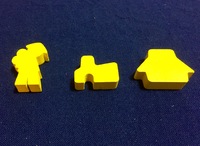
Game Play (from an unofficial translation):

Each player controls a tatara – a bellows for making steel and a worker whose job is to harvest wood for income and tools and also for building as well as managing replanting the forest. The goal of the game is to build a grand tatara.

Each player starts with one tatara and one worker. The board is seeded with neutral Kashi oaks. The number of players determines the size of the board and the number of succession tiles.

pic3338116_t

First a worker must move:

Workers must move at least one hex and up to two hexes. Workers may move additional spaces by turning in foot tokens. Each foot token spent adds 1 movement. You may spend up to 4 per turn. Movement is limited by fully grown trees, opponents’ workers and opponents’ tatara. Hexes with grown trees count double for movement. You cannot end movement on the same tile you started on. You cannot end your turn on a tile with an opponent’s worker, tatara or full grown tree. You cannot pass through a tile with an opponent’s tatara.

The worker may then do two actions.

Available actions:

Planting – Players may plant one of their trees as a sapling for an action. Only two species are available to plant Red Pine and Cedar. Sawtooth Oaks (the third type of player tree) only reach the board through ecological forest succession. When a tree is planted it is laid flat to indicate it is a sapling. After the succession and growth phase if it is a Red Pine it stands up. Cedars are initially planted with the 1 side up, then flip to the 2 side in a subsequent succession and growth phase before standing.

Harvest – Most fully grown trees may be harvested if adjacent to a worker yielding money or tools. Neutral “Buna” Japanese Beech trees may not be harvested. Players may harvest neutral Kashi Oak trees for 1 money or 1 tool.Harvested Kashi oaks are removed from the game. Red Pine yield 2 money. Sawtooth Oaks give 1 money and Cedars give one money or 3 tools. Players may harvest opponent’s trees by paying them 1 money. When Pine, Sawtooth Oak and Cedar are harvested, they may be immediately replanted in the space they were harvested from.

Take a foot token.

There are 2 special actions a player may do which do not count as part of the above 2 actions.

Once per game a player may build a second tatara for 2 money and 2 tools. It may be placed on any empty hex. It grants the player a third action per turn.

Additionally once per game a player may build a grand tatara for 10 money and 10 tools. It may be placed on any empty hex and signals the game end (players complete the round).

End of the round:

Succession tiles equal to the number of players are flipped face up. At the end of the round new tiles are flipped face up and these indicate that the board sections which match the succession tiles then have a growth period. All saplings except cedar become fully grown. Cedar saplings flip from side 1 to side 2. If they are already on side 2 then they become full grown.

Full grown Pine trees that were not harvested become Sawtooth Oak saplings which represents ecological forest succession due to the growth of trees restricting their own kind and allowing other species to take their place. Full grown Sawtooth Oaks and Cedars that grow become Buna saplings-neutral trees which cannot be harvested and do not grow or have succession after they are mature. Kashi Oaks the other neutral tree also do not grow or have succession past standing. pic3338115_t
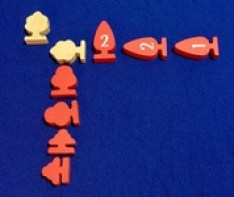
from the bottom left Japanese Red Pine sapling->Red Pine tree->Sawtooth Oak sapling->Sawtooth Oak tree->Japanese Beech (Buna)sapling->tree

from the upper right Japanese Cedar sapling 1->cedar sapling 2->Cedar tree->Beech (Buna) sapling->tree


End of game:

Once a player has built a grand tatara the game ends that round. Other players may also build grand tatara if able. Ties are broken by most money, then materials.

The game also ends if a Buna tree is needed to place on the board and none are left in the reserve.

pic3338117_t

My Thoughts:

I love the treeples, they are nice and chunky. The game is fairly simple to understand and play but there is a still a lot to consider. It interesting trying to anticipate growth and no growth is important. Trying to figure out what to plant and where to plant takes some thought but won’t drag the game down. It plays quickly. Being blocked by trees or an opponents’ tatara can also happen so planning for movement is necessary.

What I really like about the game is the theme of managing natural renewable resources and I love the growth and succession mechanism. It really helps capture the theme. I certainly hope this game will see wider distribution.

Thoughts from Other Opinionated Gamers:

Joe Huber (1 play): I’m not particularly big on games which feel abstract to me, which Tataraba does; it all works, and as Lorna says the mechanisms support the theme well.  But in spite of that the theme didn’t shine through enough for the game to really make the game for me, though I did enjoy getting the chance to try it.

Ratings from the Opinionated Gamers

I love it! Lorna

I like it.

Neutral. Joe H.

Not for me…

Posted in Reviews | Leave a comment