- Designer: Hisashi Hayashi
- Publisher: Okazu Brand, Tasty Minstrel Games
- Players: 2-4
- Ages: 12+
- Time: 90 Minutes
Yokohama is the latest game from Hisashi Hayashi of Okazu Brand. He is one of the most diverse designers out there currently and I’m always interested in his latest games. Yokohama may be his most ambitious game to date. The game emulates the development of international trade in Yokohama during the Meiji era. You play merchants trying to gain contracts with foreign ministers and obtain import goods. Along the way you might also stop at church to show your faith or gain some technological advancements.
Components:

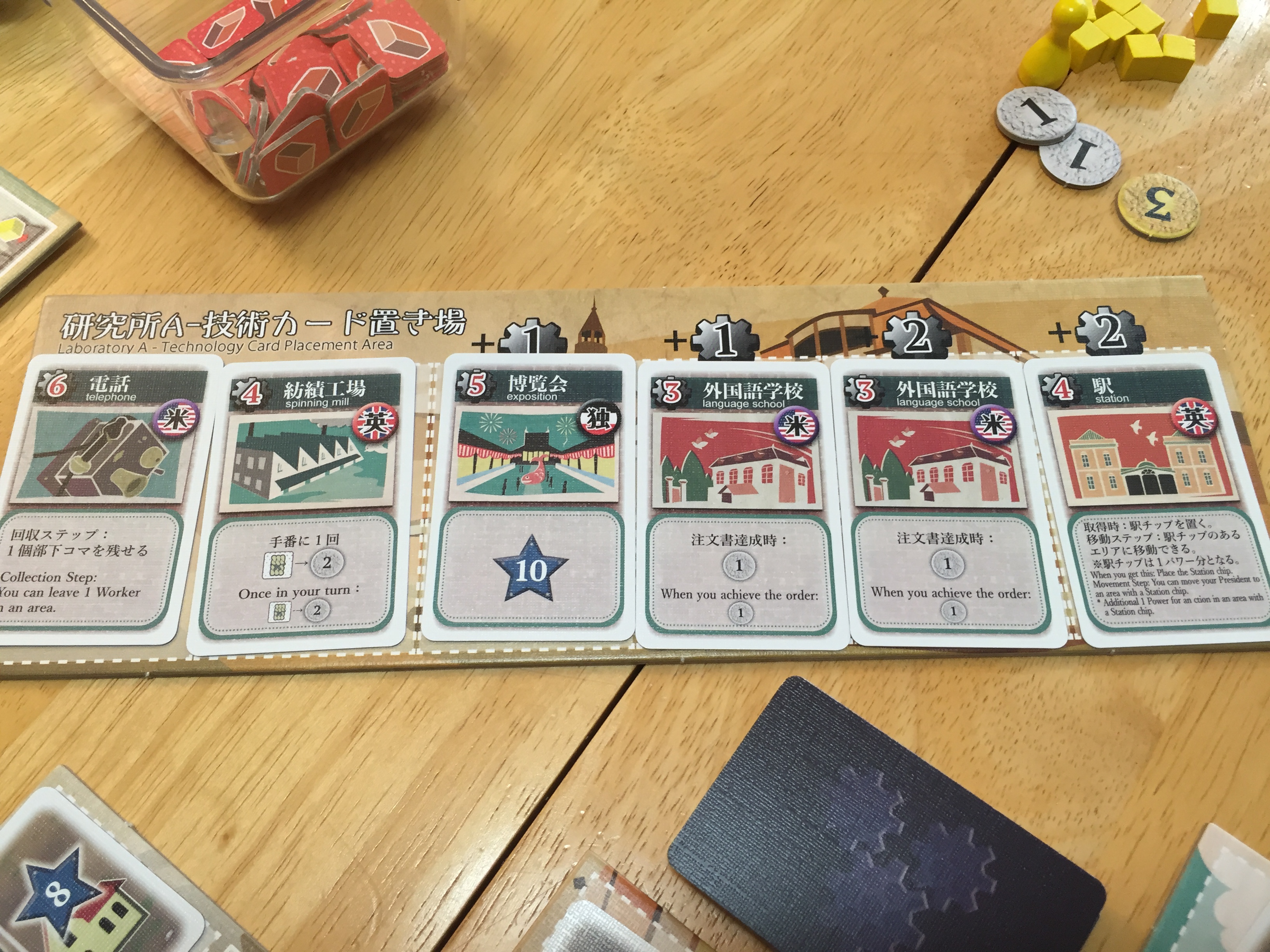
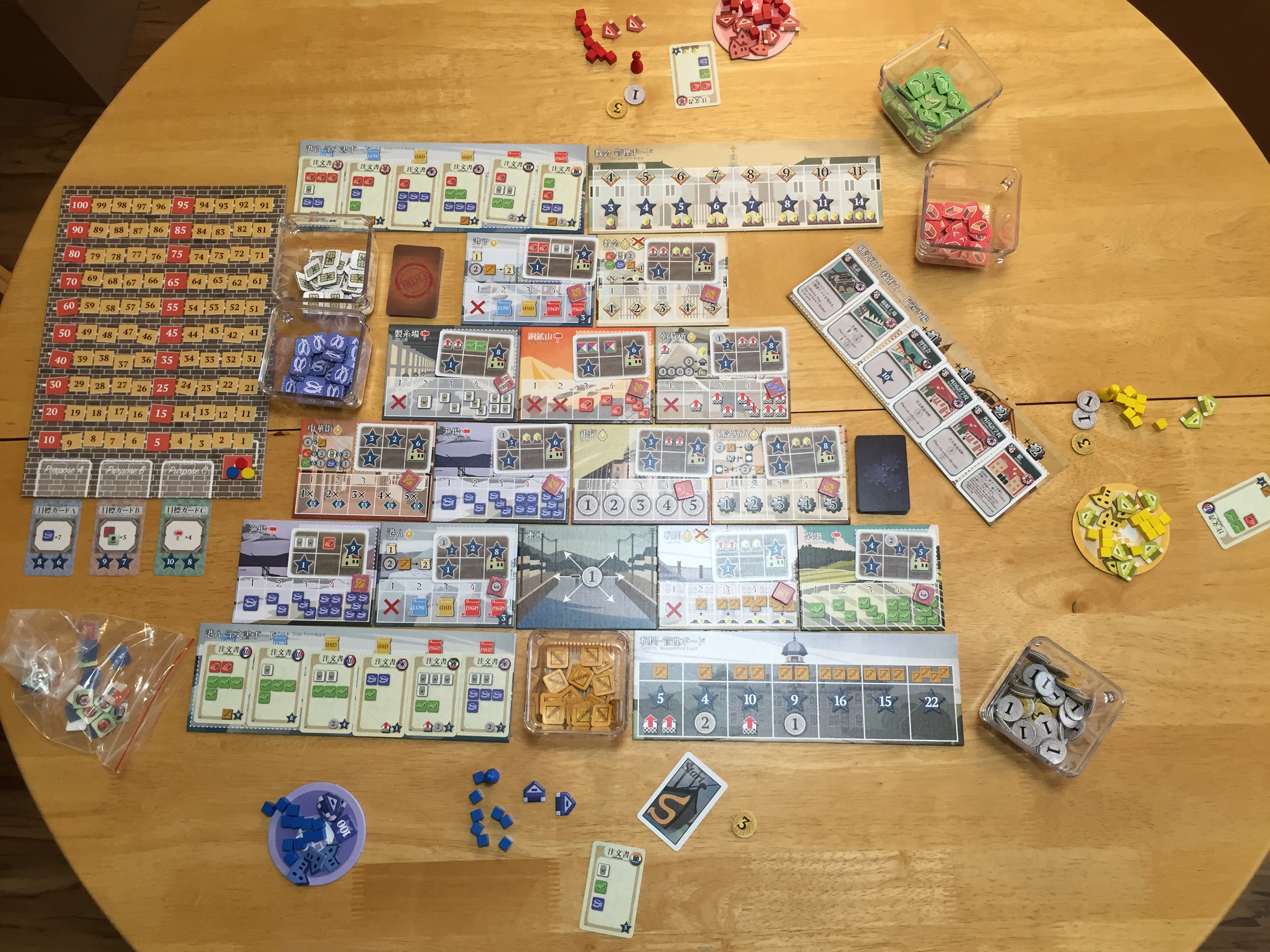
The game consists of a modular board. The size of the play area adjusts to the number of players. The board tiles are nicely done with thick cardboard and functional art. The games also comes with quality cards and ubiquitous cubes. The cards contain both Japanese and English so the print is on the small side. The game box has great graphics and is just the right size to fit everything.
Play:
The rules are well done and straightforward. Each player has a president pawn, assistant cubes, shops and trade houses. Some of these start in hand and the others start in your warehouse/reserve and are not available immediately.
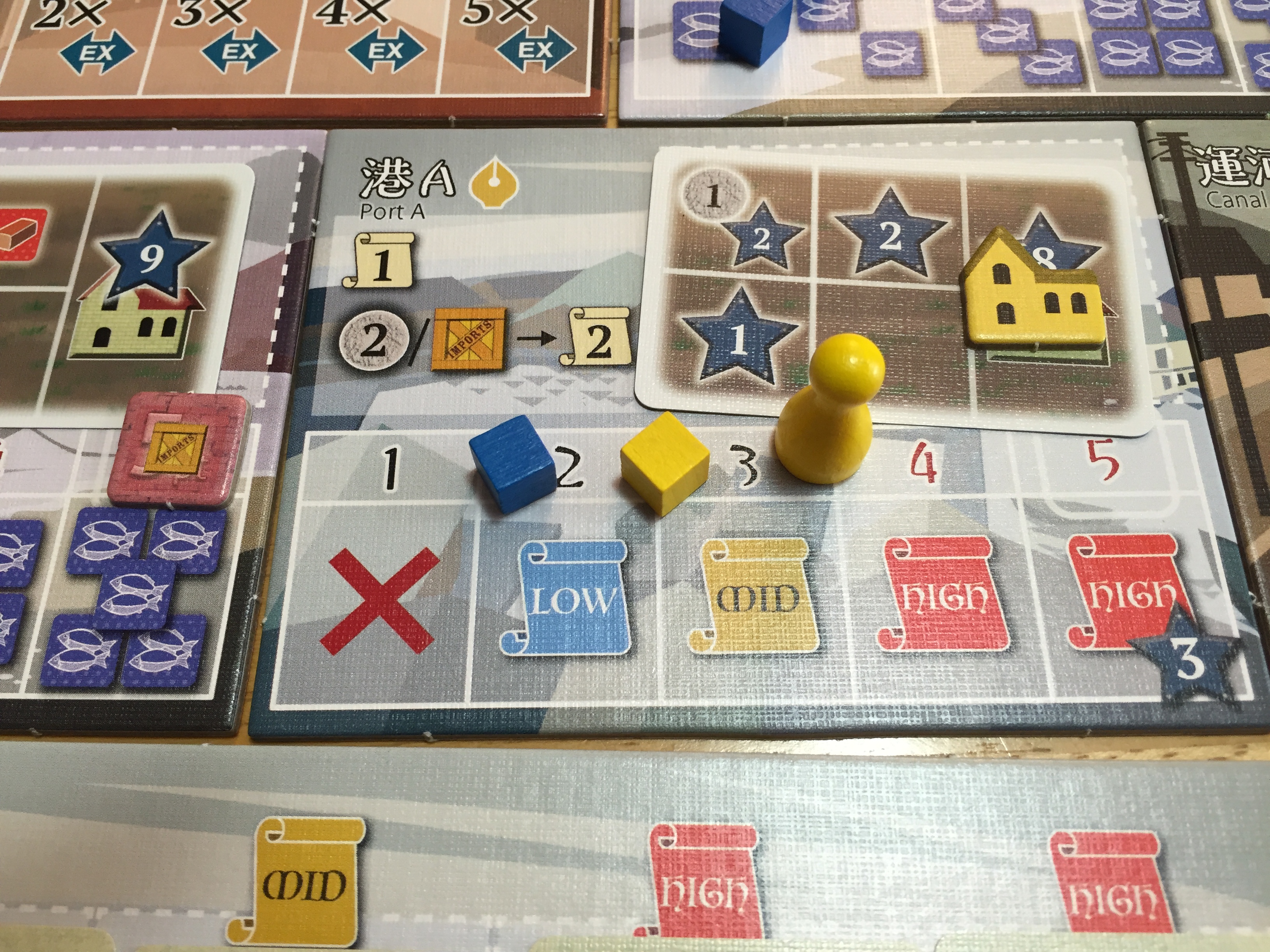
Each area of the board provides different actions resulting in acquisition of different things such as resources, money, contracts, technology and points. Each area will have a random building site card on which to build shops and trade houses. To activate an area a player moves their president to an area with their assistants.


On your turn you may play 1 assistant in 3 different areas or 2 assistants in one area from your hand. Then you may move your president only through areas where you have an assistant. You cannot stop in the same area as an opponent’s president. You may choose instead to pick up your president from the board in order to place it next time.
Then you may perform the action associated with the area and activate it. Afterwards you return any assistants that were in the area to your hand. The benefit of the action is dependent on the power the player has in the area. The power is the sum of the president and any assistants and any buildings in the area. If a power of 4 or more is reached you may build a shop or trading house which will earn points or other rewards. In addition these buildings will add to your power on subsequent visits to the area.

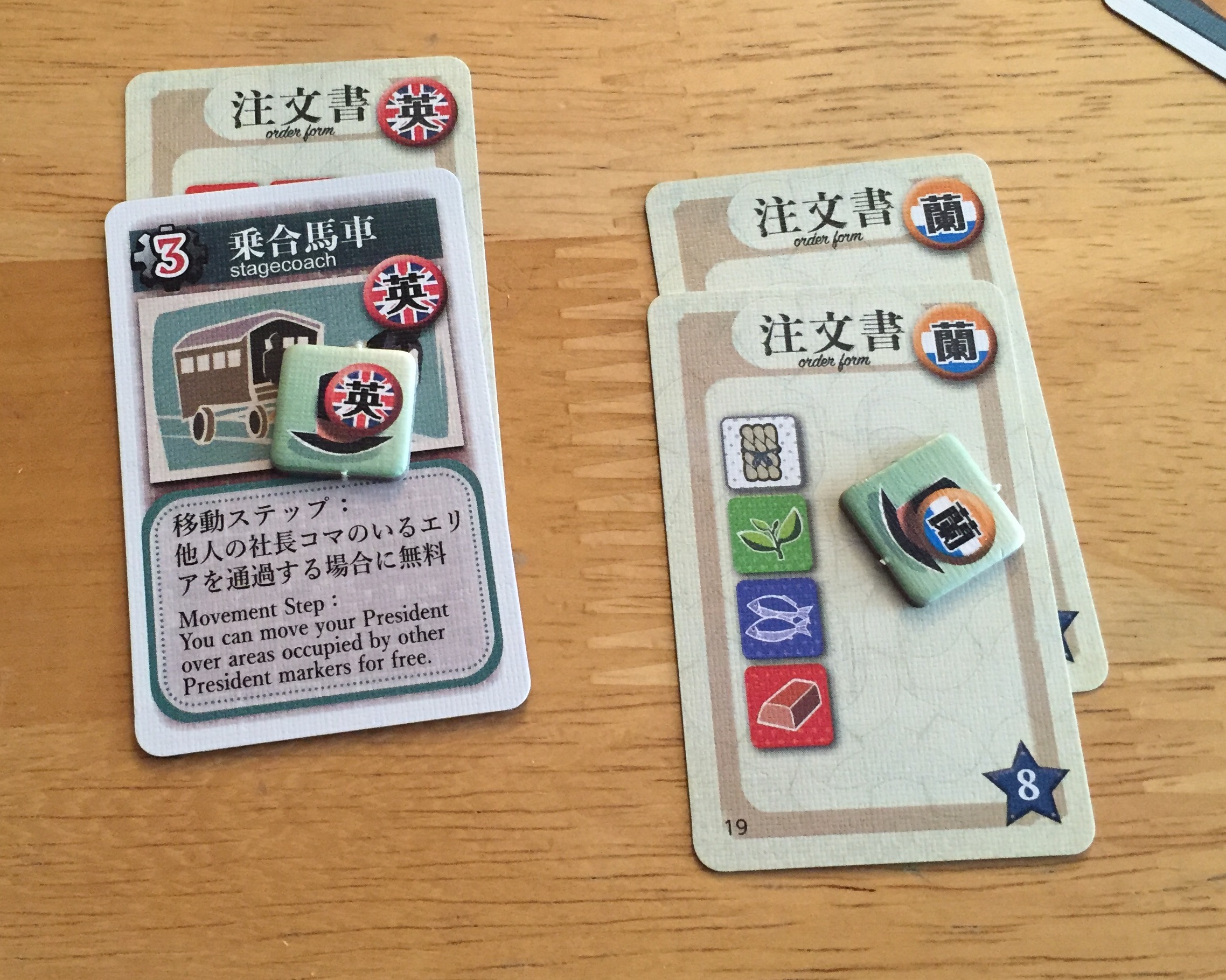
On your turn you can also fulfill contracts, complete achievements, and/or use a foreign minister to perform an extra action. Foreign ministers are obtained from completing contracts or purchasing technology from different countries.
There are multiple game ending conditions.
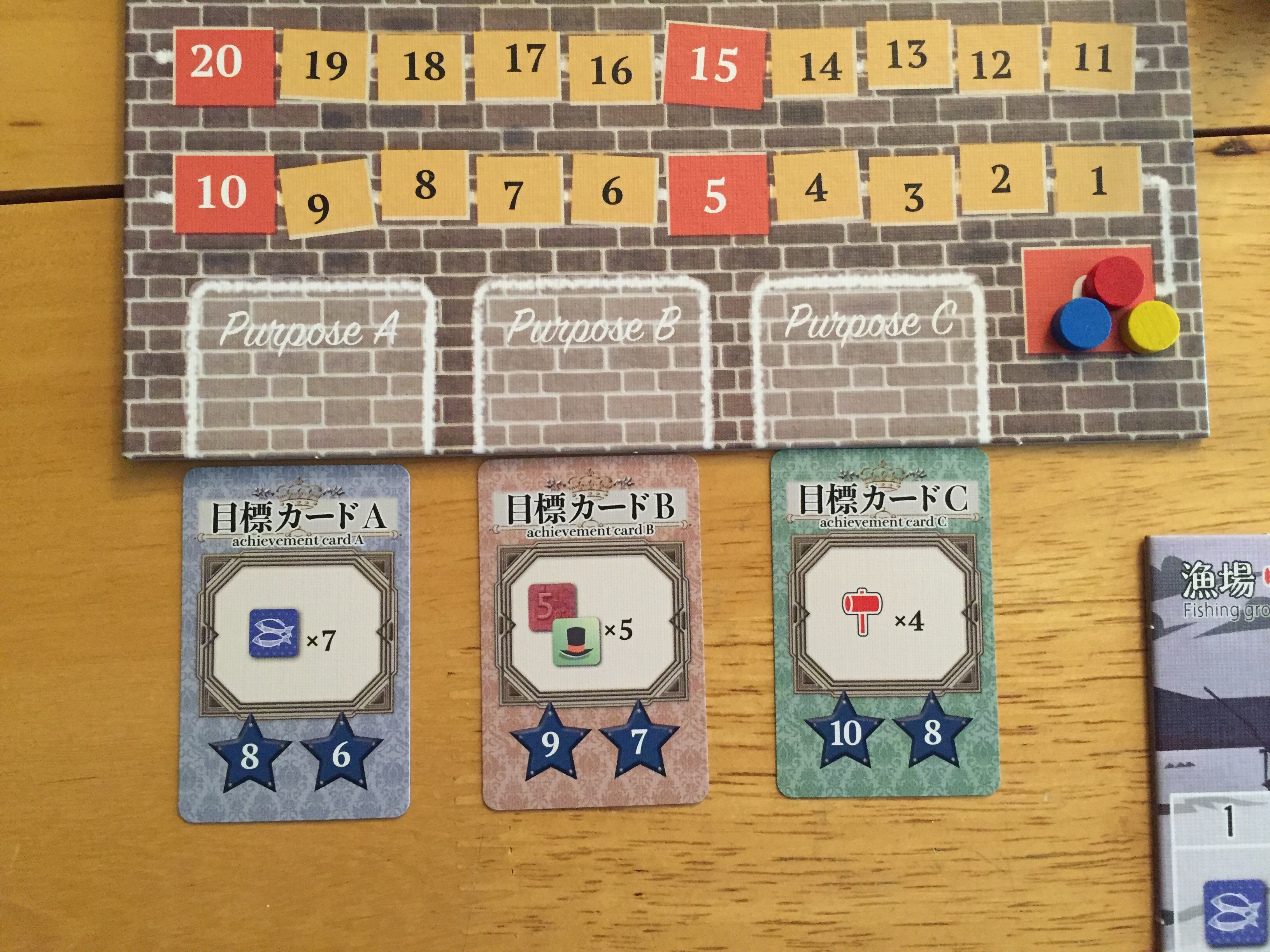
Points are earned in multiple ways. You can earn points from fulfilling contracts, completing achievements (there are 3 random achievements selected each game), visiting the church, using the customs office, and end game points for having majorities in church, customs and tech. Money, left over goods and unused foreign ministers also earn points. You also gain points for sets of different foreign contracts or technology cards collected. The most points leads to victory.

Opinions:
I really enjoy this game. The components are great and I enjoy the graphics. My only complaint has more to do with my lack of ability to see small script than the game.
The game has a lot of replayability. The modular board can really change the feel of the game as the location of different areas may affect your strategy. The building cards also provide more variables as do the order in which technology and contract cards appear.
I’ve played 4 times already with 2 and 3 players. It plays quite well with both numbers. The game does go to 4 but I think I will wait to play with 4 experienced players. There are a myriad of options to consider in this game and that could potentially slow the game a bit too much for me with too many new players. (YMMV on this point but I prefer snappy play) That said, mostly what I enjoy are the options in this game. You can go for points in many directions. Point salad some might say, but the big plus for me is that Yokohama feels so cohesive with these options. It does not feel disjointed at all. I have seen some very different strategies and the game has been close. I also like having to balance actions for points with actions for moving assistants and buildings from your warehouse to your hand. The mechanisms are not new but the way the game meshes keeps the mechanisms fresh. Is there interaction? Yes, it tends to be a little indirect but a well-placed president can certainly change someone’s plans. Of course there is a race aspect to meeting achievements or finding a place on the church or customs board. With the multiple game ending conditions you may be able to control it to your advantage and it’s important to watch your opponents closely. So far Yokohama is my favorite game this year.
Thoughts from other Opinionated Gamers . . .
Dan Blum (4 plays): Yeah, what Lorna said. This is a very good game. Point-salady games are often not my favorites, but I agree that the various ways to score are well-integrated so it doesn’t feel much like a point salad. There is a lot of built-in variation from game to game – aside from the expected aspects of which achievement cards are used and which technologies are available early, the board layout can have a large effect on the game. It works fine with four players as long as no one is particularly AP-prone.
My only issue with the game is the tiny print used for the English on the technology cards; while the original edition is certainly playable, I would advise English speakers without excellent eyesight to get the now-Kickstartering TMG edition which will have more room for English since they are not including the Japanese. And if you like lots of wooden bits, TMG will sell you a deluxe version, but I think the cardboard in the regular version is perfectly fine (as opposed to the components in Hiyashi and Ozaku’s earlier Minerva, which were a bit too small and thin).
Joe Huber (5 plays): I mostly agree with Lorna and Dan, so I’ll just note that I _have_ seen the final turn slow down. Once you know the game is ending, many things are calculable, and the combinations of possible moves is not always easy to trim down. It’s not a big deal, but it does mean the game tends to drag a little at the end. This isn’t enough to keep me from enjoying the game – but might be enough to keep it from being an all-time favorite.
Craig Massey (2 plays): My reaction after my first play was tepid, but I saw the glass as half full. I enjoyed my second play more, while a few things bothered me a bit more too. Dan’s observation about the myriad ways to score points is spot on, but it doesn’t feel any more integrated to me than any other game of similar ilk when it comes to lots of points scoring options. Joe’s observation about the last turn is more bothersome for me. The last round turn feels unnecessary and tacked on. The end game should really not be a surprise to anyone. Adding that final round after the end game conditions are met really slows down the pace of play for a series of turns of point counting, min/max analysis, and little fun.
Ratings from the Opinionated Gamers
- I love it! Lorna, Dan Blum, Joe H.
- I like it. Craig M.
- Neutral.
- Not for me…

 Publisher: Stronghold Games/Eggertspiele